
Orthorexia Test

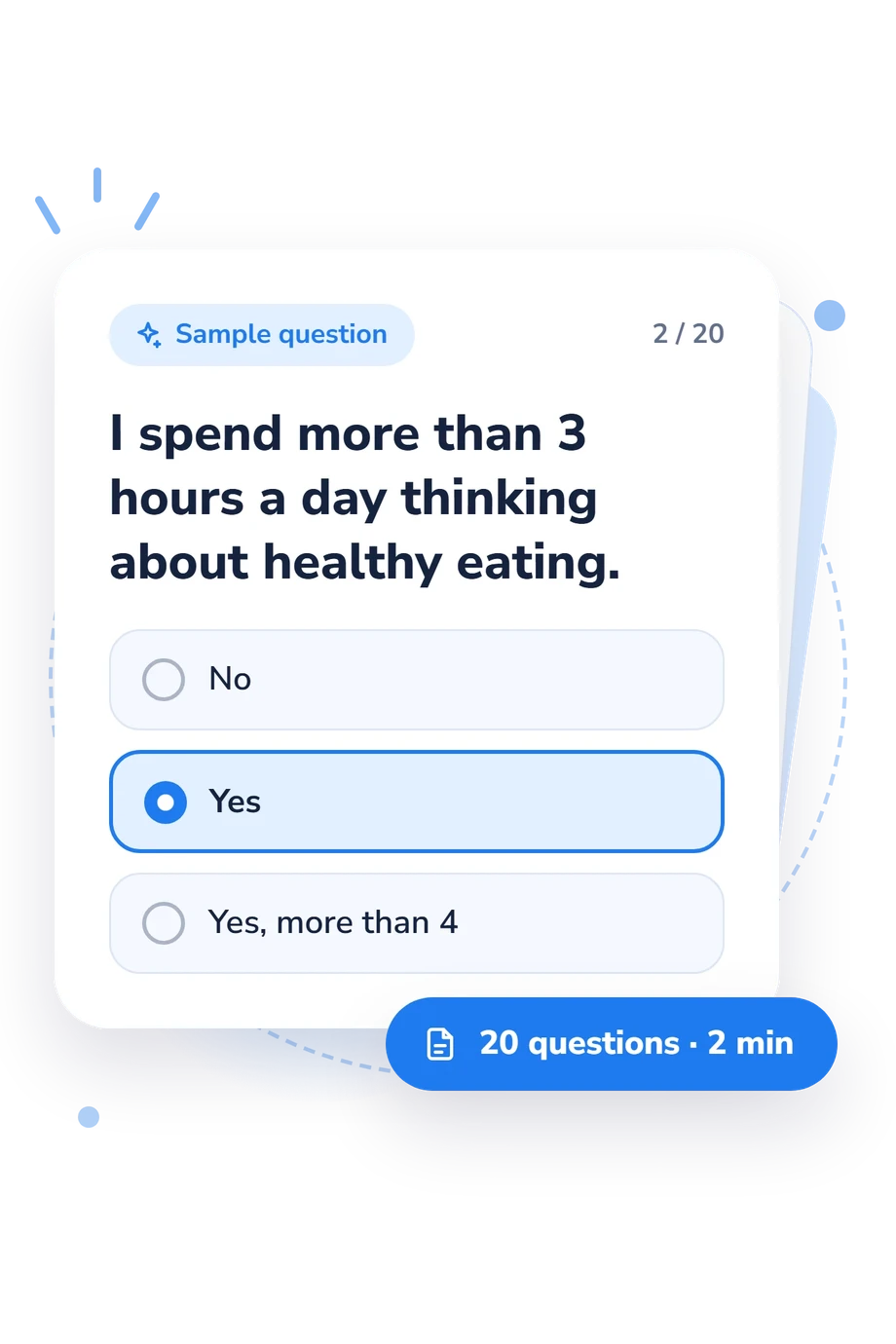
This questionnaire based on Bratman's Orthorexia Test screens for orthorexia nervosa — a pathological obsession with healthy eating that leads to restrictive diets, food anxiety, and impaired daily functioning — identifying whether your focus on clean eating has crossed into disordered territory. Take this orthorexia test to find out whether your eating habits reflect genuine health awareness or an obsessive pattern that may need attention.
Start Online Test
Questions102 minutes
Hi! My name is Freudly, i am an AI therapist, I will give you an interpretation of the test after you complete it.
08:30
October 2, 2025
October 2, 2025
Material has been updated
24,258 views
2,957 completions
2,430 likes
Verified by Daniel Hall
Psychologist with 25 years of experience
Share
Scale Explorer

How the Scales are Structured

example score
4/11
Orthorexia Scale (OS)
Assesses the degree of obsessive concern with eating “healthy” or “pure” foods and related psychological discomfort.
Low concern
Elevated concern
03Low concern411Elevated concern
A score of 4 falls in the Elevated concern range, suggesting a more pronounced preoccupation with healthy eating and greater rigidity or distress around food choices.
Start Online Test
just completed the test
DATA-BASED USER COHORTS

Who Usually Takes This Test?

Strict clean-eating followers
44%OF USERS
People who have increasingly rigid food rules and feel anxious or guilty when they can’t eat “perfectly.”
Fitness and wellness enthusiasts
33%OF USERS
People focused on performance or body goals who want to check whether healthy-eating habits have become obsessive.
Clients in therapy intake
23%OF USERS
People starting counseling or nutrition support who take a quick screen to flag possible orthorexic patterns to discuss with a professional.
BASED ON AGGREGATED, ANONYMIZED DATA FROM TENS OF THOUSANDS OF FREUDLY USERS.
Benchmarking

See How You Compare

Once you complete the test, your results are compared with real-world data from people in your country.
Below is a preview of how scores are typically distributed across each scale.
Orthorexia Scale (OS)
Average
5
Normal range
3.66.3
min.
0
max.
11
Majority
This curve shows how scores are typically distributed.
Once you complete the test, your result will appear on the scale so you can see how you compare.
Featured On
CLEAR ANSWERS TO COMMON QUESTIONS

Frequently Asked Questions

What does this orthorexia test measure?
This orthorexia test screens for orthorexia nervosa — a pathological obsession with healthy eating that goes beyond genuine health awareness. It assesses obsessive preoccupation with food purity, rigid and escalating dietary rules, food anxiety and guilt when rules are broken, and functional impairment in social life or nutrition as a result of eating-related beliefs.
How long does it take to complete?
The questionnaire is brief and typically takes only a few minutes to complete. Answer each item honestly based on your actual thoughts and behaviors around food — not how you think you should respond.
Who should take an orthorexia test?
It is designed for adults who follow strict healthy eating rules and want to understand whether their relationship with food has become obsessive or disordered. Dietitians and mental health clinicians also use the orthorexia assessment during intake to identify clients whose clean eating patterns have crossed into orthorexia nervosa.
How are the results of an orthorexia assessment interpreted?
Results indicate the likelihood of orthorexia nervosa based on the number and intensity of orthorexic beliefs and behaviors present. Higher scores reflect greater risk. Results are screening indicators — not a clinical diagnosis — and should be discussed with a healthcare professional, particularly if they suggest elevated risk or if eating habits are affecting nutrition, social functioning, or daily life.
What is the difference between orthorexia and healthy eating?
Healthy eating is a conscious choice that supports wellbeing without dominating daily life or causing distress. Orthorexia nervosa is characterized by escalating restriction, obsessive thoughts about food purity, intense guilt after dietary violations, and impaired functioning — social isolation, nutritional deficiencies, or anxiety — as a direct result of food beliefs. This orthorexia questionnaire is specifically designed to identify where that line has been crossed.
Is orthorexia nervosa an official eating disorder?
Orthorexia nervosa is not yet formally listed in the DSM-5 as a distinct eating disorder, but it is widely recognized in clinical and research settings as a serious and meaningful pattern of disordered eating. It overlaps with obsessive-compulsive disorder and other restrictive eating disorders, and can lead to significant nutritional deficiencies and functional impairment. Many clinicians treat it within existing eating disorder frameworks while research toward formal diagnostic criteria continues.
Can this orthorexia nervosa test replace a clinical evaluation?
No. This test is a screening tool, not a diagnostic instrument. It can identify whether orthorexic patterns are likely present and prompt a conversation with a healthcare provider, but a full clinical evaluation — including dietary history, nutritional assessment, and mental health screening — is necessary to determine whether orthorexia nervosa requires treatment and what form that treatment should take.
WHAT THE TEST MEASURES
About This Assessment
Bratman’s Orthorexia Nervosa Questionnaire Test

The orthorexia test is a self-report instrument based on Bratman's Orthorexia Questionnaire — the original screening tool developed by Dr. Steven Bratman, who first described orthorexia nervosa in 1997. It screens for the defining features of orthorexic behavior: obsessive preoccupation with food purity and healthiness, rigid dietary rules that escalate over time, intense anxiety or guilt when those rules are broken, and functional impairment in social, occupational, or nutritional domains as a direct result of eating-related beliefs.

Why Take an Orthorexia Test

The boundary between healthy eating awareness and orthorexia nervosa is not always obvious — especially because orthorexic behavior is culturally reinforced by wellness culture and clean eating trends. A structured orthorexia assessment draws that line concretely by screening for the features that distinguish genuine health consciousness from a pathological obsession: escalating restriction, food anxiety, guilt after dietary "violations," and social isolation driven by eating rules.

An orthorexia questionnaire is used by clinicians, dietitians, and mental health professionals to identify clients whose relationship with healthy eating has become disordered and to distinguish orthorexia nervosa from other eating disorders. For individuals, results provide a validated reference point for an honest conversation with a healthcare provider about whether eating habits are serving health or undermining it.

What the Assessment Measures

  • Obsessive preoccupation with food quality — the degree to which thoughts about food purity, healthiness, and "clean eating" dominate daily mental life and decision-making.
  • Rigid dietary rules and escalating restriction — a pattern of increasingly strict food rules that expand over time and lead to the elimination of entire food groups without medical justification.
  • Food anxiety and guilt — intense emotional distress, guilt, or self-criticism when eating rules are broken, reflecting the anxiety-driven nature of orthorexic behavior.
  • Functional impairment — the extent to which eating-related beliefs have reduced social participation, interfered with daily functioning, or contributed to nutritional deficiencies through overly restrictive diets.

Who This Assessment Is For

The orthorexia test is appropriate for adults who follow strict healthy eating rules and want to understand whether their relationship with food has become obsessive or disordered. People who find themselves spending significant mental energy on food purity, avoiding social eating situations, or experiencing guilt after "impure" meals should consider completing this orthorexia assessment. Dietitians and mental health clinicians use it during intake to identify clients whose clean eating practices have crossed into orthorexia nervosa and to distinguish orthorexic patterns from anorexia nervosa or other restrictive eating disorders. Researchers studying the prevalence and correlates of orthorexia nervosa also use Bratman-based instruments as a validated screening tool. The questionnaire is straightforward — each item describes a specific belief or behavior related to healthy eating, and respondents indicate how accurately it reflects their experience.

Clinical Validity and Use in Practice

Orthorexia nervosa was first described by Bratman in 1997 and the Bratman Orthorexia Test (BOT) represents the original screening instrument in this area. While orthorexia nervosa is not yet formally recognized in DSM-5 as a distinct eating disorder, it has received substantial and growing clinical attention — particularly its overlap with obsessive-compulsive disorder, anorexia nervosa, and anxiety disorders. Research using Bratman-based instruments consistently identifies orthorexia nervosa as a clinically meaningful pattern associated with nutritional deficiencies, social isolation, and reduced quality of life. Results of this orthorexia assessment are screening-level indicators and should be interpreted alongside clinical interview findings, dietary history, and nutritional status. If results suggest elevated risk, consultation with a healthcare professional is strongly recommended.

Author: Bratman, S.
Literature: Bratman, S., & Knight, D. Health food junkies: Orthorexia nervosa: Overcoming the obsession with healthful eating. Broadway Books. 2000.
Test Question Form
You Might Also Like
Rome Orthorexia Nervosa Questionnaire (ORTO-15)
This self-report measure is used to screen for orthorexic eating attitudes…
Start Test
Neuropsychological Adaptation Test
This brief self-report measure is designed to screen how an individual is a…
Start Test
Assessment of Behavioral Manifestations of Nervous System Properties
This measure is designed to evaluate everyday behavioral indicators that ma…
Start Test
Popular tests
Narcissistic Personality Inventory (NPI)
This self-report measure is used to assess narcissism as a personality trai…
Start Test
Yale-Brown Obsessive Compulsive Scale (Y-BOCS)
This measure is used to rapidly quantify the current severity of obsessive…
Start Test
CRAFFT Screening Test (CRAFFT 2.1)
This brief screening measure is designed to identify potential alcohol and…
Start Test
Patient Health Questionnaire-9 (PHQ-9)
This measure is commonly used to quickly screen for the presence and severi…
Start Test
Maslach Burnout Inventory (MBI)
This self-report measure is used to assess occupational burnout symptoms in…
Start Test
Adolescent Anxiety Questionnaire
This measure is designed to support a brief appraisal of anxiety symptoms a…
Start Test
Emotional Creativity Inventory (ECI)
This self-report measure assesses individual differences in the originality…
Start Test
Horne–Ostberg Morningness–Eveningness Questionnaire (MEQ)
Circadian preferences influence typical patterns of alertness and sleep tim…
Start Test
Ambivalent Sexism Inventory (ASI)
This measure is designed to assess attitudes toward women, including both o…
Start Test
Internalized Misogyny Scale (IMS)
This measure is designed to assess internalized negative beliefs and stereo…
Start Test
Perceived Stress Scale (PSS-10)
This self-report measure assesses the degree to which individuals appraise…
Start Test
Impulsive Behavior Scale (SUPPS-P)
Impulsivity is a multidimensional construct that is often assessed with bri…
Start Test
Clinical Institute Withdrawal Assessment for Alcohol, Revised (CIWA-Ar)
This rating scale is used to rapidly assess the severity of alcohol withdra…
Start Test
Positive and Negative Affect Schedule (PANAS)
This measure provides a brief self-report assessment of current or typical…
Start Test
Light Triad Scale (LTS)
This self-report measure assesses prosocial personality tendencies and orie…
Start Test
Suicidal Ideation Scale
In clinical settings, the Suicidal Ideation Scale is used to structure an i…
Start Test
Body Dysmorphic Disorder Scale (BDD-D)
This brief self-report measure is designed to screen for and quantify distr…
Start Test
Beck Anxiety Inventory (BAI)
This measure is a brief self-report inventory used to screen for anxiety sy…
Start Test
Differential Test of Perfectionism
This instrument is used to screen for perfectionism-related attitudes and t…
Start Test
Locus of Control Scale
This measure assesses generalized expectancies regarding the degree to whic…
Start Test
New Apathy Scale
This brief self-report measure is used to screen for apathy-related symptom…
Start Test
Perth Alexithymia Questionnaire (PAQ)
This measure assesses individual differences in alexithymia, including diff…
Start Test
Social Intelligence Scale
This brief self-report measure is designed to support rapid screening of in…
Start Test
Fear Test
This measure is designed to evaluate individual differences in fear-related…
Start Test
Neuroticism Level Scale
The measure is intended for brief screening of an individual’s propensity t…
Start Test
Aggressiveness Indicators Screening Questionnaire
This screening tool is designed to quickly identify behavioral indicators a…
Start Test
Comments
Leave a Comment