
Constructive Patriotism Questionnaire Test
How the Scales are Structured
Who Usually Takes This Test?
See How You Compare
Below is a preview of how scores are typically distributed across each scale.
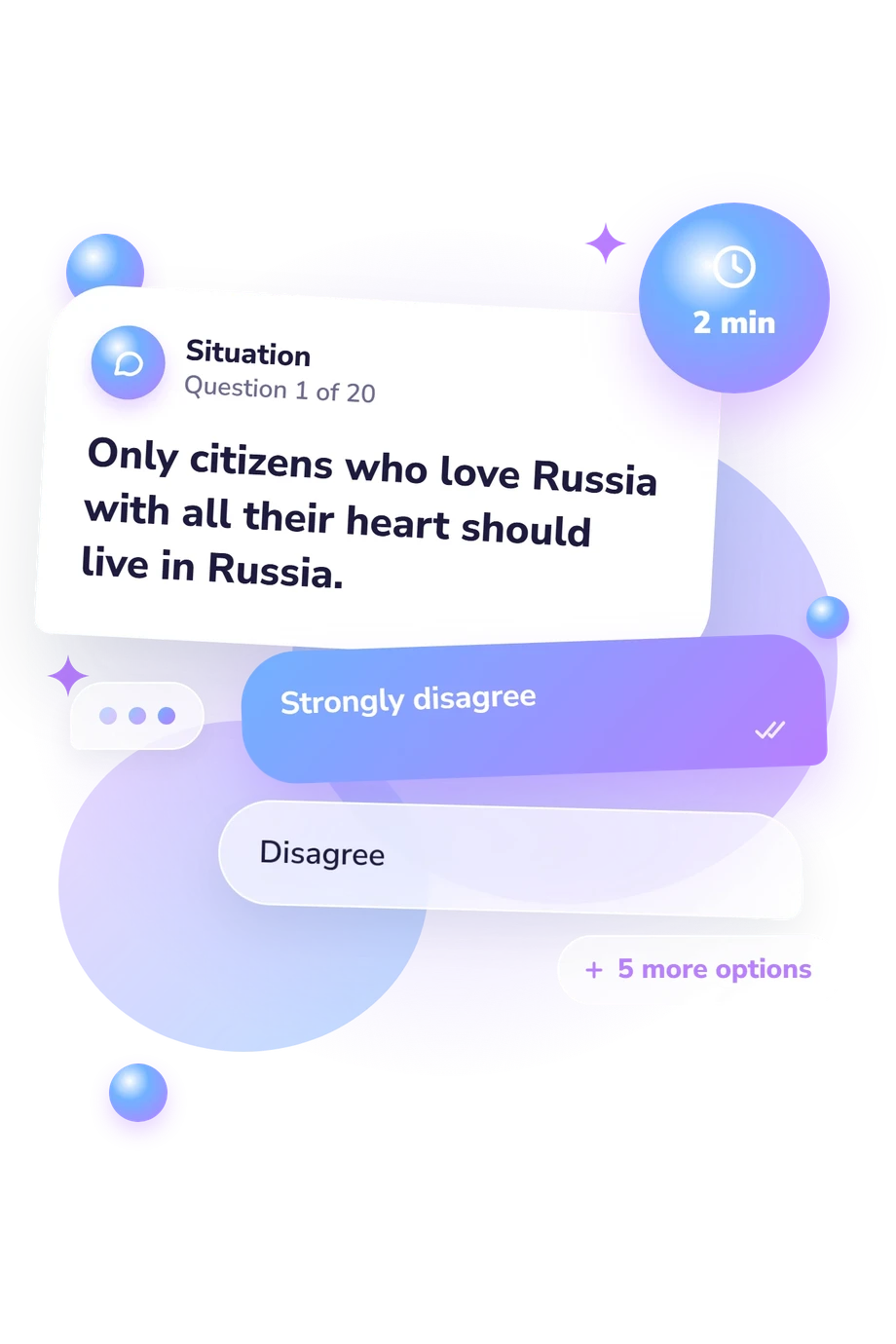
Example Questions From the Test
- Strongly disagree
- Disagree
- Somewhat disagree
- Neutral / cannot decide
- Somewhat agree
- Agree
- Strongly agree
- Strongly disagree
- Disagree
- Disagree somewhat more than agree
- Neutral / cannot decide
- Agree somewhat more than disagree
- Agree
- Completely agree
- Strongly disagree
- Disagree
- Somewhat disagree rather than agree
- Neutral / cannot decide
- Somewhat agree rather than disagree
- Agree
- Completely agree
Constructive Patriotism Questionnaire Test - Description and methodology of the test
People who want to examine how they connect national identity with responsibility for their country can use this questionnaire as a structured self-reflection tool. Its questions examine civic engagement by asking whether attachment leaves room for criticism, participation, and improvement. The Constructive Patriotism Questionnaire Test is especially relevant when you want to distinguish active civic commitment from loyalty expressed mainly through emotional allegiance or comparison with other countries.
What This Assessment Explores
Rather than treating patriotism as one attitude, the questionnaire separates constructive engagement from a more unquestioning national attachment. Its statements address criticism of the country, social improvement, environmental concern, volunteering, and community participation. Because the items name Russia, responses are tied to a concrete national context. The questionnaire functions as a patriotism self-assessment, helping you consider whether attachment is expressed through protecting the country's image or improving everyday life.
The result is organized around these displayed dimensions:
- Constructive Patriotism (5-35) measures civic identification and readiness to improve life through criticism and development; results are Low constructive patriotism (5-24) or High constructive patriotism (25-35).
- Blind Patriotism (5-35) reflects emotional attachment expressed by contrasting the country with others; results are Low (5-15) or High (16-35), with higher scores potentially aligning with national conservatism.
Alongside the two scales, the items also cover civic action through volunteering, environmental care, professional contribution, and community participation.
Methodology and Scientific Basis
The questionnaire uses short statements answered on a seven-point agreement scale, from strong disagreement to strong agreement, with a neutral or undecided midpoint. This lets respondents show degrees of endorsement while judging statements about loyalty, criticism, contribution, and change.
The result reports the two displayed scale scores with their low or high bands; no additional point weights or scoring mechanics are defined. The patriotism questionnaire produces a profile of tendencies rather than one overall score.
The closest conceptual source is Constructive Patriotism Questionnaire (Vasileva & Miklyaeva, 2023), a psychometric study of an adolescent version. This online questionnaire is conceptually consistent with that work, not presented as an adaptation of it. The distinction between the two forms of attachment comes from Schatz, Staub, and Lavine's 1999 model.
The online self-report version has no established norms or validation conditions. Current events, social desirability, and self-awareness may influence responses, so the bands describe organized tendencies rather than a diagnosis or complete account of political identity.
- Vasileva, S. V., and Miklyaeva, A. V. (2023). Constructive patriotism questionnaire (adolescent version): Psychometric characteristics. Psychology in Education, 5(3), 458-472. 10.33910/2686-9527-2023-5-3-458-472
- Schatz, R. T., Staub, E., and Lavine, H. (1999). On the Varieties of National Attachment: Blind Versus Constructive Patriotism. Political Psychology, 20(1), 151-174. 10.1111/0162-895X.00140
Updated: