
Freudly+971 508685814hello@freudly.ai
Freudly
attitude towards illness

Zarit Burden Interview (ZBI) Test
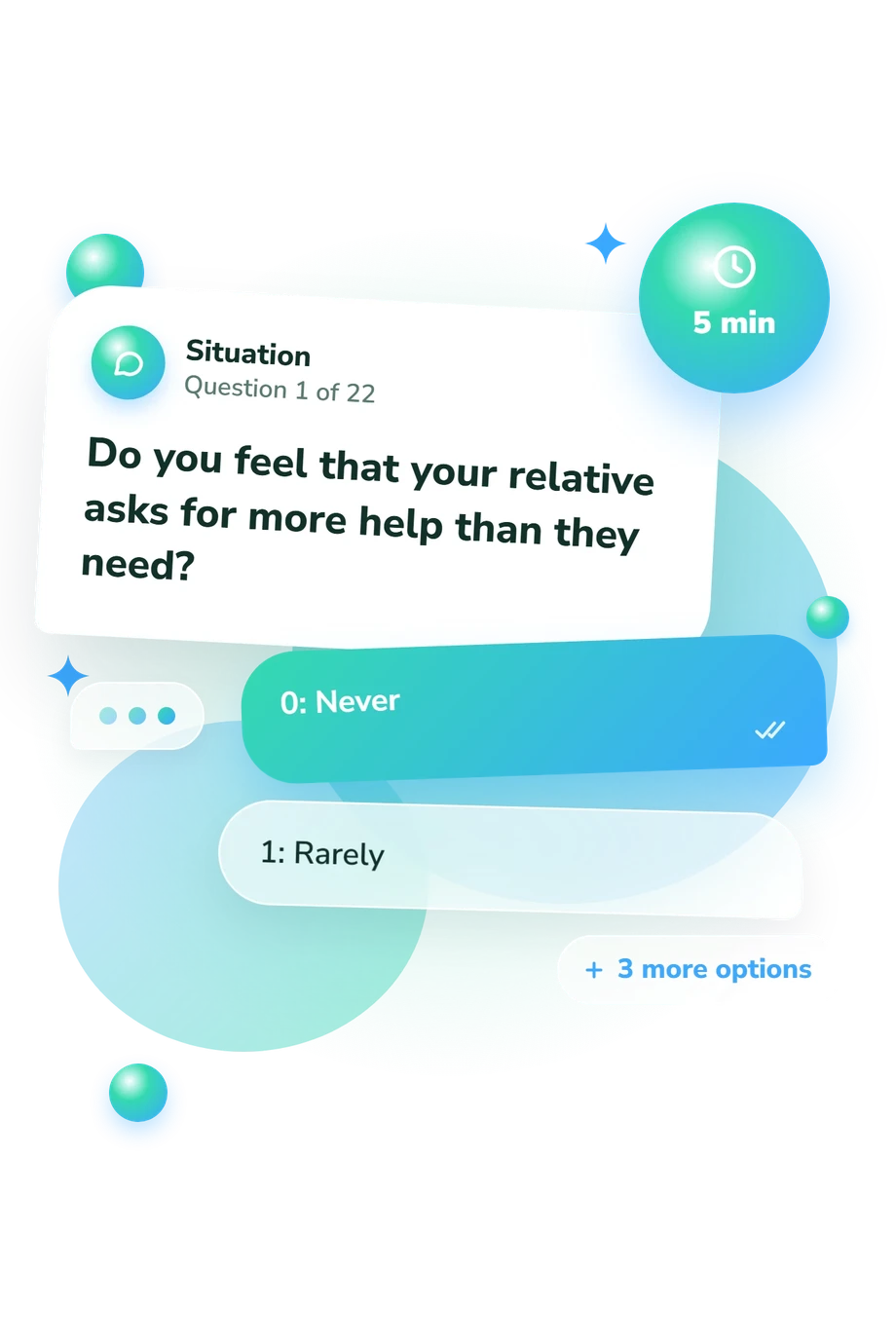
Take the online Zarit Burden Interview (ZBI) Test - AI psychologist FreudlyYou can take Zarit Burden Interview (ZBI) Testhere. Online version of a simple and accurate psychological test with interpretation.en
Understand caregiver stress and strain in about 5 minutes. A 22 item tool that pinpoints key pressure points to guide timely support and care planning.
Start Online Test
Questions: 225 minutes
08:30
October 2, 2025
October 2, 2025
Material has been updated
October 2, 2025
Material has been published
25,239 views
3,108 completions
2,571 likes
Verified by Daniel Hall
Psychologist with 25 years of experience
Share
Scale Explorer

How the Scales are Structured

example score
3/4
Self-Criticism About Caregiving And Burden (SCACAB)
Measures the degree of self-criticism, guilt, or dissatisfaction a caregiver feels about leaving the person and about the workload of caregiving.
Low
Moderate
High
01: Low | 23: Moderate | 4: High
A score of 3 falls in the Moderate range, suggesting noticeable self-criticism or guilt about caregiving demands, though not at the highest intensity on this scale.
example score
2/4
Uncertainty (U)
Measures the caregiver’s anxiety about the future and uncertainty about their role in the caregiving process.
Low uncertainty
Moderate uncertainty
High uncertainty
01: Low uncertainty | 23: Moderate uncertainty | 4: High uncertainty
A score of 2 suggests a moderate level of uncertainty, reflecting noticeable worries about what lies ahead and some lack of clarity in the caregiving role.
example score
2/4
Emotional Strain (ES)
Measures the caregiver’s negative emotional reactions and stress experienced while providing care.
Low strain
Moderate strain
High strain
01: Low strain | 23: Moderate strain | 4: High strain
A score of 2 indicates a moderate level of emotional strain, suggesting noticeable stress or emotional fatigue in the caregiving role.
example score
3/4
Patient-Caregiver Interdependence (PCI)
Measures the degree to which caregiving is driven by the patient’s lack of autonomy and restricts the caregiver’s personal freedom.
Low interdependence
Moderate interdependence
High interdependence
01: Low interdependence | 23: Moderate interdependence | 4: High interdependence
A score of 3 indicates moderate patient–caregiver interdependence, suggesting notable limits on personal freedom due to the patient’s need for assistance.
example score
2/4
Perceived Resource Deficit (PRD)
Measures the caregiver’s perceived lack of personal resources (financial, physical, and social) needed to provide care.
Low scarcity
Moderate scarcity
High scarcity
01: Low scarcity | 23: Moderate scarcity | 4: High scarcity
A score of 2 indicates a moderate perception of resource scarcity, suggesting the caregiver sometimes feels limited in the support, energy, or finances available for caregiving.
example score
18/88
Family Burden Severity (FBS)
Measures the overall intensity of stress and strain a caregiver experiences in relation to family caregiving responsibilities.
Low burden
Moderate burden
High to severe burden
020: Low burden | 2140: Moderate burden | 4188: High to severe burden
A score of 18 falls in the Low burden range, suggesting relatively limited overall caregiver strain at this time.
Start Online Test
just completed the test
DATA-BASED USER COHORTS

Who Usually Takes This Test?

Family primary caregivers
46%OF USERS
Spouses, parents, or siblings caring for a relative with schizophrenia use it to gauge stress, exhaustion, and daily-life impact.
Mental health clinicians
34%OF USERS
Psychiatrists, psychologists, and social workers administer it to identify caregiver strain and plan targeted support.
Research study participants
20%OF USERS
Caregivers enrolled in clinical or community studies take it to provide standardized data on burden over time.
BASED ON AGGREGATED, ANONYMIZED DATA FROM TENS OF THOUSANDS OF FREUDLY USERS.
Benchmarking

See How You Compare

Once you complete the test, your results are compared with real-world data from people in your country.
Below is a preview of how scores are typically distributed across each scale.
Self-criticism about leaving and workload (Salaw)
Average
1.8
Normal range
1.12.5
min.
0
max.
4
This curve shows how scores are typically distributed.
Once you complete the test, your result will appear on the scale so you can see how you compare.
Uncertainty (U)
Uncertainty (U)
Average
3
Normal range
2.33.6
min.
0
max.
4
This curve shows how scores are typically distributed.
Once you complete the test, your result will appear on the scale so you can see how you compare.
Emotional Tension (ET)
Average
2.9
Normal range
2.33.6
min.
0
max.
4
This curve shows how scores are typically distributed.
Once you complete the test, your result will appear on the scale so you can see how you compare.
Interdependence of patient/caregiver (Iop)
Average
2.9
Normal range
2.33.5
min.
0
max.
4
This curve shows how scores are typically distributed.
Once you complete the test, your result will appear on the scale so you can see how you compare.
Perception of resource scarcity (Pors)
Average
1.1
Normal range
0.61.7
min.
0
max.
4
This curve shows how scores are typically distributed.
Once you complete the test, your result will appear on the scale so you can see how you compare.
Intensity of Family Burden (IoFB)
Average
65.8
Normal range
52.778.8
min.
0
max.
88
This curve shows how scores are typically distributed.
Once you complete the test, your result will appear on the scale so you can see how you compare.
Featured On
SAMPLE QUESTIONS

Example Questions From the Test

    • 0: Never
    • 1: Rarely
    • 2: Sometimes
    • 3: Often
    • 4: Nearly always
    • 0: Never
    • 1: Rarely
    • 2: Sometimes
    • 3: Often
    • 4: Nearly always
    • 0: Never
    • 1: Rarely
    • 2: Sometimes
    • 3: Often
    • 4: Nearly always
WHAT THE TEST MEASURES
About This Assessment
Caregiver Burden Questionnaire, ZBI Test

Zarit Burden Interview (ZBI) Test - Symptoms and Signs

attitude towards illness
schizophrenia

Caregiving responsibilities can contribute to clinically meaningful psychological and practical strain. The Zarit Burden Interview (ZBI) is a brief self-report measure designed to quantify perceived caregiver burden and related distress.

Developed by Steven H. Zarit, Judy M. Reever, and Joseph Bach-Peterson, it consists of 22 items and typically takes about 5 minutes to complete. Items ask respondents to rate the extent to which caregiving affects emotional well-being, social functioning, and daily life demands, supporting identification of areas where additional assessment or support may be indicated.

The Zarit Burden Interview (ZBI) is commonly used in clinical and research settings to monitor caregiver strain over time and to inform care planning, referral decisions, and evaluation of intervention response.

Author: Joseph Bach-Peterson, Judy M. Reever, Steven H. Zarit
Literature: Pearlin, L. I., Mullan, J. T., Semple, S. J., & Skaff, M. M. Caregiving and the stress process: an overview of concepts and their measures. The Gerontologist. 1990.; Zarit, S. H., Reever, K. E., & Bach-Peterson, J. Relatives of the impaired elderly: correlates of feelings of burden. The Gerontologist. 1980.
Popular tests
Comments
Leave a Comment