
Bullying Risk Assessment Questionnaire Test
How the Scales are Structured
Who Usually Takes This Test?
See How You Compare
Below is a preview of how scores are typically distributed across each scale.
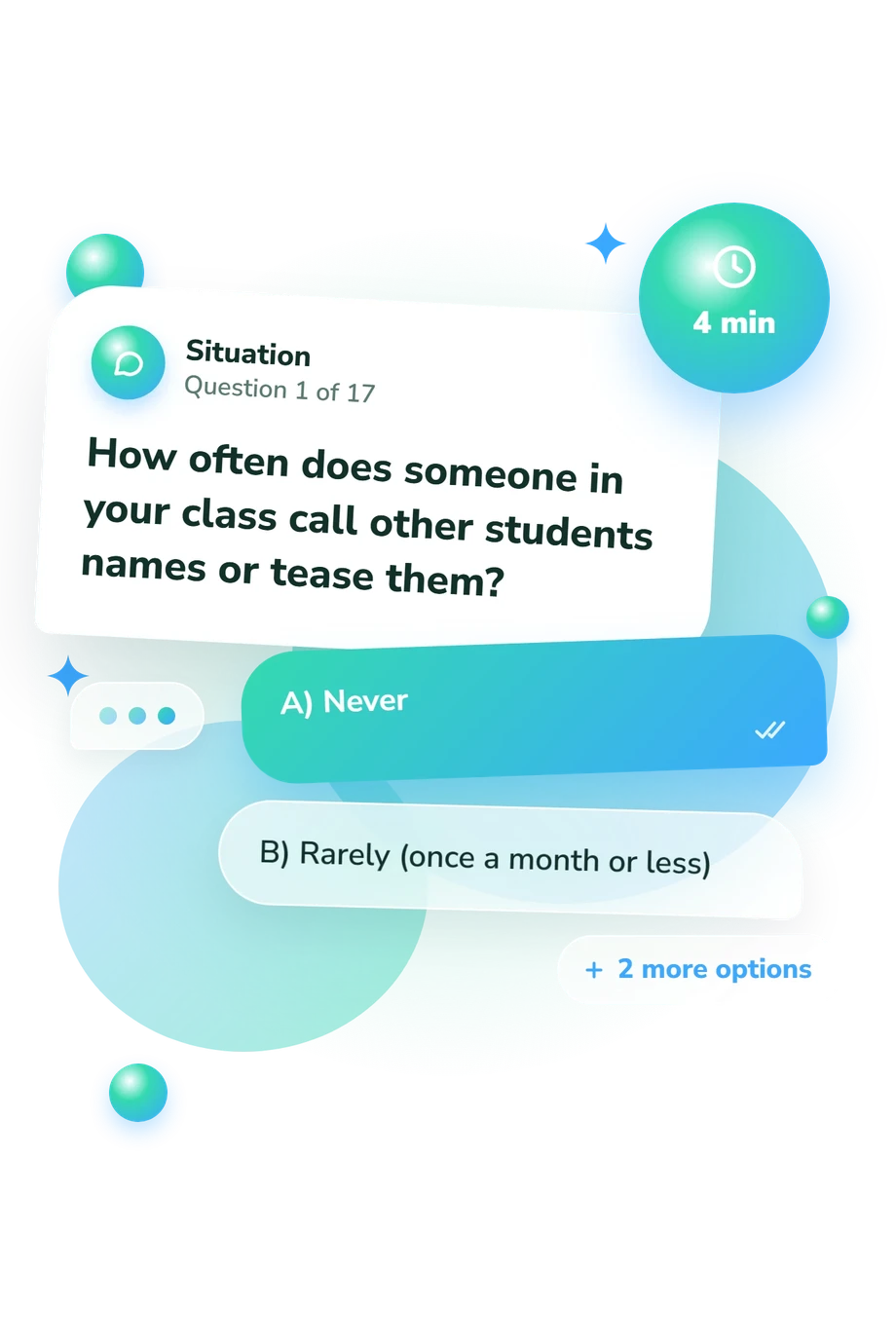
Example Questions From the Test
- A) Never
- B) Rarely (once a month or less)
- C) Sometimes (once a week)
- D) Often (almost every day)
- This does not happen
- Yes, but rarely
- Sometimes
- Often
- No, this does not happen
- This happens, but very rarely
- This happens from time to time
- Yes, this happens often
Bullying Risk Assessment Questionnaire Test - Description and methodology of the test
People with direct knowledge of a class or school environment may use the Bullying Risk Assessment Questionnaire Test to examine conditions that can make students feel unsafe or unsupported. As a school bullying questionnaire, it organizes observations about peer behavior, bystander responses, adult involvement, and social climate. This can help clarify where prevention or support deserves attention, while the overall result indicates the level of bullying risk.
What This Assessment Measures
Rather than focusing only on a targeted student, this assessment examines the class setting where bullying may occur. As a classroom climate assessment, it covers name-calling, exclusion, damaged belongings, fear, fighting, rumors, cyberbullying, humiliation, isolation, peer defense, access to help, teacher involvement, mutual support, and speaking up.
The questions cover these thematic areas; together, they contribute to one overall risk score rather than producing separate dimension scores:
- Peer aggression shows how often harmful acts or threats are noticed.
- Exclusion shows whether students are left out or unsupported.
- Bystander and adult response show whether classmates and teachers help.
- Climate and student voice show openness and comfort speaking up.
Total Score ranges from 0-51 and represents overall bullying risk. The displayed bands are Low risk 0-17, Moderate risk 18-34, and High risk 35-51. Low suggests a favorable situation; average results suggest indicators needing attention; high results may indicate substantial risk.
Methodology and Evidence Base
Each item offers four ordered choices, usually describing frequency or intensity from never to often. Other choices address support, openness, or teacher action, so the respondent rates observed conditions rather than only personal victimization. Responses are combined into the displayed total; no point value is stated for each label, so scoring should not be inferred from wording.
The closest subject match is the Risk of Bullying Questionnaire, while Bochaver's school-environment study addresses support, safety, openness, and relationships. Olweus’s work supplies the broader bullying-at-school framework, and Solberg and Olweus provide context for structured school-bullying measurement. The questionnaire is conceptually consistent with these sources, not a direct adaptation or standardized reproduction of any one of them.
As a bullying risk test, it helps organize observations and identify patterns for discussion. Population norms have not been established for this online version, so its displayed bands are questionnaire-specific and should not be treated as population norms. Current events, visibility, memory, and candor can affect results; they do not establish causes or a clinical diagnosis.
- Bochaver, A. A., Kuznetsova, V. B., Bianki, E. M., Dmitriyevsky, P. V., Zavalishina, M. A., Kaporskaya, N. A., and Khlomov, K. D. (2015). The Risk of Bullying Questionnaire. Issues of Psychology, no. 5, pp. 146-157.
- Bochaver, A. A., Korneev, A. A., and Khlomov, K. D. (2022). School Climate Questionnaire: A New Tool for Assessing the School Environment. Frontiers in Psychology, 13, 871466. 10.3389/fpsyg.2022.871466
- Olweus, D. (1993). Bullying at School: What We Know and What We Can Do. Oxford: Blackwell Publishers.
- Solberg, M. E., and Olweus, D. (2003). Prevalence Estimation of School Bullying with the Olweus Bully/Victim Questionnaire. Aggressive Behavior, 29(3), pp. 239-268. 10.1002/ab.10047
Updated: