
Sense of Safety Questionnaire (SQ) Test
How the Scales are Structured
Who Usually Takes This Test?
See How You Compare
Below is a preview of how scores are typically distributed across each scale.
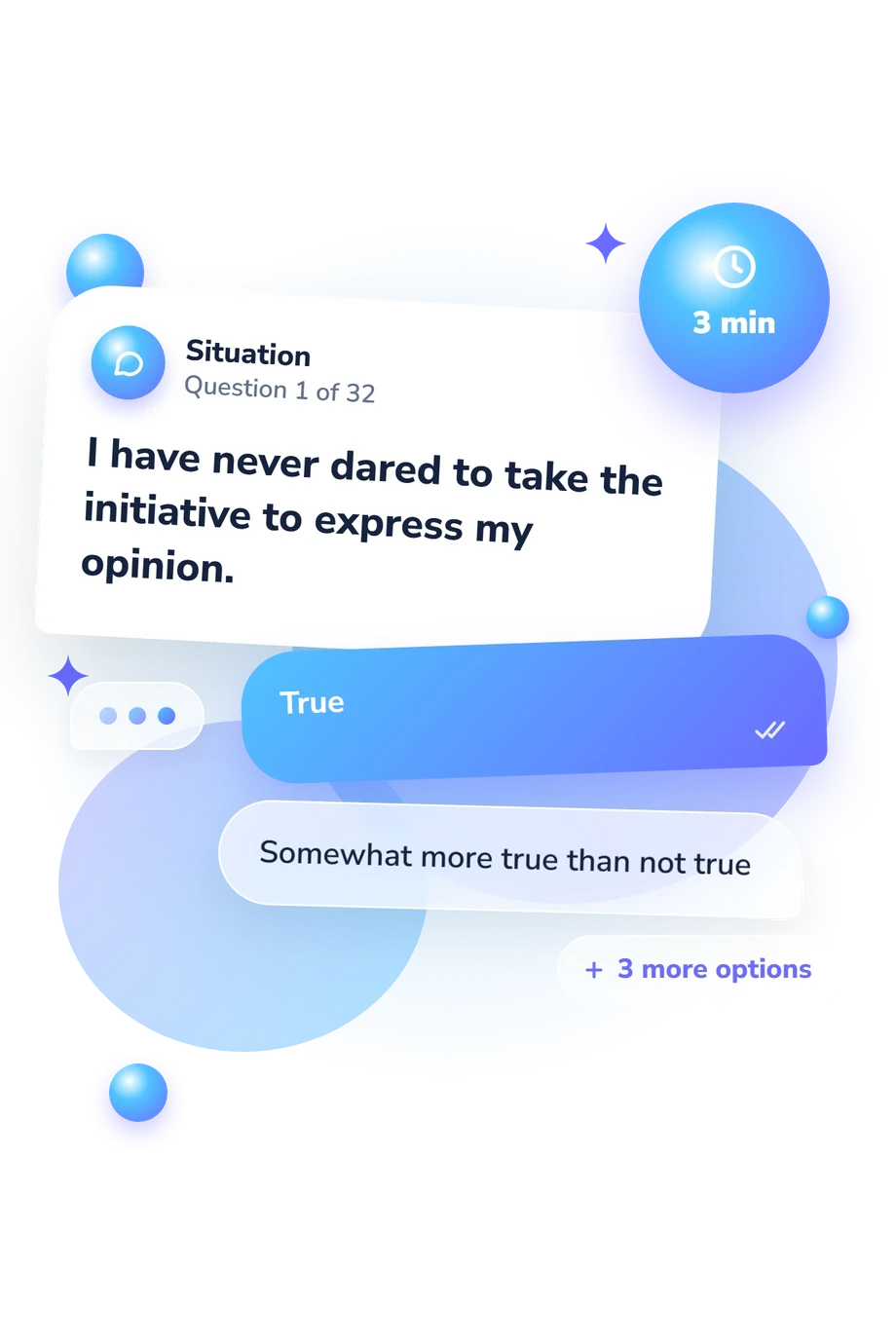
Example Questions From the Test
- Applies
- Rather applies than does not apply
- Hard to say
- Rather does not apply than applies
- Does not apply
- True
- More true than not true
- Hard to say
- More not true than true
- Not true
- Applies to me
- Applies to me rather than does not apply
- Hard to say
- Does not apply rather than applies
- Does not apply
Sense of Safety Questionnaire (SQ) Test - Description and methodology of the test
People who want to understand why ordinary situations sometimes feel manageable and sometimes unsafe can use the Sense of Safety Questionnaire (SQ) Test as a structured self-report profile. The questionnaire examines a person's sense of safety while reflecting on confidence, relationships, uncertainty, and emotional security. The result shows how strongly inner control, interpersonal protection, and overall safety are represented in the respondent's current outlook.
What This Assessment Explores
Across the items, the focus is on doubting personal agency, expecting disorder, struggling with danger, withdrawing from authority or closeness, and fearing damaged relationships. Other themes include unspoken needs, difficulty refusing requests, social disconnection, and intense reactions after painful events. These experiences reflect perceived safety, control, and interpersonal confidence. Together, they form a safety and control profile.
The displayed result separates three dimensions:
- Confidence in Control (8-40) reflects perceived predictability and ability to manage life; Low control confidence (8-19) indicates insecurity, while High control confidence (20-40) indicates greater internal control.
- Interpersonal Safety (8-40) shows trust and protection in relationships; Low interpersonal safety (8-24) reflects wariness, while High interpersonal safety (25-40) reflects greater comfort with others.
- Sense of Safety (16-80) shows overall perceived protection across life situations; Low safety (16-45), Moderate safety (46-74), and High safety (75-80) mark the displayed bands.
Methodology and Scientific Basis
Each of the 16 statements uses a five-point continuum, moving from applies or true through an uncertain middle option to does not apply or not true. Although wording varies, every response asks how closely the statement matches personal experience. The format is graded self-report, not a right-or-wrong task.
Responses combine into three displayed totals, and named bands classify the profile; the questionnaire presents these scale totals and result bands, while its item-level scoring formula is not specified. Read the three totals together as a present-oriented pattern across control, relationships, and overall safety.
Its closest conceptual reference is Security Questionnaire (Cong & An, 2004), which addresses personal and interpersonal security. Maslow et al. (1945) likewise treated psychological security as measurable. The Freudly questionnaire is conceptually consistent with both sources, but is not established as identical to either instrument. For this online version, the bands are descriptive rather than documented population norms or clinical thresholds. Current circumstances, self-awareness, and willingness to disclose difficult feelings can also shape the result, so read it as a present-oriented profile in context.
- Cong, Zhong, and An, Lijuan. "Developing of Security Questionnaire and Its Reliability and Validity." Chinese Mental Health Journal 18, no. 2 (2004): 97-99. 10.3321/j.issn:1000-6729.2004.02.010
- Maslow, Abraham H., Elisa Hirsh, Marcella Stein, and Irma Honigmann. "A Clinically Derived Test for Measuring Psychological Security-Insecurity." The Journal of General Psychology 33, no. 1 (1945): 21-41. 10.1080/00221309.1945.10544493
Updated: