
Freudly+971 508685814hello@freudly.ai
Freudly
cyberpsychology

Trolling Attitudes Questionnaire Test
Take the online Trolling Attitudes Questionnaire Test - AI psychologist FreudlyYou can take Trolling Attitudes Questionnaire Testhere. Online version of a simple and accurate psychological test with interpretation.en
Understand attitudes toward online trolling and provocations in about 6 minutes. Get a clear snapshot of support or rejection of trolling to guide research and moderation.
Start Online Test
Questions: 306 minutes
08:30
October 2, 2025
October 2, 2025
Material has been updated
October 2, 2025
Material has been published
19,695 views
1,253 completions
1,078 likes
Verified by Daniel Hall
Psychologist with 25 years of experience
Share
Scale Explorer

How the Scales are Structured

example score
4/15
Ethnic Trolling (ET)
Assesses how tolerant or approving a person is of trolling that targets ethnic themes online.
Low tolerance
Moderate tolerance
High tolerance
05: Low tolerance | 610: Moderate tolerance | 1115: High tolerance
A score of 4 suggests a low level of tolerance or approval for ethnic-themed trolling.
example score
6/15
Trolling as Entertainment (TaE)
Measures how positively a person views trolling as a form of entertainment.
Low enjoyment
Mixed enjoyment
High enjoyment
05: Low enjoyment | 610: Mixed enjoyment | 1115: High enjoyment
A score of 6 falls in the Mixed enjoyment range, suggesting a somewhat ambivalent but occasionally positive view of trolling as entertainment.
example score
11/15
Age Trolling (AT)
Measures how positively a person views age-related trolling and provocations online.
Rejecting
Mixed
Supportive
05: Rejecting | 610: Mixed | 1115: Supportive
A score of 11 falls in the Supportive range, indicating a generally positive attitude toward age-related trolling.
example score
12/15
Religious Trolling (RT)
Measures how tolerant a person is toward trolling and provocations on religious topics.
Low tolerance
Moderate tolerance
High tolerance
05: Low tolerance | 610: Moderate tolerance | 1115: High tolerance
A score of 12 falls in the High tolerance range, indicating comparatively greater acceptance of religious trolling or provocations.
example score
9/15
Gender Trolling (GT)
Measures how positively a person views trolling that targets or engages gender-related topics online.
Rejecting
Mixed/neutral
Supportive
05: Rejecting | 610: Mixed/neutral | 1115: Supportive
A score of 9 falls in the Mixed/neutral range, suggesting a generally ambivalent stance with some acceptance of gender-related trolling in certain contexts.
example score
6/15
Trolling of Interests and Hobbies (ToIaH)
This scale measures tolerance for trolling that targets other people's interests and hobbies.
Low tolerance
Moderate tolerance
High tolerance
05: Low tolerance | 610: Moderate tolerance | 1115: High tolerance
A score of 6 indicates moderate tolerance for trolling aimed at other people's interests and hobbies.
example score
9/15
Appearance-Based Trolling (ABT)
Measures how positively a person views trolling that targets someone’s outward appearance.
Rejecting
Mixed
Supportive
05: Rejecting | 610: Mixed | 1115: Supportive
A score of 9 falls in the Mixed range, suggesting an ambivalent or situationally accepting attitude toward appearance-based trolling.
example score
6/15
Political Trolling (PT)
Measures how accepting or supportive a person is of trolling that targets political topics and debates online.
Low acceptance
Moderate acceptance
High acceptance
05: Low acceptance | 610: Moderate acceptance | 1115: High acceptance
A score of 6 falls in the Moderate acceptance range, suggesting some tolerance for political trolling while not strongly endorsing it.
example score
4/15
Social Domain Trolling (SDT)
Measures how positively a person perceives trolling that impacts various social spheres.
Rejecting
Mixed
Supportive
05: Rejecting | 610: Mixed | 1115: Supportive
A score of 4 falls in the Rejecting range, suggesting a generally negative view of trolling that affects social spheres.
example score
4/15
Trolling of Psychological Characteristics (ToPC)
Measures how positively or negatively a person views trolling that targets an individual's psychological characteristics.
Negative attitude
Mixed/neutral attitude
Positive attitude
05: Negative attitude | 610: Mixed/neutral attitude | 1115: Positive attitude
A score of 4 falls in the Negative attitude range, suggesting the person tends to disapprove of trolling aimed at psychological characteristics.
Start Online Test
just completed the test
DATA-BASED USER COHORTS

Who Usually Takes This Test?

Active social media users
41%OF USERS
People who comment, argue, or meme online and want to understand their own reactions to provocation and edgy humor.
Community moderators and admins
34%OF USERS
People managing forums or group chats who need a clearer view of what kinds of trolling users tolerate, encourage, or reject.
Psychology students and researchers
25%OF USERS
People running surveys or writing papers who need a quick measure of attitudes toward trolling for studies and reports.
BASED ON AGGREGATED, ANONYMIZED DATA FROM TENS OF THOUSANDS OF FREUDLY USERS.
Benchmarking

See How You Compare

Once you complete the test, your results are compared with real-world data from people in your country.
Below is a preview of how scores are typically distributed across each scale.
Ethnic trolling (Et)
Average
10.2
Normal range
7.513
min.
0
max.
15
This curve shows how scores are typically distributed.
Once you complete the test, your result will appear on the scale so you can see how you compare.
Trolling Fun (TF)
Trolling Fun (TF)
Average
9
Normal range
6.711.2
min.
0
max.
15
This curve shows how scores are typically distributed.
Once you complete the test, your result will appear on the scale so you can see how you compare.
Age-trolling (A)
Age-trolling (A)
Average
9.7
Normal range
7.511.9
min.
0
max.
15
This curve shows how scores are typically distributed.
Once you complete the test, your result will appear on the scale so you can see how you compare.
Religious trolling (Rt)
Average
7.7
Normal range
510.4
min.
0
max.
15
This curve shows how scores are typically distributed.
Once you complete the test, your result will appear on the scale so you can see how you compare.
Gender Trolling (GT)
Average
6.5
Normal range
49
min.
0
max.
15
This curve shows how scores are typically distributed.
Once you complete the test, your result will appear on the scale so you can see how you compare.
Trolling interests, hobbies (Tih)
Average
6.2
Normal range
4.18.3
min.
0
max.
15
This curve shows how scores are typically distributed.
Once you complete the test, your result will appear on the scale so you can see how you compare.
Trolling Based on Appearance (TBoA)
Average
9.2
Normal range
6.511.9
min.
0
max.
15
This curve shows how scores are typically distributed.
Once you complete the test, your result will appear on the scale so you can see how you compare.
Political trolling (Pt)
Average
5.4
Normal range
3.47.3
min.
0
max.
15
This curve shows how scores are typically distributed.
Once you complete the test, your result will appear on the scale so you can see how you compare.
Trolling in Social Spheres (TiSS)
Average
6.2
Normal range
3.68.9
min.
0
max.
15
This curve shows how scores are typically distributed.
Once you complete the test, your result will appear on the scale so you can see how you compare.
Trolling of Psychological Characteristics (ToPC)
Average
11.2
Normal range
8.713.8
min.
0
max.
15
This curve shows how scores are typically distributed.
Once you complete the test, your result will appear on the scale so you can see how you compare.
Featured On
SAMPLE QUESTIONS

Example Questions From the Test

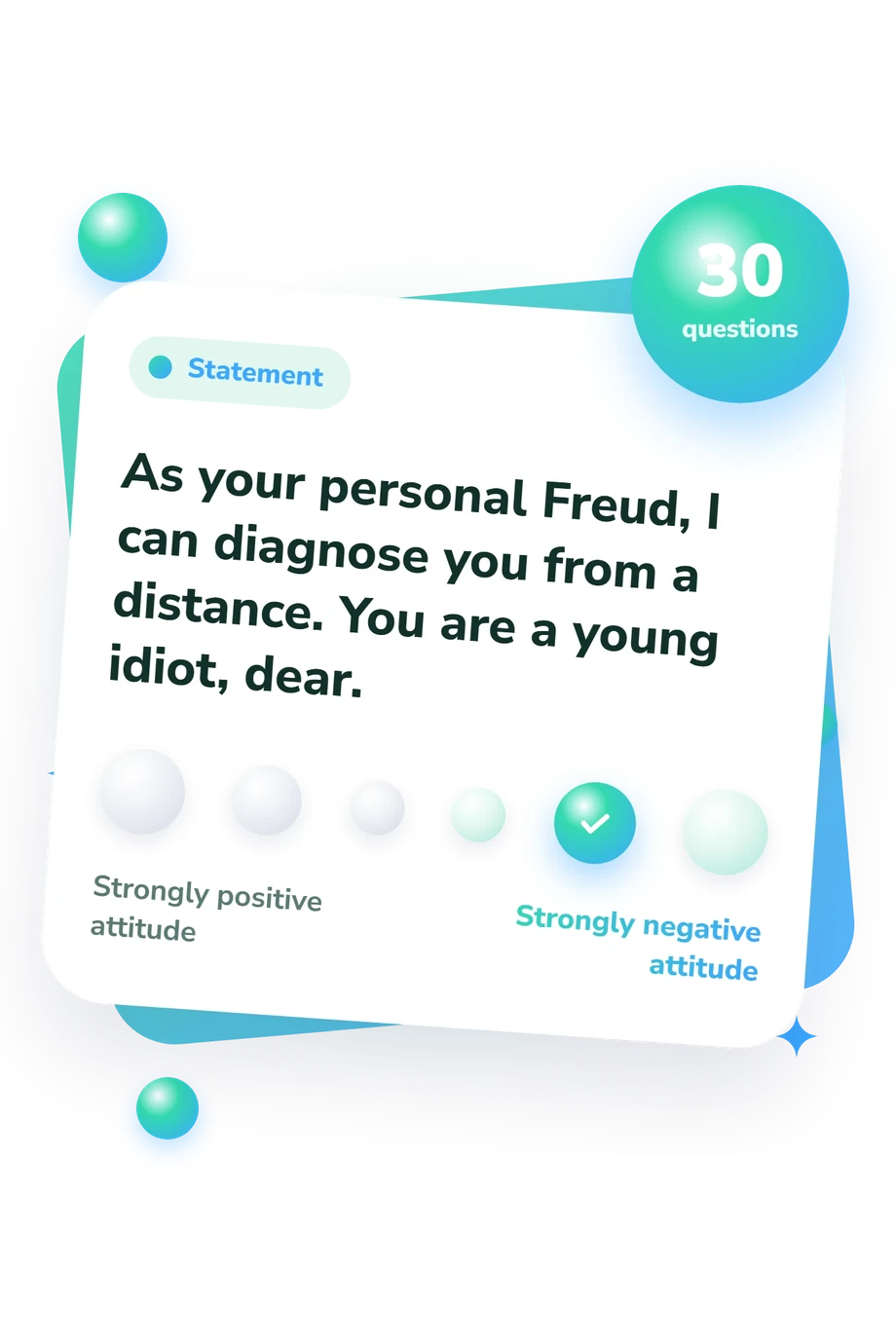
You will be presented with the texts of 30 online comments found on social media that relate to various areas of life, social interests, hobbies, and personal pursuits. Please rate your attitude toward each comment by selecting one response option: • Strongly positive attitude — I fully approve of this comment and similar comments; I prefer to post comments like this myself (or plan to); I often click “like,” send screenshots to acquaintances, or repost. • Positive attitude — I fully approve of this comment and similar comments; I click “like,” send screenshots to acquaintances, or repost, or I simply observe. • Situational attitude — The comment elicits approval or disapproval depending on the views, attitudes, preferences, etc. that are most salient at the time of completing the questionnaire. • Neutral attitude — The comment does not elicit any positive or negative emotions, as each person has the right to express what concerns them. • Negative attitude — I have a negative attitude toward this comment. • Strongly negative attitude — I have a negative attitude toward this comment and consider it necessary to engage in an online argument or submit a complaint to an administrator, because the comment offends my views or universal human principles.
    • Strongly positive attitude
    • Positive attitude
    • Situational attitude
    • Neutral attitude
    • Negative attitude
    • Strongly negative attitude
    • Strongly positive attitude
    • Positive attitude
    • Situational attitude
    • Neutral attitude
    • Negative attitude
    • Strongly negative attitude
    • Strongly positive attitude
    • Positive attitude
    • Situational attitude
    • Neutral attitude
    • Negative attitude
    • Strongly negative attitude
WHAT THE TEST MEASURES
About This Assessment
Questionnaire on Attitudes Toward Trolling Test

Trolling Attitudes Questionnaire Test - Symptoms and Signs

cyberpsychology
social networks

This self-report measure assesses attitudes toward online provocation and trolling behaviors. The Trolling Attitudes Questionnaire is intended to characterize respondents’ endorsement, acceptance, or rejection of common forms of trolling in digital contexts.

It consists of 30 items and typically takes about 6 minutes to complete. Items focus on viewpoints and reactions to trolling-related content (e.g., irony, antagonistic provocation) and may be used in research or applied settings to inform understanding of users’ orientations toward online provocation. The Trolling Attitudes Questionnaire has been attributed to Mark D. Griffiths.

Author: Mark D. Griffiths
Literature: Buckels, E. E., Trapnell, P. D., & Paulhus, D. L. Trolls just want to have fun. Personality and Individual Differences. 2014.
Popular tests
Comments
Leave a Comment