
Consecutive Action Questionnaire (CAQ-8) Test
How the Scales are Structured
Who Usually Takes This Test?
See How You Compare
Below is a preview of how scores are typically distributed across each scale.
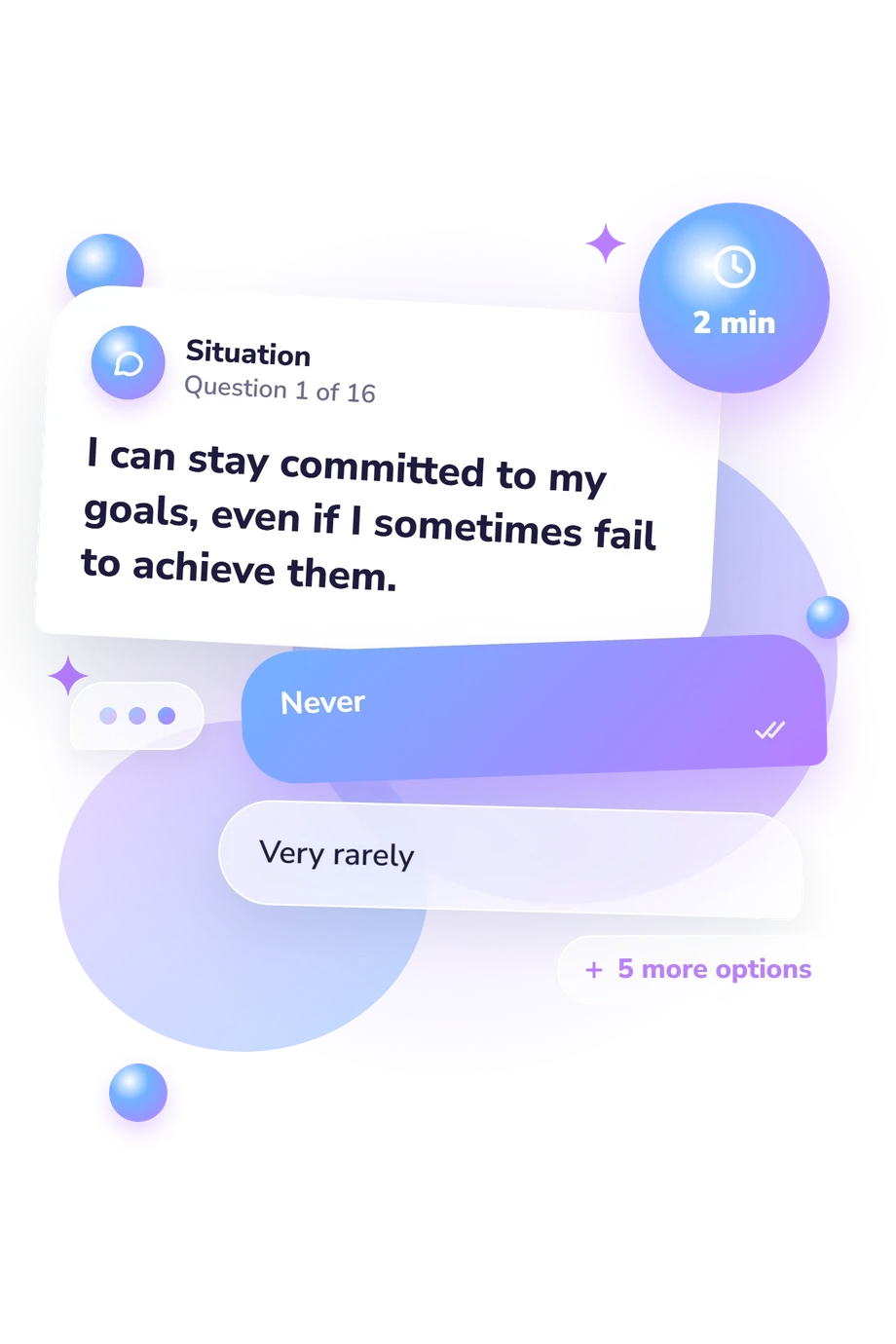
Example Questions From the Test
- Never
- Very rarely
- Occasionally
- Sometimes
- Often
- Almost always
- Always
- Never
- Very rarely
- Rarely
- Sometimes
- Often
- Almost always
- Always
- Never
- Very rarely
- Rarely
- Sometimes
- Often
- Almost always
- Always
Consecutive Action Questionnaire (CAQ-8) Test - Description and methodology of the test
People who want to understand how reliably they act on important goals can use this assessment to examine persistence, flexibility, and self-regulation in everyday situations. The Consecutive Action Questionnaire (CAQ-8) Test is intended for self-reflection when setbacks, disappointment, slow progress, or difficult inner experiences may affect behavior. By focusing on follow-through rather than outcome, this goal commitment assessment examines how a person continues pursuing a goal when success is uncertain.
What This Assessment Explores
Rather than measuring success or productivity, the questionnaire examines whether behavior stays connected to personal goals and values when circumstances become difficult. Its items address persistence after setbacks, gradual progress, flexible strategy changes, and the ways disappointment or rigid preferences can interrupt important action.
One displayed scale, Consecutive Action: 0-48, summarizes commitment to consistent, goal-directed behavior, psychological flexibility, and self-regulation. Its bands are Low consistency (0-16), Moderate consistency (17-32), and High consistency (33-48). The score reflects consistency of action rather than achievement itself.
As a goal-directed behavior test, it organizes three dimensions:
- Persistence after setbacks shows whether you continue valued efforts when progress is uncertain.
- Flexible pursuit shows whether you adjust methods, use small steps, and retain the larger aim.
- Emotional and behavioral interference indicates how difficult inner experiences or rigid preferences can divert important action.
Methodology and Evidence Base
Responses use ordered seven-point choices from Never to Always, asking how well each statement fits. Some items describe persistence and adaptation; others describe losing direction or acting rigidly. The questionnaire presents one displayed scale, but the conversion or weighting of the seven response choices is not specified.
The question themes are conceptually aligned with the published Committed Action Questionnaire (CAQ-8) (McCracken et al., 2015), while this online test uses the distinct name Consecutive Action Questionnaire. McCracken (2013) connects committed action with activity patterns, while McCracken and Morley (2014) explain how flexibility supports meaningful behavior alongside difficult private experiences.
The published CAQ-8 study provides evidence about that source instrument, not automatically about this online presentation. This online version has no published norms or standardization; current mood, context, self-awareness, and response bias can shape self-report. The displayed bands are consistency descriptors rather than clinical cutoffs, so this psychological flexibility assessment is best used for structured reflection.
- McCracken, L. M., Chilcot, J., & Norton, S. (2015). Further development in the assessment of psychological flexibility: a shortened Committed Action Questionnaire (CAQ-8). European Journal of Pain, 19(5), 677-685. 10.1002/ejp.589
- McCracken, L. M. (2013). Committed action: an application of the psychological flexibility model to activity patterns in chronic pain. The Journal of Pain, 14(8), 828-835. 10.1016/j.jpain.2013.02.009
- McCracken, L. M., & Morley, S. (2014). The psychological flexibility model: a basis for integration and progress in psychological approaches to chronic pain management. The Journal of Pain, 15(3), 221-234. 10.1016/j.jpain.2013.10.014
Updated: