
Maslach Burnout Inventory (MBI) Test
How the Scales are Structured
Who Usually Takes This Test?
See How You Compare
Below is a preview of how scores are typically distributed across each scale.
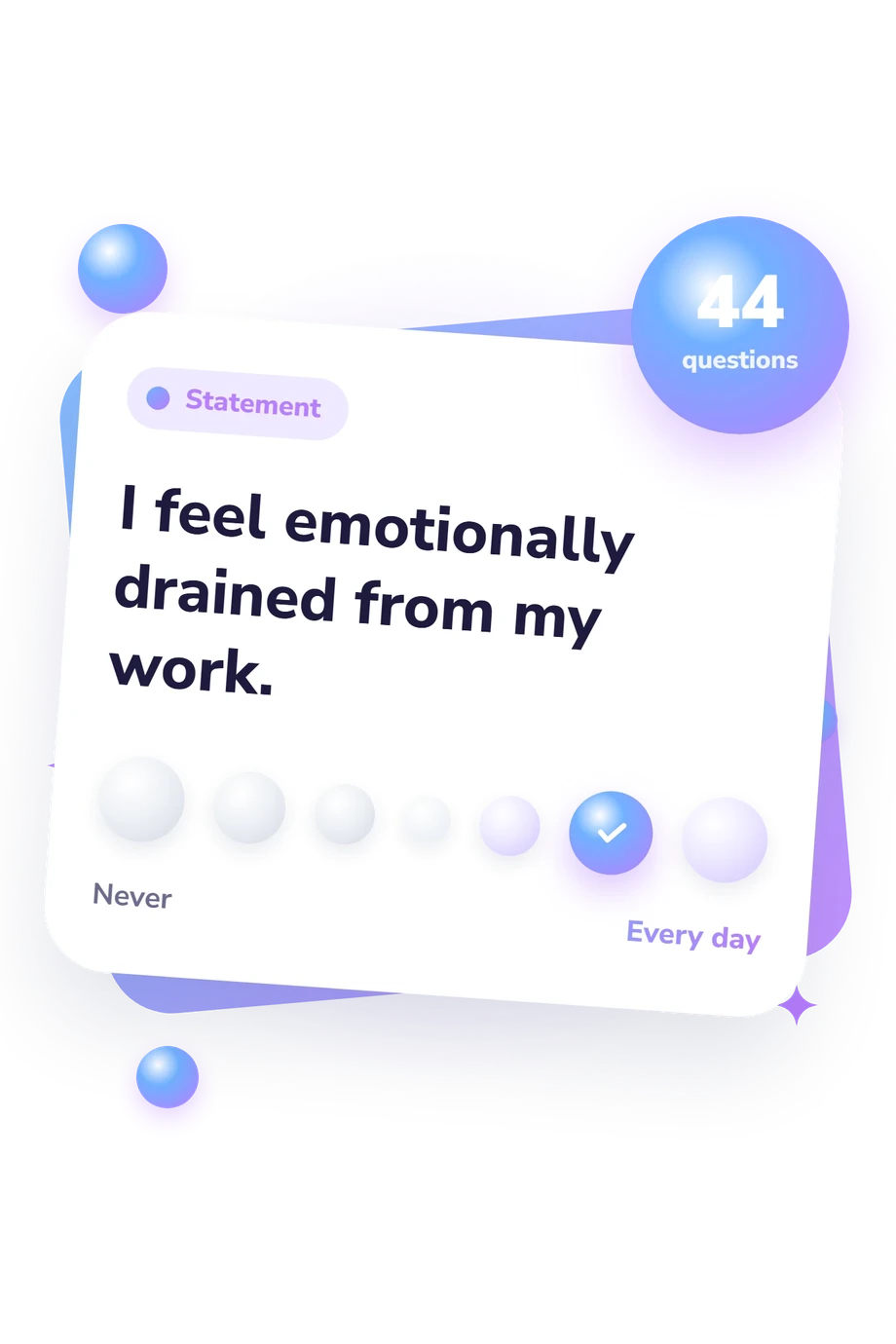
Example Questions From the Test
- Never
- Very rarely
- Rarely
- Sometimes
- Often
- Very often
- Every day
- Never
- Very rarely
- Rarely
- Sometimes
- Often
- Very often
- Every day
- Never
- Very rarely
- Rarely
- Sometimes
- Often
- Very often
- Every day
Maslach Burnout Inventory (MBI) Test - Description and methodology of the test
People who want to examine how work is affecting their energy, professional relationships, and sense of effectiveness may find the Maslach Burnout Inventory (MBI) Test useful. This MBI burnout assessment organizes self-reported experiences into a current burnout profile that includes individual dimensions and an overall severity indicator. The result offers a focused starting point for reflecting on current demands and the pattern of experiences reported.
What This Assessment Explores
Burnout is a work-related pattern, not simply tiredness. The questions suit work involving patients, relatives, and colleagues, addressing emotional demands, empathy, conflict, usefulness, and withdrawal. The questionnaire shows how the burnout dimensions relate to exhaustion, interpersonal distance, confidence in one's contribution, and overall severity. These four outputs describe the profile:
- Burnout Syndrome System Index (0-1) is a quantitative indicator based on a mathematical model and reflects overall severity: No burnout (0-0) or Maximum severity (0.01-1).
- Reduced Personal Accomplishment (0-48) measures satisfaction with personal and professional competence; low scores signal negative appraisal of competence and productivity, reduced motivation, withdrawal, and avoidance: Low reduction (0-30), Moderate reduction (31-36), or High reduction (37-48).
- Depersonalization (0-30) reflects detachment, indifference, cynicism, and unhelpful distance: Low (0-5), Moderate (6-10), High (11-30).
- Emotional Exhaustion (0-54) reflects depleted energy, fatigue, lost interest, and feeling overwhelmed: Low (0-15), Moderate (16-24), High (25-54).
Methodology and Scientific Basis
Each statement uses a seven-point frequency response, from Never through Every day. The items combine direct experiences of exhaustion or detachment with positively framed experiences of energy, empathy, conflict resolution, effectiveness, and optimism. These seven-point frequency responses produce the displayed scale results; the questionnaire does not state how individual response values are weighted.
The questionnaire is conceptually consistent with the Systemic Index of Burnout Syndrome (Lozinskaya et al., 2007) and the MBI's three-domain structure described in Maslach and Jackson's 1981 measurement study and 1996 manual. It is an online questionnaire rather than the published instrument, and it is not identified as an adaptation or validation of those sources.
The published instrument's norms and psychometric properties do not automatically carry over to this online burnout questionnaire. Interpret results as a profile of current self-reported functioning: current workload, mood, recent events, self-awareness, and impression management can affect answers. Results are best read alongside the circumstances that shaped them, with broader context needed to judge causes, persistence, or clinical significance.
- Lozinskaya, E. I., Lutova, N. B., & Vid, V. D. (2007). Systemic Index of Burnout Syndrome (Based on the MBI Test): Methodological Recommendations. St. Petersburg: St. Petersburg Research Psychoneurological Institute named after V. M. Bekhterev. 19 pp.
- Maslach, C., & Jackson, S. E. (1981). The measurement of experienced burnout. Journal of Organizational Behavior, 2(2), 99-113. 10.1002/job.4030020205
- Maslach, C., Jackson, S. E., & Leiter, M. P. (1996). Maslach Burnout Inventory Manual (3rd ed.). Palo Alto, CA: Consulting Psychologists Press. 52 pp.
Updated: