
Subjective Locus of Control Questionnaire Test
How the Scales are Structured
Who Usually Takes This Test?
See How You Compare
Below is a preview of how scores are typically distributed across each scale.
Example Questions From the Test
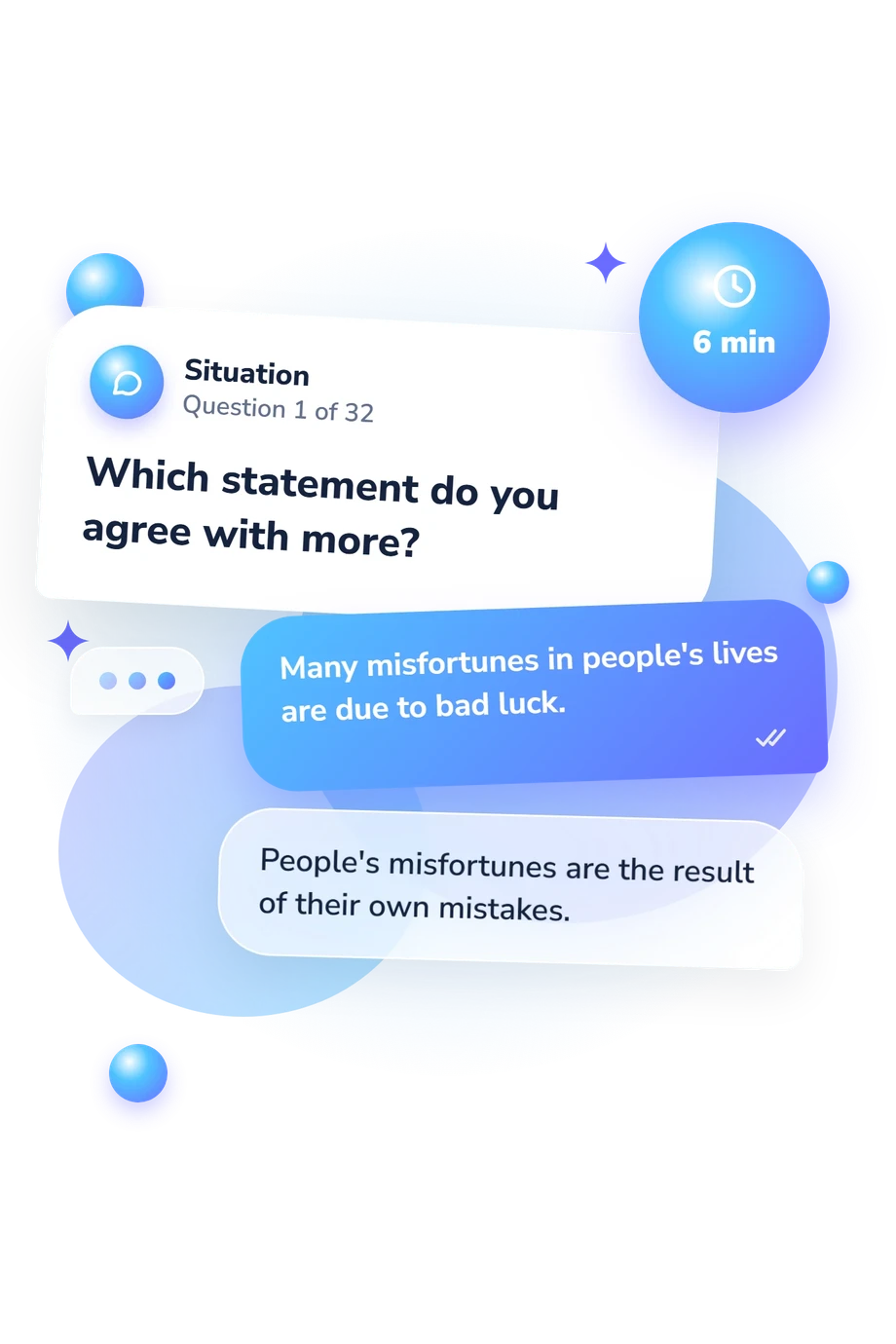
- Many misfortunes in people's lives are due to bad luck.
- People's misfortunes are the result of their own mistakes.
- There are certain people in whom there is nothing good.
- There is something good in everyone.
- What happens to me is the result of my own actions and behavior.
- Sometimes it seems to me that my life just happens on its own.
Subjective Locus of Control Questionnaire Test - Description and methodology of the test
People who want to understand how they explain success, setbacks, grades, relationships, leadership, and public events may find the Subjective Locus of Control Questionnaire Test useful. As a locus of control test, it examines whether outcomes feel shaped mainly by personal effort or by luck, circumstances, and other people. The result describes an attribution tendency, not a permanent identity.
What This Assessment Explores
It examines how people explain outcomes. It suits anyone reflecting on whether outcomes are attributed to personal effort or outside forces. Internality attributes outcomes to one’s effort, competence, and goal-directed action; externality attributes them to circumstances, luck, or other people, including approval, support, or chance.
Paired choices assess internality and externality: each side offers an explanation, and the respondent selects the better fit. This locus of control questionnaire focuses on habitual expectations.
These are the two result dimensions:
- Externality (E) Scale, 0-10, measures attribution to circumstances, luck, or other people, including approval, support, or chance; Low externality (0-3), Moderate externality (4-6), and High externality (7-10) mark outside reliance.
- Internality (I), 0-10, measures attribution to one’s effort, competence, and goal-directed action; More external (0-3), Balanced (4-6), and More internal (7-10) mark stronger personal attribution.
Methodology and Evidence Base
Responses use paired, forced-choice statements. The respondent selects the option they agree with more, expressing a relative preference rather than a frequency rating. Situations cover chance, effort, social acceptance, mistakes, study, authority, leadership, and civic influence.
The online attribution questionnaire reports the two dimensions through displayed ranges and bands; the point assignment for individual responses is not specified. Higher values show stronger endorsement of the relevant attribution pattern, not better character or constant behavior; a person can feel influential in one area and powerless in another.
The themes align conceptually with Panteleev and Stolin’s 1988 work on subjective locus of control, but this online questionnaire is distinct from that instrument, not a reproduction or adaptation. Rotter’s 1966 model links outcomes with behavior or external forces; Levenson’s 1974 work distinguishes internal control from control by powerful others.
The displayed bands are result labels and should not be treated as validated population cutoffs. Self-report answers may shift with current context, self-awareness, and response bias, so the result works best as a structured reflection rather than a diagnosis.
- Panteleev, S. R., & Stolin, V. V. (1988). Subjective Locus of Control Questionnaire: A Modification of Rotter's I-E Scale. In A. A. Bodalev, I. M. Karlinskaya, S. R. Panteleev, & V. V. Stolin (Eds.), Practicum in Psychodiagnostics: Psychodiagnostic Materials (pp. 118-123). Moscow: Moscow University Press.
- Rotter, J. B. (1966). Generalized expectancies for internal versus external control of reinforcement. Psychological Monographs: General and Applied, 80(1), 1-28. 10.1037/h0092976.
- Levenson, H. (1974). Activism and Powerful Others: Distinctions within the Concept of Internal-External Control. Journal of Personality Assessment, 38(4), 377-383. 10.1080/00223891.1974.10119988.
Updated: