
Attitudes Toward Moral Decision-Making in Sport Questionnaire Test
How the Scales are Structured
Who Usually Takes This Test?
See How You Compare
Below is a preview of how scores are typically distributed across each scale.
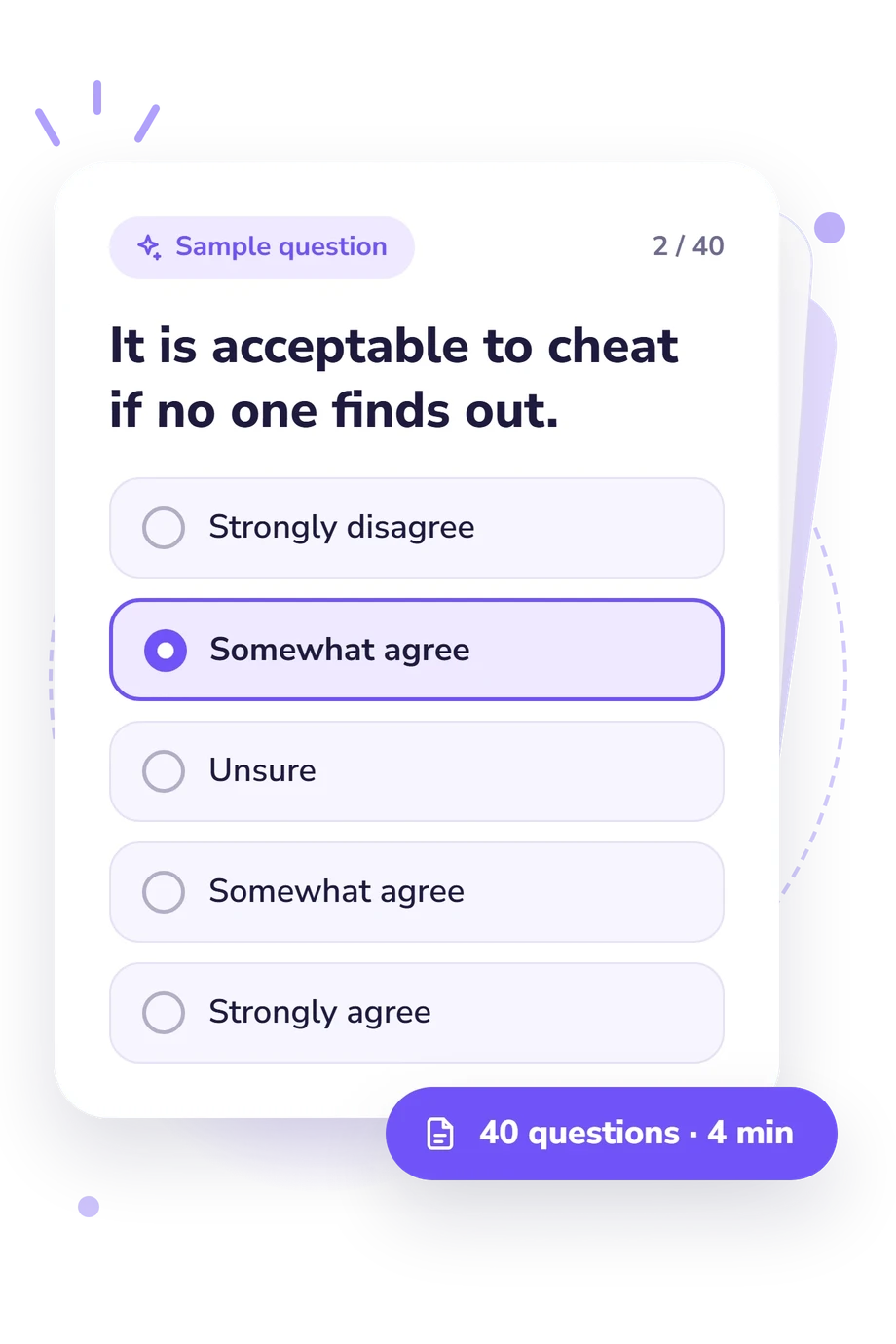
Example Questions From the Test
- Strongly disagree
- Somewhat agree
- Unsure
- Somewhat agree
- Strongly agree
- Strongly disagree
- Agree more than disagree
- Not sure
- Agree more than disagree
- Strongly agree
- Strongly disagree
- Agree more than disagree
- Not sure
- Agree more than disagree
- Strongly agree
Attitudes Toward Moral Decision-Making in Sport Questionnaire Test - Description and methodology of the test
People who want to examine their competitive values may find the Attitudes Toward Moral Decision-Making in Sport Questionnaire Test useful for evaluating how they weigh ethical choices in competition. This moral decision-making in sport test examines attitudes toward rules, opponents, winning, and losing. Its result helps readers evaluate whether their stated standards emphasize fair play, respect for opponents, and acceptance of loss.
What This Assessment Explores
Competition reveals how people balance rules, opponents, and outcomes. The assessment examines cheating, fair victory, dignified loss, and provocation. It suits anyone considering ethics. As a sports ethics questionnaire, it describes ethical tendencies.
The displayed result covers four dimensions:
- Rejection of Aggressive Behavior (6-30) measures disapproval of unsportsmanlike actions intended to provoke or upset an opponent: Low rejection 6-13; Moderate rejection 14-22; High rejection 23-30.
- Orientation Toward Fair Victory (5-25) measures endorsement of winning through fair play, rejection of winning at any cost, and ability to lose with dignity: Low 5-12; Moderate 13-19; High 20-25.
- Rejection of Cheating (7-35) measures disapproval of violating rules to win: Low rejection 7-16; Moderate rejection 17-25; High rejection 26-35.
- Total Score (20-100) means higher scores indicate a greater tendency toward moral decision-making in sport: Lower moral orientation 20-56; Moderate moral orientation 57-81; High moral orientation 82-100.
Methodology and Evidence Base
Each statement offers five response options, with an unsure or hard-to-say midpoint and agreement or disagreement labels; this format is not a standard ordered continuum. The items cover cheating, winning and losing, fair play, and attempts to unsettle opponents. Results show three subscale scores and a total, but the questionnaire does not specify how items are calculated.
AMDYSQ is the closest published instrument, measuring moral decision-making attitudes in youth sport. This questionnaire is conceptually consistent with it and AMDYSQ-2 work by Whitehead and Ntoumanis, but is not a direct reproduction; those studies support comparison rather than independently validating this questionnaire. Related research links moral attitudes with values and achievement orientations. Results from the fair play attitude test show how strongly respondents endorse ethical victory standards in this self-report.
Interpret the profile as a snapshot of attitudes in situations represented by the items. Higher total scores indicate a greater tendency toward moral decision-making in sport. The displayed bands are descriptive ranges, not clinical cutoffs or population norms; responses vary with honesty, self-awareness, and current competitive context.
- Lee, M. J., Whitehead, J., & Ntoumanis, N. (2007). Development of the Attitudes to Moral Decision-making in Youth Sport Questionnaire (AMDYSQ). Psychology of Sport and Exercise, 8, 369-392. 10.1016/j.psychsport.2006.12.002
- Whitehead, J., & Ntoumanis, N. (2013). Further use of AMDYSQ and the development of AMDYSQ-2. In J. Whitehead, H. Telfer, & J. Lambert (Eds.), Values in Youth Sport and Physical Education (pp. 230-237). Routledge.
- Lee, M. J., Whitehead, J., Ntoumanis, N., & Hatzigeorgiadis, A. (2008). Relationships Among Values, Achievement Orientations, and Attitudes in Youth Sport. Journal of Sport and Exercise Psychology, 30(5), 588-610. 10.1123/jsep.30.5.588
Updated: