
Thought Control Questionnaire (TCQ) Test
How the Scales are Structured
Who Usually Takes This Test?
See How You Compare
Below is a preview of how scores are typically distributed across each scale.
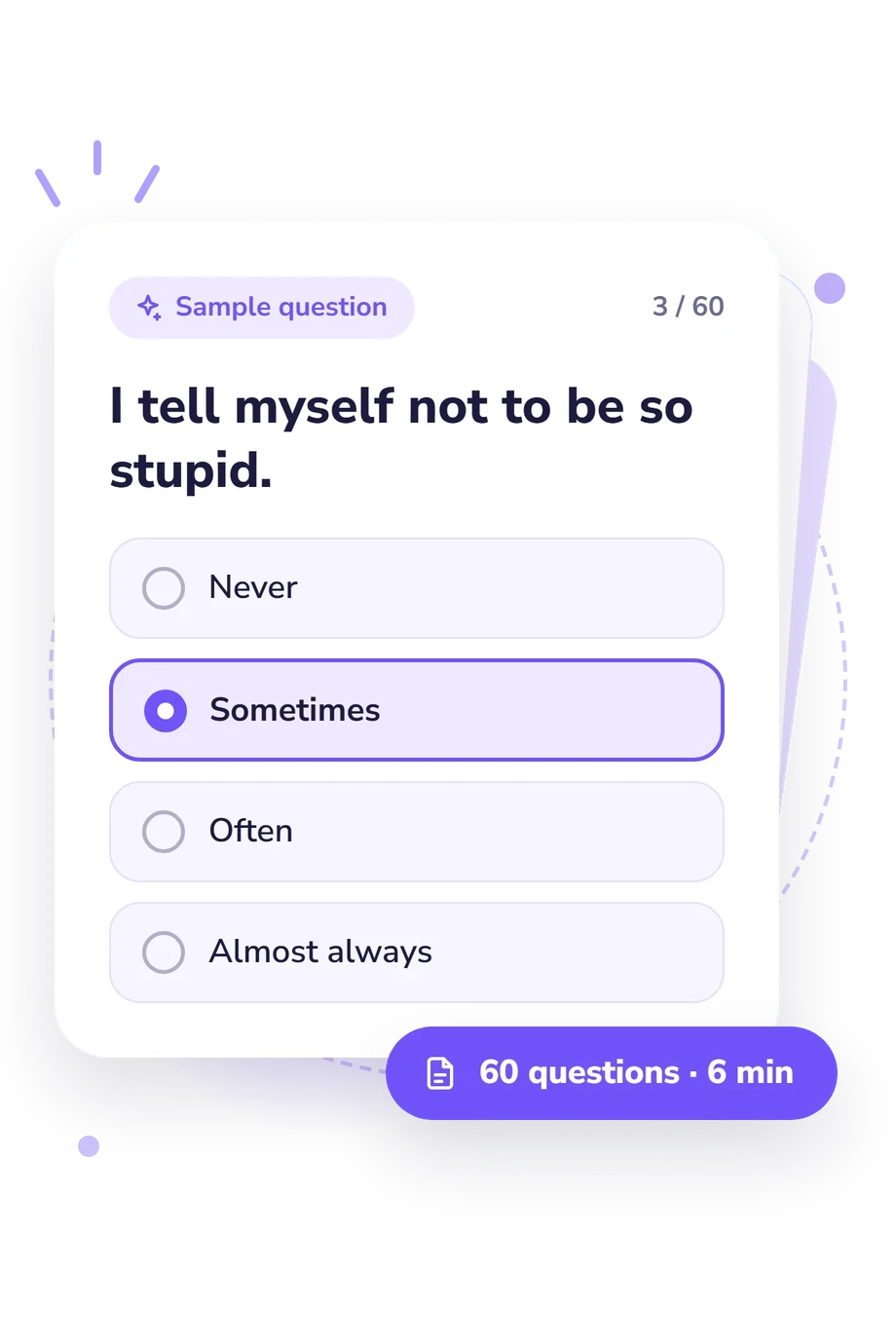
Example Questions From the Test
- Never
- Sometimes
- Often
- Almost always
- Never
- Sometimes
- Often
- Almost always
- Never
- Sometimes
- Often
- Almost always
Thought Control Questionnaire (TCQ) Test - Description and methodology of the test
For people who want to understand what happens when unwanted thoughts appear, the Thought Control Questionnaire (TCQ) Test offers a structured look at habitual responses. It suits self-reflection for anyone noticing rumination, mental intrusions, or efforts to push thoughts away. As an intrusive thought questionnaire, it describes patterns of managing thoughts rather than judging whether the thoughts themselves are reasonable or meaningful.
What This Test Measures
It examines what you do when an unpleasant or unwanted thought appears. The result describes patterns rather than the content of thoughts or a judgment about your character. The profile presents these dimensions:
- Reappraisal (6-24) measures reinterpretation: Low use 6-11; Moderate use 12-16; High use 17-24.
- Punishment (6-24) measures self-punishment or self-criticism: Low 6-12; High 13-24.
- Worry (6-24) measures increased anxiety after intrusive thoughts: Low 6-7; Moderate 8-12; High 13-24.
- Social Control (6-24) measures using social interaction or seeking support to manage thoughts: Low use 6-11; Moderate 12-17; High use 18-24.
- Distraction (6-24) measures redirection through activities or other thoughts: Lower use 6-11; Moderate 12-17; Higher use 18-24.
- Total Score (30-120) reflects overall strategy use: Low use 30-42; Moderate 43-54; High 55-120.
Together, the profile describes how often you use different strategies for managing unwanted thoughts.
Methodology and Evidence Base
Each statement asks how often you use a response, from Never to Almost always. Answers are combined into strategy scores and an overall score; the displayed ranges describe reported use, not whether a method is helpful or harmful.
The framework is the Thought Control Questionnaire, a self-report measure of individual differences in controlling unwanted thoughts developed by Wells and Davies. Its original five-factor structure was examined in clinical research by Reynolds and Wells, while later work by Fehm and Hoyer found the factors relatively independent but noted that reliability was not fully satisfactory.
These studies support the questionnaire’s conceptual model, but they do not establish norms or diagnostic cutoffs for this online administration. Read the result as a profile of current or habitual thought-control strategies. A high total may reflect more active attempts to manage intrusions, yet frequent control efforts can also coexist with greater intrusiveness. Stress, mood, self-criticism, and avoidance can shape responses, so the pattern is more informative alongside daily experience than as a fixed trait.
- Wells, Adrian, and Mark I. Davies. (1994). The thought control questionnaire: A measure of individual differences in the control of unwanted thoughts. Behaviour Research and Therapy, 32(8), 871-878. 10.1016/0005-7967(94)90168-6
- Reynolds, Martina, and Adrian Wells. (1999). The Thought Control Questionnaire-psychometric properties in a clinical sample, and relationships with PTSD and depression. Psychological Medicine, 29(5), 1089-1099. 10.1017/S003329179900104X
- Fehm, Lydia, and Juergen Hoyer. (2004). Measuring Thought Control Strategies: The Thought Control Questionnaire and a Look Beyond. Cognitive Therapy and Research, 28(1), 105-117. 10.1023/B:COTR.0000016933.41653.DC
Updated: