
Klontz Money Attitudes Questionnaire Test
How the Scales are Structured
Who Usually Takes This Test?
See How You Compare
Below is a preview of how scores are typically distributed across each scale.
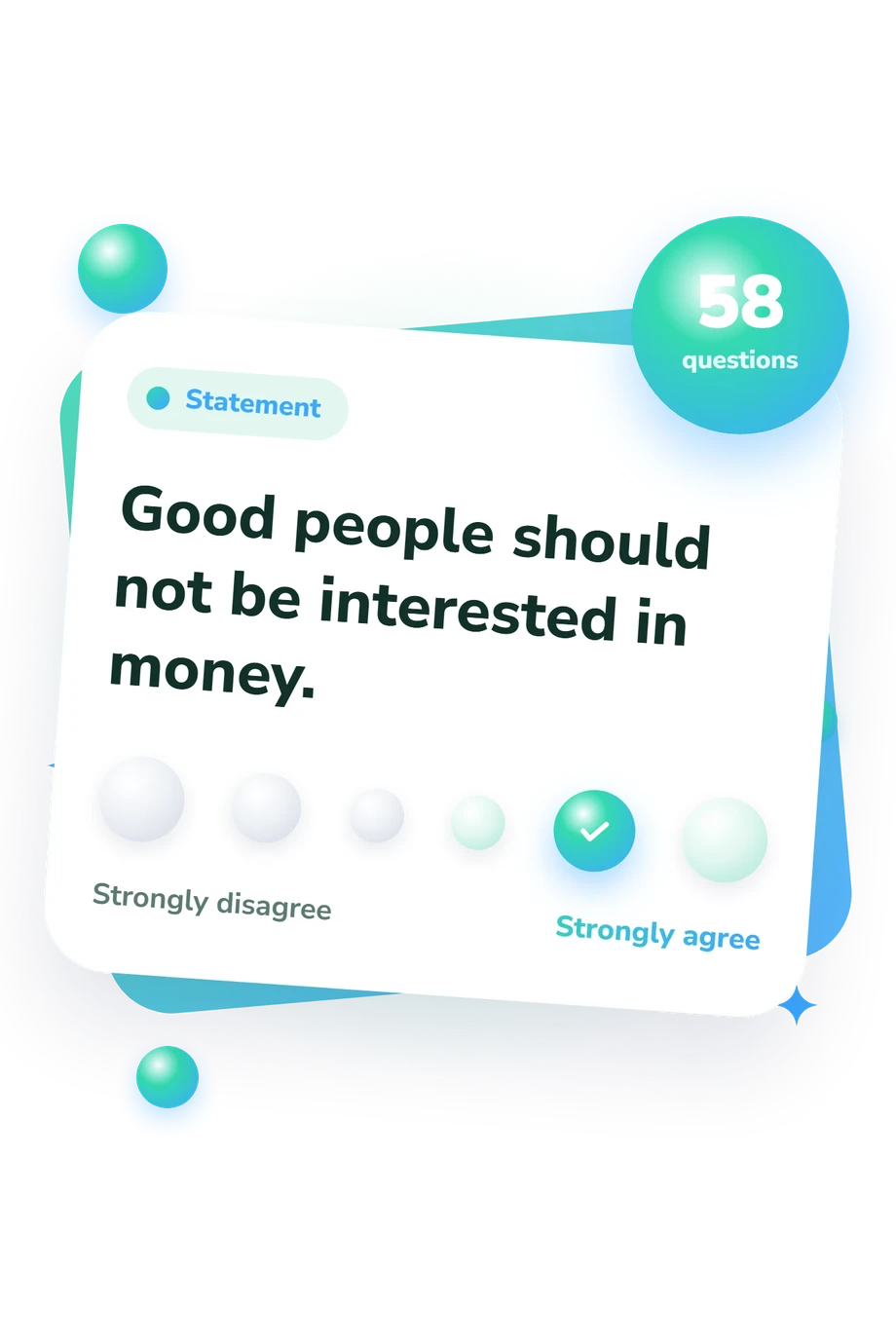
Example Questions From the Test
- Strongly disagree
- Disagree
- Somewhat disagree
- Somewhat agree
- Agree
- Strongly agree
- Strongly disagree
- Disagree
- Somewhat disagree
- Somewhat agree
- Agree
- Strongly agree
- Strongly disagree
- Disagree
- Somewhat disagree
- Somewhat agree
- Agree
- Strongly agree
Klontz Money Attitudes Questionnaire Test - Description and methodology of the test
People comparing conflicting reactions to saving, spending, privacy, or status can use the Klontz Money Attitudes Questionnaire Test to examine which money themes stand out. A money attitudes assessment helps distinguish caution, avoidance, status concerns, and money-focused expectations across the results. This approach suits readers seeking a more specific interpretation of their financial assumptions.
What This Assessment Explores
Items examine beliefs about earning, spending, privacy, status, and money. This money beliefs questionnaire covers trust, morality, and wealth.
Four dimensions follow:
- Money Vigilance (1-6) measures secrecy, distrust, fear of loss, and caution; Low vigilance (1-2.86), Moderate vigilance (2.87-4.53), High vigilance (4.54-6).
- Money Worship (1-6) measures belief that money solves problems and possible hoarding; Low (1-2.89), Moderate (2.9-4.6), High (4.61-6).
- Money as Status (1-6) measures judging people by finances and possible status-driven risk or overspending; Low (1-1.58), Moderate (1.59-3.01), High (3.02-6).
- Money Avoidance (1-6) measures reluctance to manage money or buy necessities; Low avoidance (1-1.58), Moderate avoidance (1.59-2.85), High avoidance (2.86-6).
Bands show tendency strength, not a diagnosis.
Methodology and Scientific Basis
Each statement uses six ordered agreement choices, from Strongly disagree to Strongly agree. A few items use Completely disagree and Completely agree, but the format remains six-point.
Scoring yields four separate results rather than one overall label. However, item weights, reverse-scoring rules, and any total-score formula are not stated in the questionnaire, so they should not be inferred from the displayed ranges.
Conceptually, this online assessment is consistent with the Klontz Money Script Inventory (Klontz et al., 2011). Klontz, Klontz, and Kahler (2008) describe the wider money-script framework. This is not automatically the published inventory or a documented adaptation. Taylor, Klontz, and Britt (2016) reported reliability and convergent validity for the revised KMSI-R; Reiter et al. (2026) later examined it across a diverse sample. Those findings support related published instruments, not automatic validation of this online questionnaire.
Because these money-attitude items use self-report, a money attitude profile can reflect current circumstances, self-awareness, and response style. It has no stated population norms or diagnostic cutoffs, so interpret the profile as endorsed money patterns.
- Klontz, Bradley, Sonya L. Britt, Jennifer Mentzer, and Ted Klontz. (2011). Money Beliefs and Financial Behaviors: Development of the Klontz Money Script Inventory. Journal of Financial Therapy, 2(1), 1-22. 10.4148/jft.v2i1.451
- Klontz, Brad, Ted Klontz, and Rick Kahler. (2008). Wired for Wealth: Change the Money Mindsets That Keep You Trapped and Unleash Your Wealth Potential. Health Communications, Inc.
- Taylor, Colby D., Bradley Klontz, and Sonya L. Britt. (2016). Reliability and Convergent Validity of the Klontz Money Script Inventory-Revised (KMSI-R). Journal of Financial Therapy, 6(2), 1-13. 10.4148/1944-9771.1100
- Reiter, Miranda, Jesse B. Jurgenson, Megan McCoy, Kimberly Watkins, Kenneth White, and Dee Warmath. (2026). Evaluating the Klontz Money Script Inventory-Revised (KMSI-R): Factorial Validity, Internal Consistency, and Measurement Invariance with a Diverse Sample. Journal of Family and Economic Issues, 47, 343-355. 10.1007/s10834-025-10055-7
Updated: