
Body Image Questionnaire Test
How the Scales are Structured
Who Usually Takes This Test?
See How You Compare
Below is a preview of how scores are typically distributed across each scale.
Example Questions From the Test
- Never
- Sometimes
- Often
- Always
- Never
- Sometimes
- Often
- Always
- Never
- Sometimes
- Often
- Always
Body Image Questionnaire Test - Description and methodology of the test
Readers who want to examine how appearance-related thoughts shape daily comfort can use this assessment as a structured starting point. The Body Image Questionnaire Test focuses on personal experiences rather than judging attractiveness or prescribing an ideal appearance. As a body image test, it helps organize concerns about weight, shape, self-criticism, comparison, and social unease before the result is considered in context.
What This Assessment Explores
These themes make the body image questionnaire relevant for people who notice appearance discomfort, weight worry, self-criticism, or avoidance. It considers thoughts, emotions, and actions together.
The result is organized around these displayed scales and question themes:
- Standard Scores (0-9) compare body-satisfaction results with normative values: Low dissatisfaction is 0-3, Moderate dissatisfaction is 4-6, and High dissatisfaction is 7-9; higher scores mean greater dissatisfaction relative to that sample.
- Body Satisfaction (0-48) covers weight, shape, specific body parts, emotions, and beliefs: Low dissatisfaction is 0-12, while Elevated dissatisfaction is 13-48. Its evaluative component combines cognitive, emotional, and behavioral attitudes toward appearance, and higher values may signal pronounced dissatisfaction affecting self-esteem, behavior, or relationships.
- Question themes include appearance-related self-criticism, shame, comparison, and avoidance, which show how body concerns may influence confidence, social comfort, and everyday activity.
Methodology and Scientific Basis
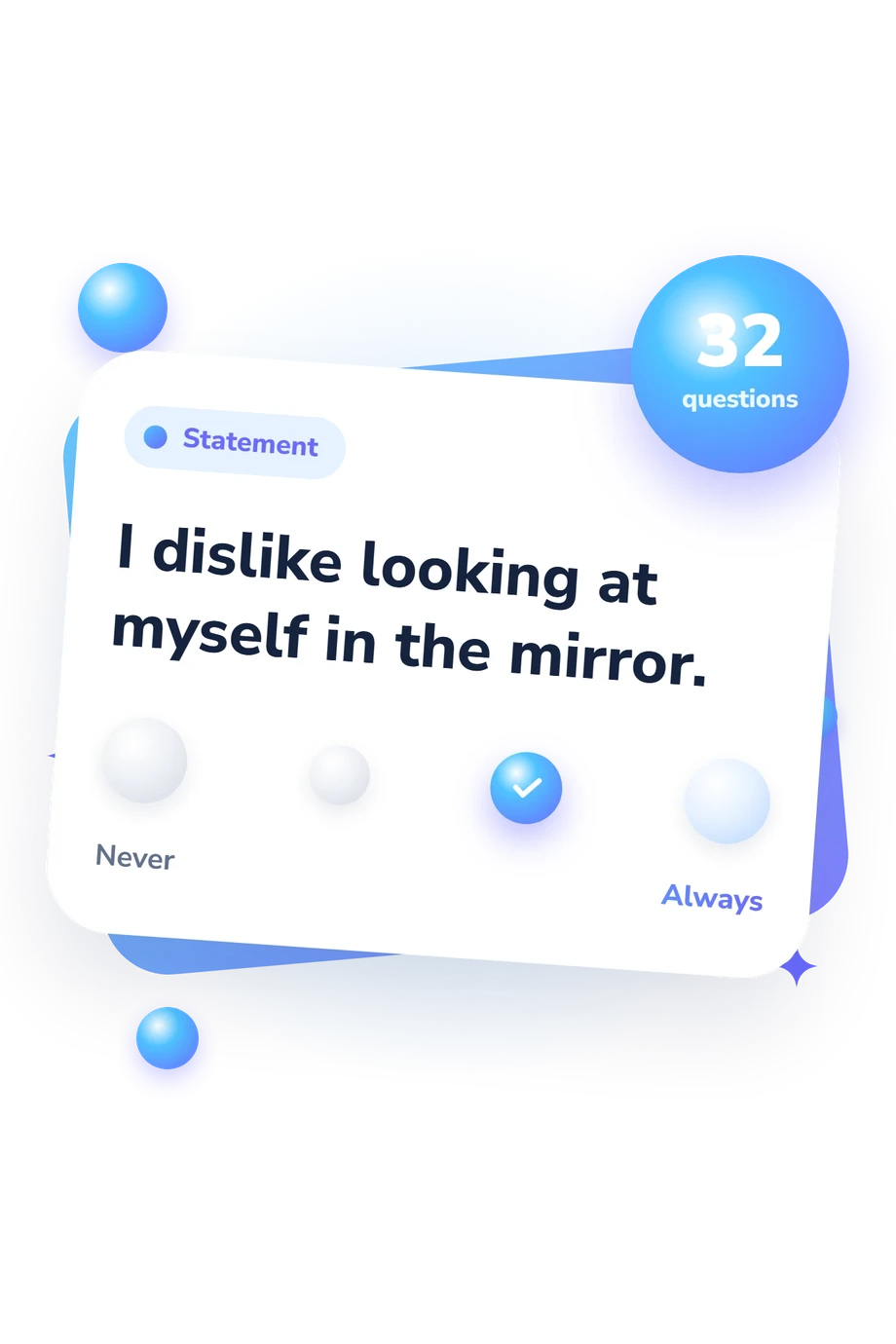
Statements describe appearance-related experiences through four frequency choices: Never, Sometimes, Often, and Always. Some choices carry numbers 1-4, but the questionnaire reports the two displayed scales while the item-to-scale conversion rule is not documented.
As a body satisfaction questionnaire, it combines self-report items into two summary outcomes: one compares the result with normative values, and the other represents dissatisfaction in the answers. Normative comparison does not by itself establish independent standardization of the online version.
A 2006 study by Skugarevsky and Sivukha describes a closely related body-image measure covering body evaluation, shame, weight concern, and appearance-related behavior. This questionnaire is conceptually consistent with that work, but is not presented as a direct adaptation of it. Together, mirror reactions, clothing, social exposure, comparisons, guilt, and weight worry connect cognitive and emotional evaluations with appearance-related behavior in everyday situations.
Interpretation is sensitive to self-awareness, response bias, current mood, recent comments, clothing, and social setting. The result supports self-reflection, not diagnosis, and is best considered alongside broader personal experience.
- Skugarevskii, O. A., & Sivukha, S. V. (2006). Body Image: Developing an Assessment Tool. Psychological Journal (Belarus), 2(10), 40-48. (In Russian).
- Skugarevsky, O. A. (2007). Eating Disorders. Minsk: Belarusian State Medical University. ISBN 978-985-462-756-4. (In Russian).
- Thompson, J. Kevin, & Schaefer, Lauren M. (2019). Thomas F. Cash: A multidimensional innovator in the measurement of body image; Some lessons learned and some lessons for the future of the field. Body Image, 31, 198-203. 10.1016/j.bodyim.2019.08.006
Updated: