
Information Security Quiz
How the Scales are Structured
Who Usually Takes This Test?
See How You Compare
Below is a preview of how scores are typically distributed across each scale.
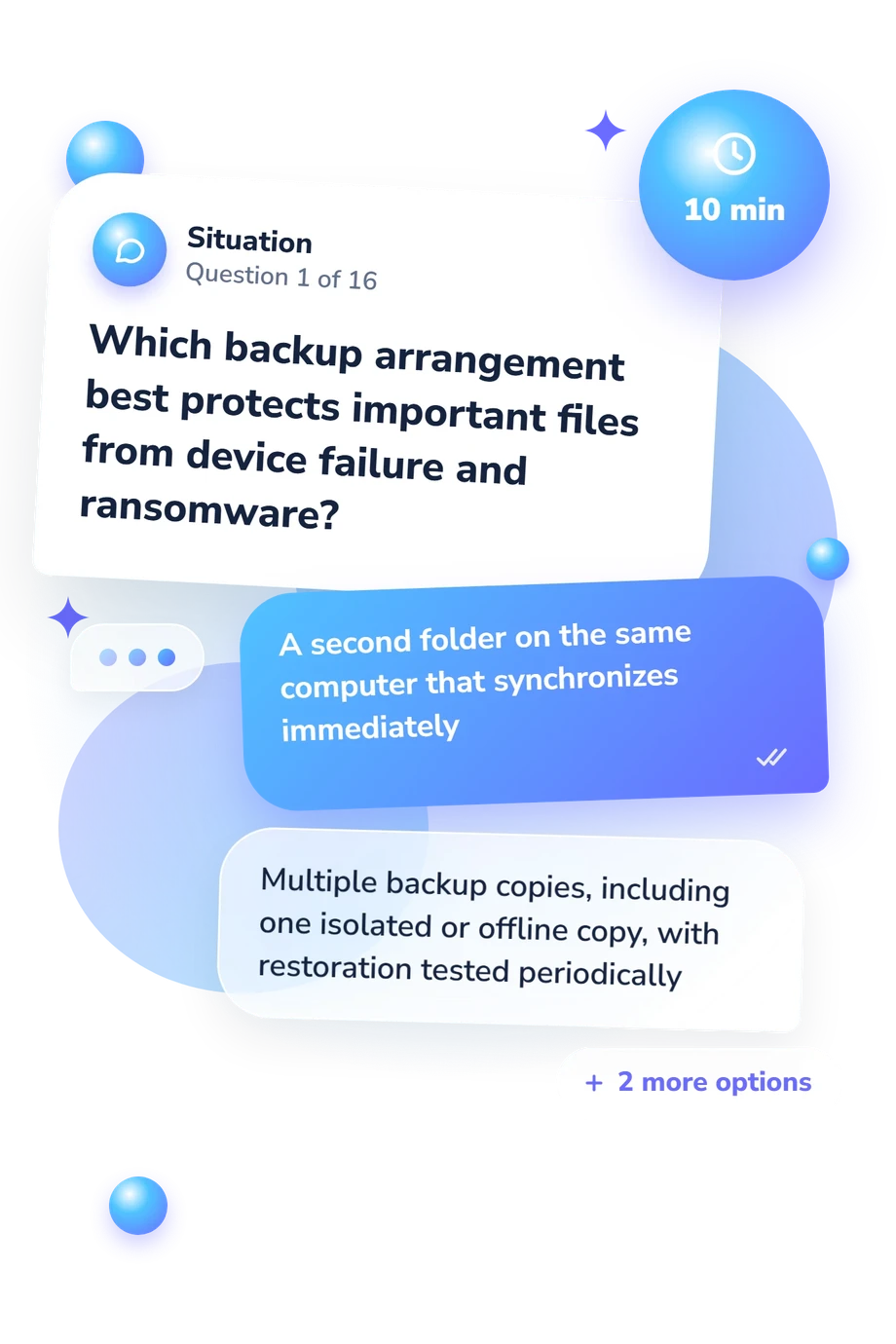
Example Questions From the Test
- A second folder on the same computer that synchronizes immediately
- Multiple backup copies, including one isolated or offline copy, with restoration tested periodically
- A single cloud folder that remains continuously connected to every device
- An archive created only after unusual computer activity is noticed
- They guarantee that phishing messages will be blocked
- They often fix known vulnerabilities that attackers could exploit
- They automatically replace reused passwords with unique ones
- They prevent authorized users from accidentally deleting files
- A distributed denial-of-service attack
- A firewall
- A security patch
- A Trojan
Information Security Quiz - Description and methodology of the test
People who want a practical picture of their knowledge and judgment in everyday security scenarios can use this assessment to check whether they recognize common attack patterns and choose proportionate protective steps. The information security quiz is suitable for learners, employees, and anyone building safer digital routines. An information security knowledge test result points to strengths and topics that deserve further study, rather than offering a professional audit.
What This Assessment Explores
Rather than measuring technical expertise, the assessment examines recognition and judgment in situations involving people, accounts, devices, or information at risk. A cybersecurity awareness assessment asks respondents to spot warning signs and choose safer actions.
The questions cover four practical groups:
- Threat recognition shows whether the result reflects understanding of phishing, ransomware, Trojans, deceptive websites, and suspicious logins.
- Protective maintenance and secure access cover backups, updates, unique passwords, multi-factor authentication, and safer public Wi-Fi choices.
- Access and data handling examine least privilege, approved sharing, visitor verification, and unknown USB devices.
- Incident response concerns urgent payment requests, account alerts, and possible compromise.
One displayed scale, Information Security Knowledge (0-16), equals the number of correct answers. Foundations to build covers 0-6, Developing knowledge 7-12, and Strong knowledge 13-16. It describes scenario knowledge, not a personality trait or full workplace security profile.
Methodology and Evidence Base
Each item presents a short workplace or online scenario with four answer choices. Selecting the best action or explanation tests applied recognition alongside recall of terms such as social engineering, least privilege, HTTPS, and ransomware. The scoring is direct: the total equals the number of correct answers, with no additional weighting stated for topics.
Methodologically, the questionnaire is a separate online knowledge assessment that is conceptually consistent with CAIN (Tempestini et al., 2023), a knowledge-focused inventory linked to the ISO/IEC 27032 framework. Reliability and validity work on CAIN (Di Nocera et al., 2025) supports that instrument’s development, while Cain, Edwards, and Still (2018) connect cyber-hygiene knowledge with protective behaviors. CAIN’s reliability and validity findings cannot be transferred to this questionnaire’s score.
Results from the online information security test provide an overall educational indication of performance on the covered material; they do not by themselves identify particular topics. The online result has no population norms or reliability estimate for this questionnaire and confers no professional certification. Attention, honesty, prior experience, and current circumstances can affect the snapshot.
- Tempestini, Giorgia; Rovira, Ericka; Pyke, Aryn; Di Nocera, Francesco. (2023). The Cybersecurity Awareness INventory (CAIN): Early Phases of Development of a Tool for Assessing Cybersecurity Knowledge Based on the ISO/IEC 27032. Journal of Cybersecurity and Privacy, 3(1), 61-75. 10.3390/jcp3010005
- Di Nocera, Francesco; Tempestini, Giorgia; Presaghi, Fabio. (2025). Reliability and validity of the Cybersecurity Awareness INventory (CAIN). Behaviour & Information Technology, 44(7), 1417-1428. 10.1080/0144929X.2024.2355362
- Cain, Ashley A.; Edwards, Morgan E.; Still, Jeremiah D. (2018). An exploratory study of cyber hygiene behaviors and knowledge. Journal of Information Security and Applications, 42, 36-45. 10.1016/j.jisa.2018.08.002
Updated: