
Clique Quiz
How the Scales are Structured
Who Usually Takes This Test?
See How You Compare
Below is a preview of how scores are typically distributed across each scale.
Example Questions From the Test
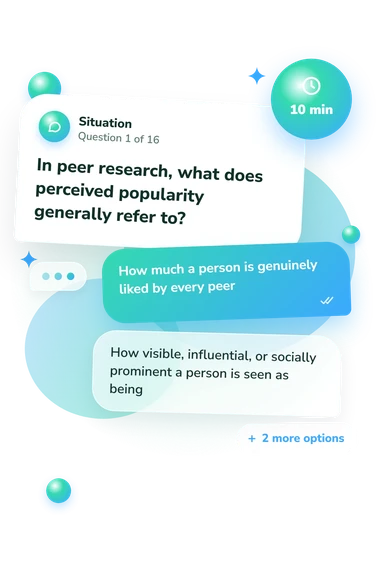
- How much a person is genuinely liked by every peer
- How visible, influential, or socially prominent a person is seen as being
- How many close and supportive friendships a person has
- How accurately a person understands group norms
- Homophily
- Reciprocity
- Deindividuation
- Social compensation
- Every member is directly connected to every other member
- All members follow the same informal leader
- One person has more connections than every other person
- The group has no connections to people outside it
Clique Quiz - Description and methodology of the test
Students, educators, and readers interested in peer relationships can use this assessment to build a clearer vocabulary for understanding how small groups form, exclude, cooperate, and influence behavior. The clique quiz focuses on concept recognition rather than personal labeling, making it suitable for connecting social-science ideas with familiar group situations. It also works as a clique knowledge test for classroom discussion, revision, or private reflection.
What This Assessment Explores
The questions examine peer-group boundaries, cohesion, influence, and social meaning. They distinguish visible popularity from genuine liking, similarity-based friendship from other processes, and cliques from crowds or broader friendship groups. Scenarios also cover norms, conformity, exclusion, relational aggression, bridging ties, out-group bias, and network structure.
This makes the assessment a practical way to review clique dynamics, with each item testing a meaningful distinction. The result reflects how accurately the respondent recognizes concepts and applies them to brief situations.
The main areas represented by the questions are:
- Clique Knowledge (0-16) places mastery of clique structure, peer dynamics, and inclusive group practices in Foundation (0-6), Developing (7-12), or Strong (13-16).
- Boundary and influence concepts show how well the respondent identifies membership rules, norms, conformity, popularity, and exclusion.
- Network and group concepts cover bridges, cohesion, the out-group homogeneity effect, and cross-group contact.
Methodology and Evidence Base
Each item presents a short definition or social situation with four answer choices. Selecting the best answer tests recognition and application of concepts rather than personal agreement with statements. The result is calculated from correct responses, so it describes educational performance on this questionnaire, not popularity or membership in a real-life group.
Its conceptual framework is consistent with Ellis and Zarbatany (2017) on peer clique influence, Cairns and colleagues (1995) on friendship networks, and the graph-based terminology described by Wasserman and Faust (1994). The questionnaire uses concepts consistent with these works, but it is not an adaptation, replication, or validation of any of them.
As an online clique assessment, it can show which distinctions the respondent currently understands and which ideas may need review. The result is a count of correct answers interpreted through the displayed performance bands, with no broader inference about the respondent’s real-life group status. Prior exposure to terminology, attention to wording, and completion context can affect performance, so the result works best as a focused learning signal and discussion starting point.
- Ellis, Wendy E., and Lynne Zarbatany. "Understanding Processes of Peer Clique Influence in Late Childhood and Early Adolescence." Child Development Perspectives 11, no. 4 (2017): 227-232. 10.1111/cdep.12248
- Cairns, Robert B., Man-Chi Leung, Lisa Buchanan, and Beverley D. Cairns. "Friendships and Social Networks in Childhood and Adolescence: Fluidity, Reliability, and Interrelations." Child Development 66, no. 5 (1995): 1330-1345. 10.1111/j.1467-8624.1995.tb00938.x
- Wasserman, Stanley, and Katherine Faust. Social Network Analysis: Methods and Applications. Cambridge University Press, 1994. 10.1017/CBO9780511815478
Updated: