
Codominance Quiz
How the Scales are Structured
Who Usually Takes This Test?
See How You Compare
Below is a preview of how scores are typically distributed across each scale.
Example Questions From the Test
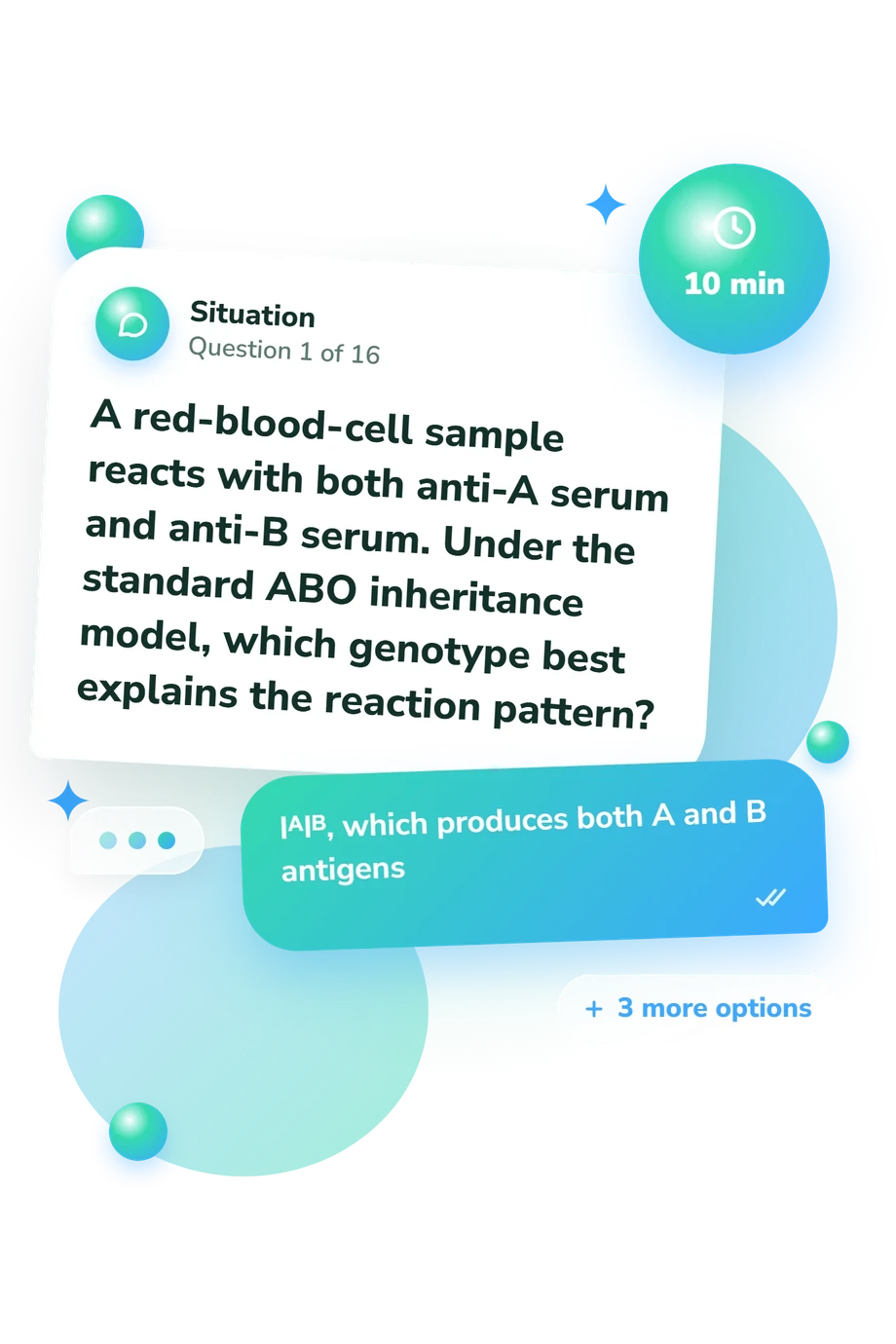
- IᴬIᴮ, which produces both A and B antigens
- ii, which produces neither A nor B antigen
- Iᴬi, which produces the A antigen but not the B antigen
- Iᴮi, which produces the B antigen but not the A antigen
- One allele completely masks the expression of the other allele.
- Both alleles in a heterozygote are distinctly expressed in the phenotype.
- The heterozygote displays an intermediate blend of the two homozygous phenotypes.
- Environmental conditions replace the effects of both inherited alleles.
- A uniform intermediate pink color
- White patches only
- Separate red and white patches
- Red patches only
Codominance Quiz - Description and methodology of the test
For students, teachers, and curious learners, this codominance quiz offers a focused way to examine whether allele-expression patterns are being interpreted correctly. Its comparisons with incomplete dominance help keep the distinction clear, while the result centers on recognizing both alleles in a heterozygote, connecting genotype with phenotype, and applying inheritance rules to familiar examples.
What This Assessment Explores
Here, codominance is treated as a genetics concept rather than a personal characteristic. Items ask whether the learner can recognize distinct expression of both alleles in a heterozygote and distinguish it from complete or incomplete dominance. Examples include ABO and MN blood groups, patterned flowers, roan cattle, feather color, molecular products, and inheritance crosses.
The questions move from identifying phenotypes to inferring genotypes, predicting offspring, and explaining evidence. A codominance assessment shows how well the concept transfers across biological situations.
The single result is Codominance Knowledge (0-16), interpreted through these bands:
- Foundations to Review (0-6) signals review of alleles, genotypes, and heterozygous phenotypes.
- Developing Understanding (7-12) reflects recognition in common examples, with some distinctions or crosses to revisit.
- Strong Understanding (13-16) reflects accurate identification and reasoning across inheritance scenarios.
It is educational, not a genetic assessment.
Methodology and Evidence Base
Each item presents a genetics scenario or comparison with four answer choices. The format asks the learner to select the best explanation, genotype, phenotype, probability, or contrast; the items therefore sample both conceptual recognition and application. The online codominance test reports one knowledge total, and the weighting of individual answers is not specified.
The Dominance Concept Inventory provides a relevant conceptual comparison because it addresses alternative conceptions about dominance and distinctions learners often confuse. The questionnaire is conceptually consistent with those distinctions, but it is not presented as an adaptation or standardized administration of that instrument.
Research on situational features in genetics assessment supports caution about interpreting genetics performance in isolation: wording and context can affect what an answer reveals. The displayed total reflects performance across recognition, comparison, and inheritance-application items. Familiarity with examples, recent instruction, and careful reading can influence the total. Population norms, reliability estimates, and clinical cutoffs are not specified for this online questionnaire.
- Strome, S., Bhalla, N., Kamakaka, R., Sharma, U., & Sullivan, W. (2024). Clarifying Mendelian vs non-Mendelian inheritance. Genetics, 227(3), iyae078. 10.1093/genetics/iyae078.
- Abraham, J. K., Perez, K. E., & Price, R. M. (2014). The Dominance Concept Inventory: A Tool for Assessing Undergraduate Student Alternative Conceptions about Dominance in Mendelian and Population Genetics. CBE-Life Sciences Education, 13(2), 349-358. 10.1187/cbe.13-08-0160.
- Schmiemann, P., Nehm, R. H., & Tornabene, R. E. (2017). Assessment of Genetics Understanding: Under What Conditions Do Situational Features Have an Impact on Measures? Science & Education, 26, 1161-1191. 10.1007/s11191-017-9925-z.
Updated: