
Economics Chapter 5 Quiz
How the Scales are Structured
Who Usually Takes This Test?
See How You Compare
Below is a preview of how scores are typically distributed across each scale.
Example Questions From the Test
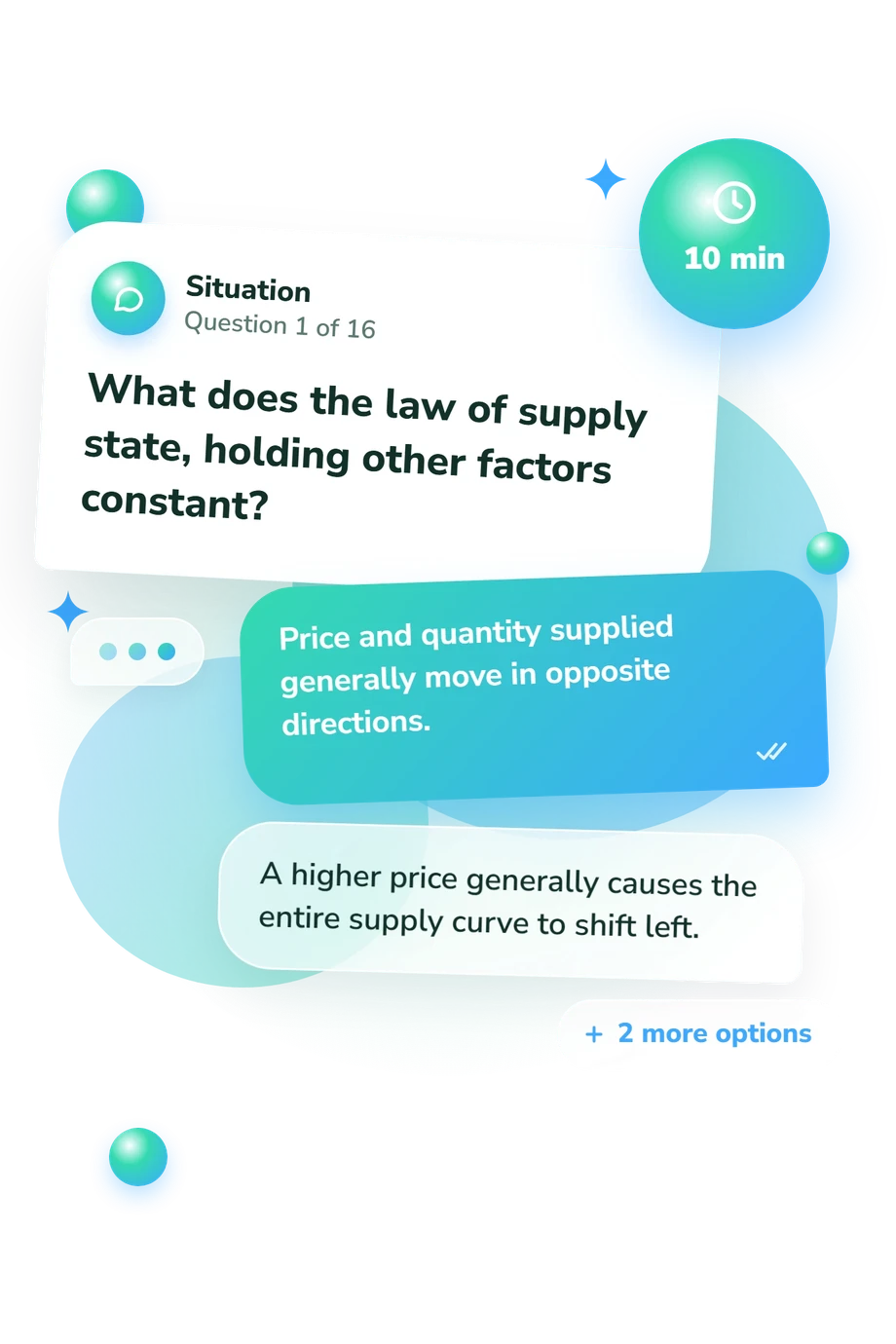
- Price and quantity supplied generally move in opposite directions.
- A higher price generally causes the entire supply curve to shift left.
- A lower price generally leads consumers to purchase a smaller quantity.
- A higher price generally leads producers to offer a greater quantity for sale.
- 5, so supply is inelastic over this change
- 10, because the two percentage changes should be subtracted
- 2, so supply is elastic over this change
- 30, because the two percentage changes should be added
- A decrease in consumers' income
- An increase in the market price of wooden tables
- An increase in the price of lumber used to make the tables
- An increase in consumer preference for metal furniture
Economics Chapter 5 Quiz - Description and methodology of the test
Students reviewing introductory supply analysis can use the Economics Chapter 5 Quiz as a focused knowledge check. It suits learners who want to connect price changes, production conditions, and market supply with sellers’ decisions. This supply economics quiz can show which concepts are secure and which need another pass before coursework or further study.
What This Assessment Explores
The questions distinguish quantity supplied from supply, own-price movements from shifts, and changes caused by costs, technology, taxes, subsidies, expectations, or new firms. Scenarios also cover shortages, market totals, and elasticity, making the questions useful for quantity supplied practice while the result remains an overall summary.
One scale reports Quantity Supplied Knowledge (0-16). Foundations to Review (0-6) signals ideas to revisit; Developing Command (7-12) indicates developing grasp, with additional practice useful for distinguishing price effects from shifts; Strong Command (13-16) indicates consistent application of supply concepts, including elasticity and market reasoning. These labels describe a study summary, not a course grade.
These are the main dimensions represented:
- Curve movement reasoning separates own-price changes from supply shifts.
- Supply shifters link non-price conditions to the correct direction.
- Market and elasticity reasoning interprets quantities, shortages, and percentage changes.
Methodology and Scientific Basis
Each item uses a single-best-answer multiple-choice format with four alternatives. The set progresses from definitions and law-of-supply reasoning to scenarios about shifters, price controls, market totals, and elasticity. Several questions about Chapter 5 economics require distinguishing a curve shift from movement along the curve, testing both terminology and application.
Scoring is the number correct, from 0 to 16. The category is a study summary rather than a measure of overall economics achievement.
Conceptually, the content is consistent with the supply-and-demand treatment in Greenlaw, Shapiro, and MacDonald’s textbook (Greenlaw et al., 2022), particularly its treatment of quantity supplied, supply shifts, and elasticity. The questionnaire is an online educational quiz rather than a standardized published instrument. Haladyna et al. (2002) provide a framework for considering multiple-choice construction, and the AERA, APA, and NCME standards support cautious interpretation of educational scores.
This online score is a study summary, not a norm-referenced measure, and should be interpreted alongside coursework and other evidence of understanding. Guessing, prior instruction, wording, and current study context can affect performance, so the result is best used as a focused checkpoint.
- Greenlaw, Steven A., David Shapiro, and Daniel MacDonald. Principles of Economics 3e, sections 3.1-3.2 and 5.1. OpenStax, 2022.
- Haladyna, Thomas M., Steven M. Downing, and Michael C. Rodriguez. “A Review of Multiple-Choice Item-Writing Guidelines for Classroom Assessment.” Applied Measurement in Education, vol. 15, no. 3, 2002, pp. 309-333. 10.1207/S15324818AME1503_5.
- American Educational Research Association, American Psychological Association, and National Council on Measurement in Education. Standards for Educational and Psychological Testing. Washington, DC: American Educational Research Association, 2014.
Updated: