
Dr. Oz Age Quiz
How the Scales are Structured
Who Usually Takes This Test?
See How You Compare
Below is a preview of how scores are typically distributed across each scale.
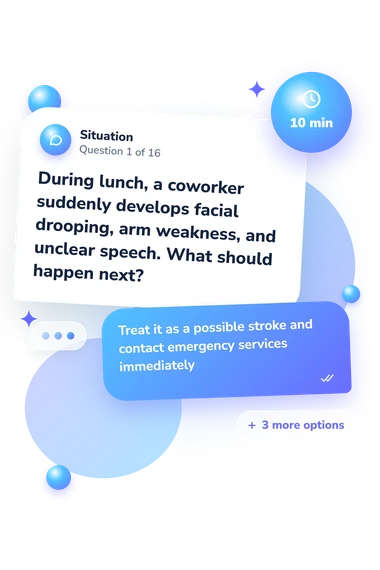
Example Questions From the Test
- Treat it as a possible stroke and contact emergency services immediately
- Offer food and encourage the person to sleep
- Wait until the end of the day to see whether the symptoms settle
- Ask the person to drive home and arrange a routine appointment
- Ignore the stress unless it produces a physical symptom
- Make several extreme lifestyle changes at once
- Use manageable strategies such as movement, relaxation, sleep routines, or support from others
- Assume feeling stressed means permanent physical damage has occurred
- Break up long periods of sitting with brief standing or movement when practical
- Stay seated throughout the day to conserve energy for workouts
- Replace every seated task with vigorous exercise
- Assume planned exercise removes every possible effect of prolonged sitting
Dr. Oz Age Quiz - Description and methodology of the test
Readers who want to examine prevention, everyday habits, and healthy-aging concepts can use this questionnaire as a focused starting point. The dr oz age quiz covers sleep, movement, screening, tobacco, food, and social connection. As a healthy aging assessment, it addresses these topics through practical situations. It suits people who want to consider how everyday health guidance applies to common situations.
What This Assessment Explores
Questions ask the respondent to recognize healthy-aging principles involving urgent responses, prevention, daily routines, and decisions shaped by personal history or context. As a healthy aging quiz, it measures knowledge rather than symptoms, personality, or biological age.
The result summarizes these areas:
- Healthy Aging Knowledge runs from 0-16; Foundations to Build covers 0-6, Developing Knowledge 7-12, and Strong Knowledge 13-16, with the score reflecting correct answers about the concepts covered.
- Emergency and preventive judgment forms an unscored thematic group about whether warning signs and screening choices receive appropriate urgency.
- Daily habits and context form another unscored thematic group about how sleep, movement, food, risk factors, family history, and social connection are understood without fixed predictions.
A higher result means more accurate answers within this educational content, while lower performance identifies concepts to revisit.
Methodology and Evidence Base
Each item presents a brief scenario or health question with four answer choices. Selecting the option that best matches general guidance produces an aggregate of correct responses. This knowledge-based self-report format depends on attention, prior learning, and applying broad advice to a situation.
The closest conceptual source is Healthy Ageing Quiz (Cyarto et al., 2013), a published knowledge measure for healthy-aging education. The World Health Organization report supplies a public-health framework covering prevention, function, activity, sleep, relationships, and risk reduction. Palmore's short aging quiz offers an earlier model for testing factual beliefs about aging. This questionnaire is conceptually consistent with those works and is not an adaptation of any one of them.
This educational healthy aging questionnaire is a learning profile: missed topics can guide further reading or a focused clinical conversation. The bands are educational categories rather than population norms or medical cutoffs, and the unvalidated score cannot determine health status or future disease. Readers can review the relevant health guidance and consider how current circumstances, self-awareness, and familiarity with health advice shaped their answers.
- Cyarto, Elizabeth V., Briony Dow, Freda Vrantsidis, and Claudia Meyer. “Promoting healthy ageing: development of the Healthy Ageing Quiz.” Australasian Journal on Ageing 32, no. 1 (2013): 15-20. 10.1111/j.1741-6612.2011.00585.x
- World Health Organization. World report on ageing and health. Geneva: World Health Organization, 2015. ISBN: 9789241565042
- Palmore, Erdman. “Facts on Aging: A Short Quiz.” The Gerontologist 17, no. 4 (1977): 315-320. 10.1093/geront/17.4.315
Updated: