
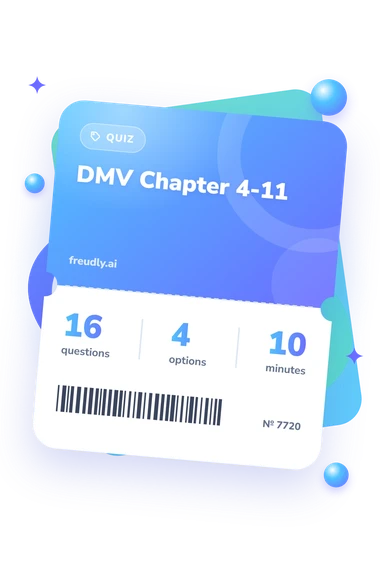
DMV Chapter 4-11 Quiz
How the Scales are Structured
Who Usually Takes This Test?
See How You Compare
Below is a preview of how scores are typically distributed across each scale.
Example Questions From the Test
- Continue if the pedestrian is walking slowly
- Sound the horn so the pedestrian pauses
- Stop and yield until the pedestrian is safely clear of your path
- Drive around the pedestrian using the open lane
- Look directly at the headlights so you can track the vehicle
- Close one eye until the vehicle has passed
- Look toward the right edge of your lane while slowing as needed
- Watch the center line continuously and maintain speed
- Yield to traffic already on the road
- Come to a complete stop and proceed only when permitted
- Do not enter from this direction
- Slow down because a hazard is ahead
DMV Chapter 4-11 Quiz - Description and methodology of the test
Drivers and learners who want a broad view of handbook knowledge can use this assessment to gauge general understanding of road rules. The DMV Chapter 4 11 Quiz gives one overall indication of knowledge across common driving principles. It works as a DMV handbook quiz, connecting handbook concepts with situations and rules encountered during study.
What This Assessment Explores
These questions examine rules in driving situations. Many ask for the safest or most accurate response; others test signs, lane markings, seat-belt fit, and alcohol effects. Topics include pedestrians, impairment, fatigue, visibility, control, vulnerable road users, and emergencies. The DMV chapter 4 quiz emphasizes safe judgment over isolated recall.
DMV Chapters Four Through Eleven Knowledge spans 0-16. Foundation Needed (0-6) means careful review is required before an official knowledge test; Developing Knowledge (7-12) indicates many core rules are understood with gaps worth revisiting; Strong Knowledge (13-16) shows a solid grasp of the tested concepts.
Four themes organize the questions:
- Traffic control and right-of-way cover signs, crossings, lanes, and turns.
- Hazard management covers glare, fog, skids, hydroplaning, and blowouts.
- Risk awareness covers alcohol, fatigue, and unsafe freeway choices.
- Shared-road protection covers motorcycles, cyclists, emergency vehicles, and seat belts.
Methodology and Scientific Basis
This multiple-choice check presents scenarios with four answer choices. Many ask for the safest or most accurate response, linking rules to glare, a blowout, a closed crossing, or a nearby cyclist. It is useful as DMV knowledge test practice but remains focused on handbook-style decisions.
Scoring produces one displayed total interpreted through the result bands. The result is not an official state examination, and state laws or chapter structures may vary, so confirm operational rules in the current state handbook. Results can reflect reading accuracy, attention, prior study, and current judgment.
Handbook guidance broadly covers the topics, including traffic control, defensive driving, impairment, and emergencies. The questionnaire is conceptually consistent with that guidance, not an adaptation of it. The 2023 New York State DMV handbook (MV-21) is a comparable example rather than its source. Conley and Smiley examined licensing tests and later violations, while McKnight and Edwards evaluated driver manuals and written tests. These studies add context about handbook learning, written testing, and driving outcomes.
- New York State Department of Motor Vehicles. New York State Driver's Manual (MV-21), May 2023. Albany, NY: New York State Department of Motor Vehicles, 2023.
- Conley, John A., and Russell Smiley. "Driver Licensing Tests as a Predictor of Subsequent Violations." Human Factors 18, no. 6 (1976): 565-573. 10.1177/001872087601800604
- McKnight, A. James, and Richard Edwards. "An Experimental Evaluation of Driver License Manuals and Written Tests." Accident Analysis & Prevention 14, no. 3 (1982): 187-192. 10.1016/0001-4575(82)90027-6