
Christmas Brain Teasers Quiz
How the Scales are Structured
Who Usually Takes This Test?
See How You Compare
Below is a preview of how scores are typically distributed across each scale.
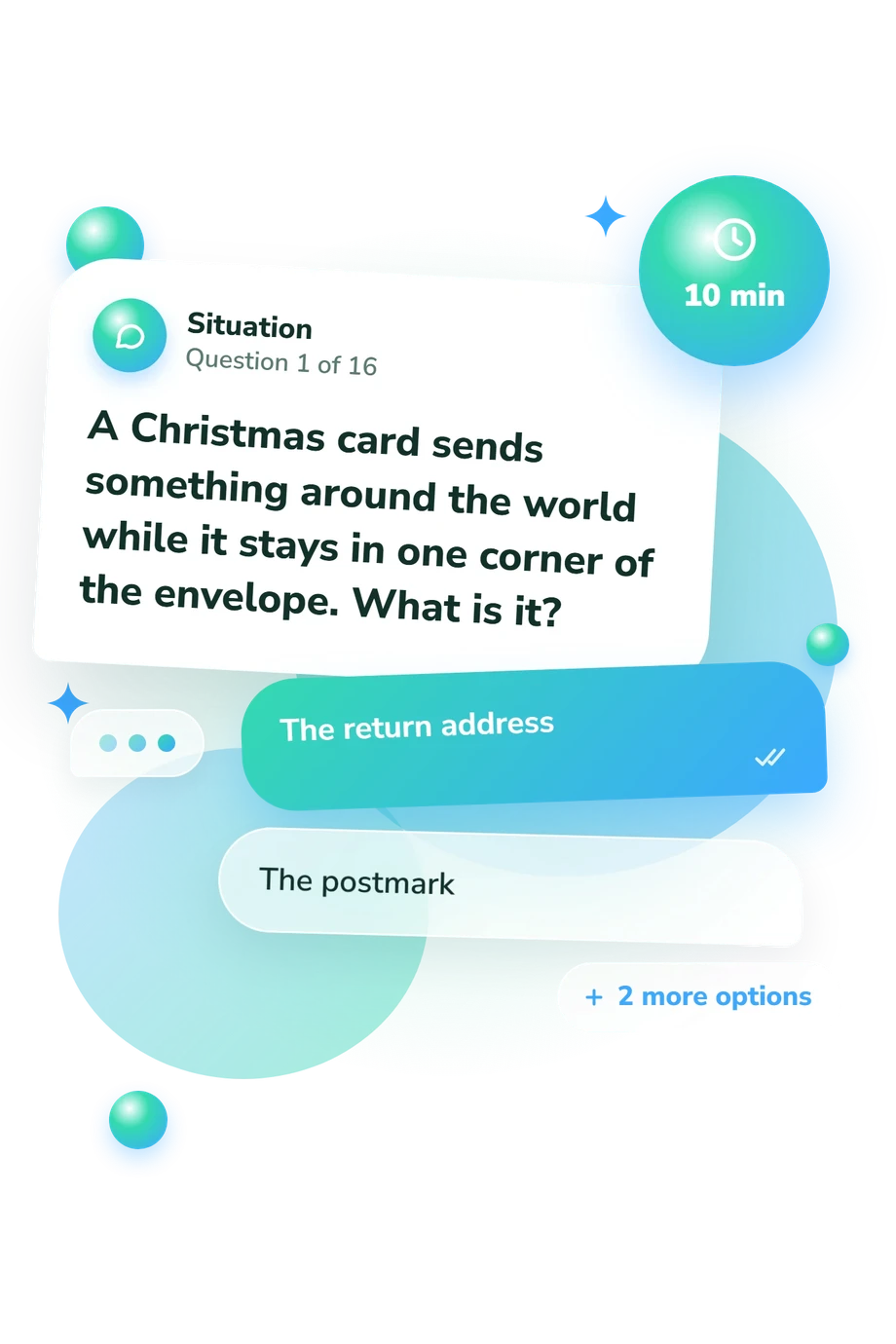
Example Questions From the Test
- The return address
- The postmark
- The card's message
- A postage stamp
- 26
- 25
- 27
- 28
- Two fathers who share one stocking with their sons
- A grandfather, his son, and his grandson
- A father, his son, and his son's friend
- Two brothers and one of their fathers
Christmas Brain Teasers Quiz - Description and methodology of the test
Readers who enjoy festive puzzles can use this assessment to see how they handle patterns, deductions, calculations, and wordplay. A christmas riddle quiz element is only one part of this broader set, which also includes logic, spatial, calendar, and timing tasks. The result describes performance on these items, not stable reasoning or general-knowledge ability. Reviewing christmas brain teasers quiz answers can support self-reflection about careful reading and problem-solving choices.
What This Assessment Explores
Questions use several routes to a solution rather than one school subject. Festive scenarios ask you to recognize sequences, apply conditions, combine quantities, track positions, interpret timing, and notice how wording changes a problem.
Across the Christmas brain teaser questions, the formats contributing to the score include:
- Pattern and sequence questions ask you to identify numerical or ordered relationships in individual items.
- Logical deduction questions require you to follow stated conditions without adding assumptions.
- Calculation, spatial, and timing questions involve quantities, distances, intervals, and arrangements.
- Wordplay and familiar-fact questions ask you to interpret language or recall information for a clue.
The displayed result is Christmas Brain Teasers Knowledge, scored from 0-16: Festive Starter (0-6), Developing Solver (7-12), and Brain-Teaser Ace (13-16). These labels describe performance on this quiz, not general intelligence. It is a focused snapshot of how this set was handled, not a measure of stable reasoning or general knowledge.
Methodology and Evidence Base
Each item presents a prompt with four answer choices, and the respondent selects the option that best solves it. One point is awarded for each correct answer, so the total summarizes performance across the set rather than converting responses through adaptive testing or population norms. The brain teaser questions combine formats, so one total can reflect uneven performance across patterns, deductions, calculations, spatial tasks, timing, and wordplay.
The closest conceptual anchor is Cognitive Illusions by Bruckmaier and colleagues, which examines reasoning problems where intuitive responses can conflict with deliberate analysis. This questionnaire is conceptually consistent with that work, not an adaptation of its tasks. Webb’s work is relevant to insight across task types, and Mercier’s study helps explain why riddles can make effortful thinking engaging.
These papers provide relevant conceptual background for some puzzle types, but they do not validate this quiz or establish its measurement properties. The questionnaire has no reported standardization, reliability, or population norms. Interpret the result within its displayed performance bands: prior familiarity with riddles, language sensitivity, attention, and guessing can influence an attempt.
- Bruckmaier, Georg, Stefan Krauss, Karin Binder, Sven Hilbert, and Martin Brunner. “Tversky and Kahneman’s Cognitive Illusions: Who Can Solve Them, and Why?” Frontiers in Psychology 12 (2021): 584689. 10.3389/fpsyg.2021.584689
- Webb, Margaret E., Daniel R. Little, and Simon J. Cropper. “Insight Is Not in the Problem: Investigating Insight in Problem Solving across Task Types.” Frontiers in Psychology 7 (2016): 1424. 10.3389/fpsyg.2016.01424
- Mercier, Marius, Alexis Garsmeur, and Hugo Mercier. “The Appeal of Insight: Why Riddles and Whodunits Captivate Us.” Psychology of Aesthetics, Creativity, and the Arts, advance online publication (2025). 10.1037/aca0000773
Updated: