
Celebrity Silhouettes Quiz
How the Scales are Structured
Who Usually Takes This Test?
See How You Compare
Below is a preview of how scores are typically distributed across each scale.
Example Questions From the Test
- Cher
- Dolly Parton
- Tina Turner
- Reba McEntire
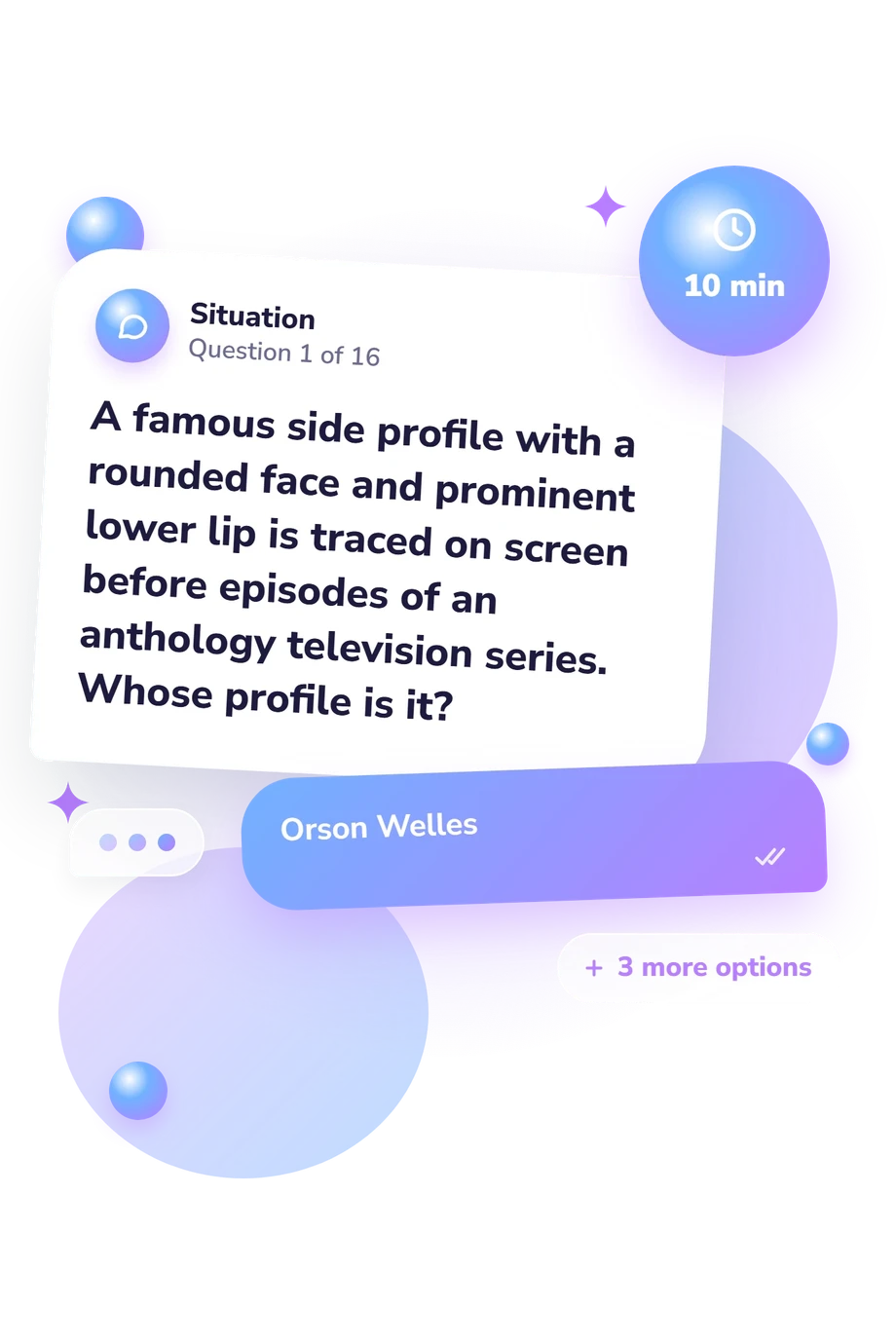
- Orson Welles
- Stanley Kubrick
- Alfred Hitchcock
- Walt Disney
- Prince
- Michael Jackson
- Usher
- George Michael
Celebrity Silhouettes Quiz - Description and methodology of the test
Designed for visitors who want to test recognition of famous performers, the ch 62 listening quiz turns combined visual and career clues into a short cultural-knowledge exercise. As a celebrity identification quiz, it suits anyone curious about how costume, posture, props, profile, or a career reference brings a celebrity to mind. The result indicates overall performance: higher levels reflect more accurate identification across these clue types.
What This Assessment Explores
These items measure public-figure recognition through visual and biographical cues. They ask visitors to connect an outline or written silhouette with a performer, actor, athlete, or musician. This assessment measures celebrity silhouette recognition when a face is absent.
Clues span music, film, television, sport, and stage performance. Costumes, props, gestures, roles, albums, and career associations offer routes to one identity. The task examines cultural knowledge and identification accuracy.
The result is reported on the Celebrity Silhouettes Knowledge scale with these bands:
- Starting Spotter (0-6) indicates recognition of some major icons, while signature outlines and career clues may blend together.
- Developing Identifier (7-12) shows many distinctive details connect with the right celebrities, although unfamiliar eras or fields may remain harder.
- Silhouette Expert (13-16) reflects consistent use of outline, costume, prop, and career clues to identify cultural icons accurately.
Methodology and Evidence Base
Across the questionnaire, each item presents a silhouette clue followed by four answer choices. The four-option format makes this celebrity knowledge assessment a forced-choice recognition task: the respondent selects the celebrity whose outline and supporting detail fit best. The questionnaire displays a 0-16 scale with the listed bands, but its item-to-score rule and standardization are not stated.
Related context comes from the Famous Faces Doppelgänger Test, a published measure of familiar-face recognition. That instrument addresses face recognition, whereas this questionnaire combines silhouettes with costume, prop, role, music, and career clues. The cited work therefore does not validate this online item set or establish its framework. The online item set has no cited validation study. Stone and Valentine’s account of famous-person knowledge as categorically organized, and research by Russell, Duchaine, and Nakayama, provide broader context for recognition differences.
Results describe performance on the presented clues, not a percentile or stable estimate of general memory. Cultural exposure, era familiarity, attention, and guessing can affect the outcome, while a career reference may compensate for a less recognizable silhouette.
- Pozo, Emilia, Laura T. Germine, Luke Scheuer, and Roger W. Strong. “Evaluating the Reliability and Validity of the Famous Faces Doppelgangers Test, a Novel Measure of Familiar Face Recognition.” Assessment 30, no. 4 (2023): 1200-1210. 10.1177/10731911221087746
- Stone, Anna, and Tim Valentine. “The Categorical Structure of Knowledge for Famous People (and a Novel Application of Centre-Surround Theory).” Cognition 104, no. 3 (2007): 535-564. 10.1016/j.cognition.2006.07.014
- Russell, Richard, Brad Duchaine, and Ken Nakayama. “Super-Recognizers: People with Extraordinary Face Recognition Ability.” Psychonomic Bulletin & Review 16, no. 2 (2009): 252-257. 10.3758/PBR.16.2.252
Updated: