
Catcher in the Rye Quiz
How the Scales are Structured
Who Usually Takes This Test?
See How You Compare
Below is a preview of how scores are typically distributed across each scale.
Example Questions From the Test
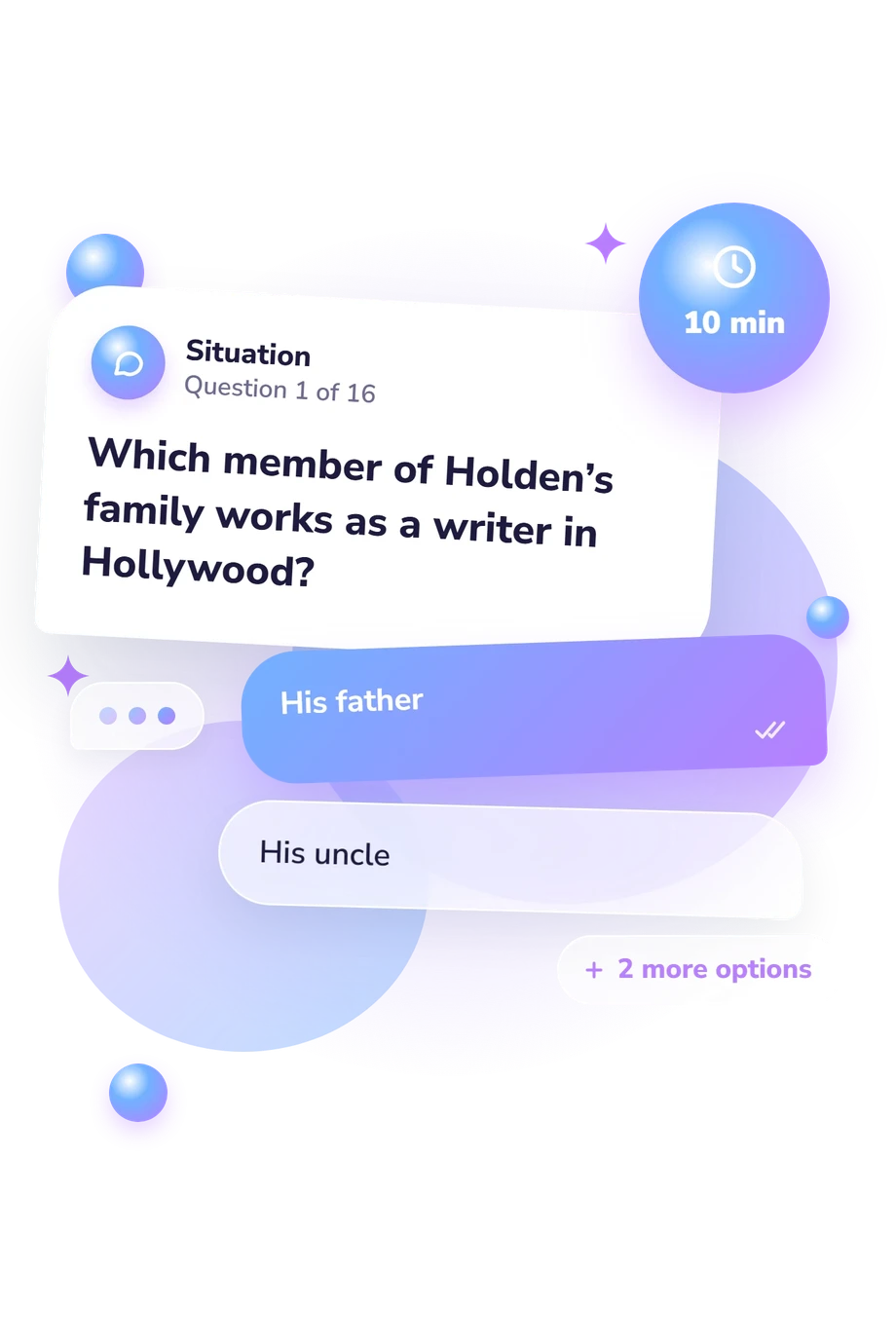
- His father
- His uncle
- His younger brother, Allie
- His older brother, D. B.
- Mr. Vinson
- Mr. Antolini
- Mr. Spencer
- Mr. Haas
- Swans
- Turtles
- Ducks
- Geese
Catcher in the Rye Quiz - Description and methodology of the test
Readers returning to Salinger’s novel may use this Catcher in the Rye book quiz to see whether a reread would refresh grasp of the story. It suits students, book-club members, teachers, and anyone preparing for discussion. Despite the celebrities real names quiz label, its literary-knowledge result can highlight details worth revisiting and provide prompts for conversation, with a higher score reflecting stronger knowledge of the novel.
What This Test Measures
This assessment checks factual recall rather than literary interpretation or personal identification with Holden. Its items cover family relationships, school life, New York episodes, remembered details, the title’s poetic source, and events shaping the ending. The result shows how much narrative information you recognize from the novel.
The questions test recognition of fictional identities through their roles, relationships, and actions. Readers seeking Catcher in the Rye trivia can use the quiz before a reread, class discussion, or book-club conversation.
One scale, The Catcher in the Rye Knowledge, ranges from 0-16 points:
- Starting the Story (0-6) means you recognize some elements but may benefit from rereading names and events.
- Developing Reader (7-12) shows solid grasp with room to sharpen less prominent relationships and details.
- Canon Confident (13-16) reflects strong knowledge of characters, settings, and major events.
Methodology and Evidence Base
Methodologically, this is a multiple-choice literary-recall exercise. Every item offers four answer choices, and the respondent selects the detail that matches the novel, such as its narrator, Holden’s school, Jane’s checkers habit, or Phoebe’s final ride. The displayed result counts correct answers rather than personality traits.
The quiz draws its literary content directly from Salinger’s novel. Pinsker and Pinsker add contextual discussion of its issues, sources, and historical setting, while Bickmore and Youngblood address Holden’s continuing relevance in literary and educational discussion. These works provide literary content and context for the questions.
That structure keeps the Catcher in the Rye knowledge test focused on literary recall rather than personality traits.
Interpret the result as a literary-knowledge score: a high score signals strong recall of characters, settings, and major events, while a lower score may reflect time since reading, attention to minor details, or uncertainty between plausible options. The outcome is unofficial literary trivia and is not endorsed by Salinger’s estate or publisher.
- Salinger, J. D. The Catcher in the Rye. Boston: Little, Brown and Company, 1951.
- Pinsker, Sanford, and Ann Pinsker. Understanding The Catcher in the Rye: A Student Casebook to Issues, Sources, and Historical Documents. Westport, CT: Greenwood Press, 1999.
- Bickmore, Steven T., and Kate Youngblood. “It’s The Catcher in the Rye… He said it was the kind of book you made your own”: Finding Holden in Contemporary YA Literature. English in Education 48, no. 3 (2014): 250-263. 10.1111/eie.12049
Updated: