
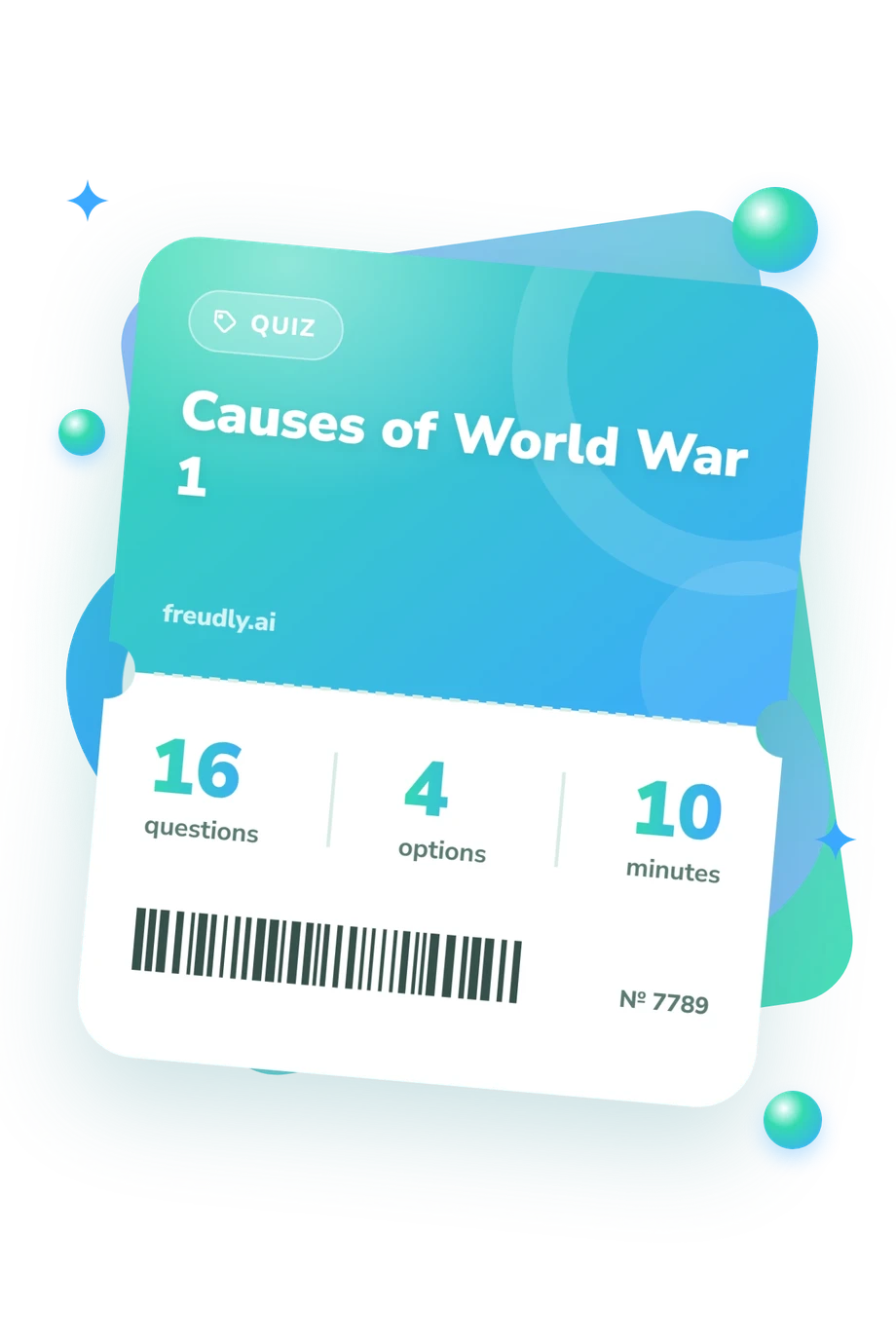
Causes of World War 1 Quiz
How the Scales are Structured
Who Usually Takes This Test?
See How You Compare
Below is a preview of how scores are typically distributed across each scale.
Example Questions From the Test
- Serbia sought to restore direct Ottoman rule over the Balkans
- Serbian leaders campaigned to expand British naval power in the Mediterranean
- Austria-Hungary promoted the creation of a unified German nation under Serbian leadership
- South Slav nationalist ambitions challenged Austria-Hungary’s control over populations in the region
- Signing a new alliance with the Ottoman Empire
- Ordering general mobilization of its armed forces
- Occupying Bosnia and Herzegovina
- Sending troops through Belgium toward France
- The outbreak of the First Balkan War
- The First Moroccan Crisis over French influence in Morocco
- The annexation of Bosnia and Herzegovina by Austria-Hungary
- The assassination of Archduke Franz Ferdinand in Sarajevo
Causes of World War 1 Quiz - Description and methodology of the test
Students, teachers, and curious readers can use this assessment to connect the political tensions, alliances, and decisions that carried Europe into World War I. The Causes of World War I Quiz is a focused history knowledge check, not a personality exercise. The celebrity moustache quiz format emphasizes historical understanding. As a World War I history quiz, it helps readers identify secure foundations and topics that need review.
What This Assessment Explores
Rather than testing isolated dates alone, the questionnaire asks how readers connect long-term pressures with decisions in 1914. It covers South Slav nationalism, Austria-Hungary’s tensions, militarism, imperial rivalry, alliances, mobilization, and the escalation from Sarajevo to wider war. As a quiz about the causes of World War I, it links structural conditions with the immediate sequence of choices.
The result is reported on one scale, Causes of World War I Knowledge (0-16), with three interpretive bands:
- Foundations to build (0-6) indicates recognition of some key people or events while pointing to review of long-term causes and the July Crisis.
- Developing knowledge (7-12) shows understanding of major causes, with possible gaps in chronology or causal detail.
- Strong knowledge (13-16) reflects a well-developed grasp of underlying tensions and immediate escalation.
These bands summarize performance on this questionnaire rather than settling historical debates.
Methodology and Evidence Base
Each item uses a four-option multiple-choice format. The alternatives test recognition, chronology, causal links, and counterfactual reasoning rather than personal opinion. Performance is reported on the displayed scale and interpreted through the result bands, so the score summarizes the selected questions rather than claiming a broader measure of historical knowledge.
The historical framework is conceptually consistent with Joll and Martel (2007), whose treatment supports the focus on long-term tensions alongside immediate causes. Otte’s 2014 account is relevant to questions about the ultimatum, mobilization, the blank cheque, and the movement from a confrontation toward general war. Hamilton and Herwig’s 2003 volume supports the treatment of interacting causes and competing interpretations. These works provide historical context; the online questionnaire is not presented as an adaptation of one instrument.
This World War I causes test is an online knowledge tool. Historical causation remains open to interpretation, so the score should not be treated as a definitive judgment about this historically debated subject. A strong band shows command of this quiz’s framework; a lower band identifies topics for review rather than measuring historical ability.
- James Joll and Gordon Martel. The Origins of the First World War. 3rd ed. Harlow: Pearson Longman, 2007.
- T. G. Otte. July Crisis: The World's Descent into War, Summer 1914. Cambridge: Cambridge University Press, 2014. 10.1017/CBO9781107587878.
- Richard F. Hamilton and Holger H. Herwig, eds. The Origins of World War I. Cambridge: Cambridge University Press, 2003. 10.1017/CBO9780511550171.
Updated: