
Chemical Formula Practice Quiz
How the Scales are Structured
Who Usually Takes This Test?
See How You Compare
Below is a preview of how scores are typically distributed across each scale.
Example Questions From the Test
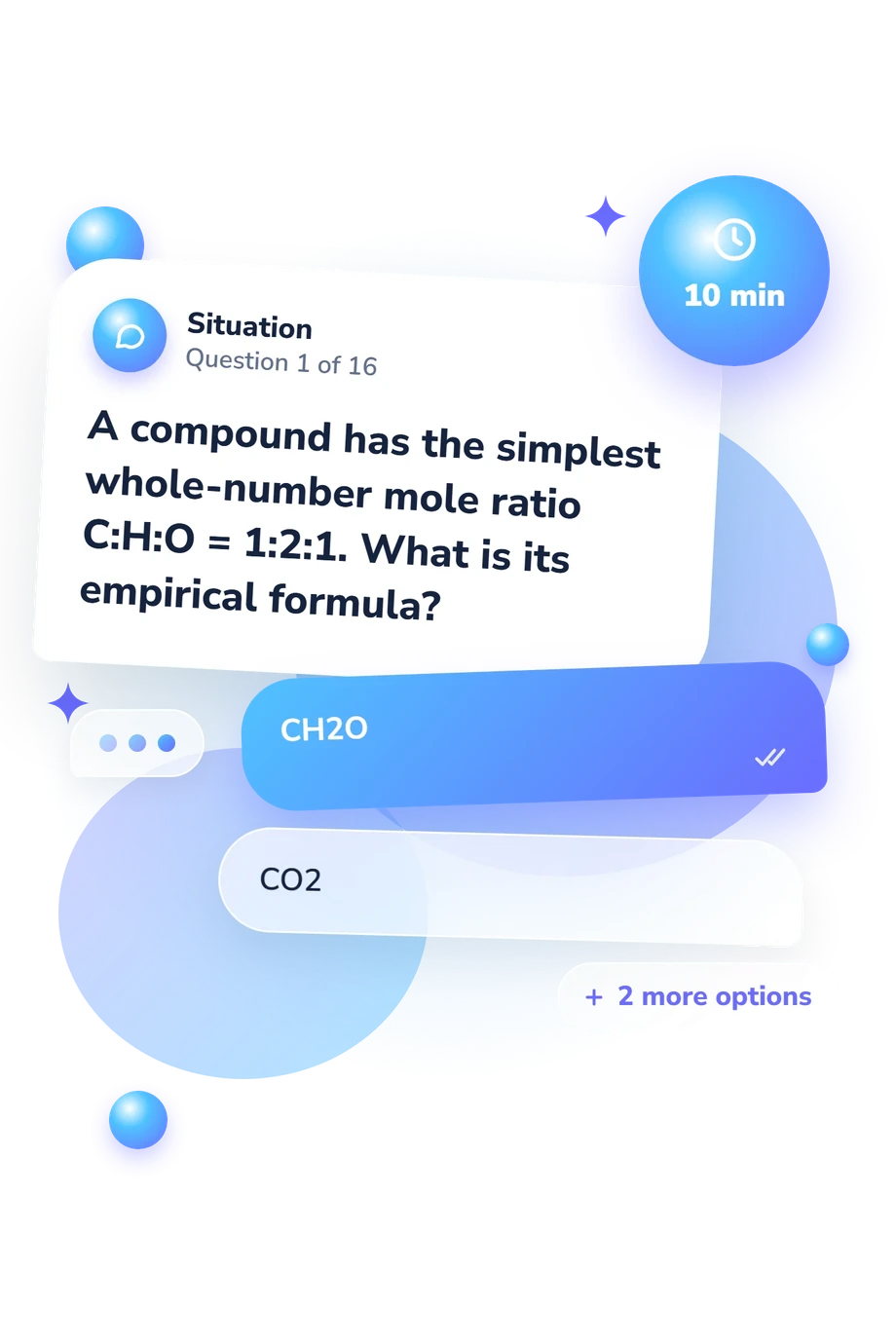
- CH2O
- CO2
- CHO
- C2H4O2
- A charge of 1+
- A charge of 2+
- A charge of 3+
- A charge of 6+
- NH4SO4, containing one ammonium ion per sulfate ion
- (NH4)2(SO4)2, containing two of each ion
- NH4(SO4)2, containing one ammonium ion and two sulfate ions
- (NH4)2SO4, containing two ammonium ions per sulfate ion
Chemical Formula Practice Quiz - Description and methodology of the test
Students who want to check their command of introductory chemical notation can use this chemical formula practice quiz as a focused step before homework, lab preparation, or review. It is intended for learners who need to connect compound names with ions, subscripts, coefficients, and ratios rather than rely on memorized formulas alone. In practice, this chemistry formula quiz helps identify which kinds of formula reasoning deserve more attention.
What This Assessment Explores
This assessment examines how learners interpret and construct formulas in chemistry. It covers empirical formulas, ionic compounds, covalent prefixes, hydrates, acids, and atom counting. The tasks test charge neutrality, ratio reduction, grouped ions, and translation between names and symbols.
As a chemical formula test, the result helps select practice topics rather than judge overall chemistry ability. It groups the content as follows:
- Chemical Formula Knowledge: 0-16 - this scale summarizes the conventions: Foundations to review (0-6) calls for work on notation and charges; Developing command (7-12) shows partial control; Strong command (13-16) shows consistent handling of examples.
- Ratio reduction and empirical formulas show whether composition is expressed in the simplest whole-number relationship.
- Charge balance and ionic composition show whether ions are combined in neutral proportions.
- Notation and atom counting show whether subscripts, coefficients, parentheses, prefixes, and hydrate dots are read correctly.
Methodology and Evidence Base
Across the item set, each question offers four answer choices built around a defined chemistry situation. The chemical formula questions ask learners to select the formula or interpretation that fits stated ions, prefixes, ratios, or notation. The result summarizes performance across the selected responses, not every chemistry skill.
Taskin and Bernholt (2014) provide the closest conceptual reference: their review connects chemical formula learning with symbolic representations, quantitative relationships, and movement between chemical language and notation. The OpenStax text supports the conventions for charges, formulas, hydrates, acids, and molecular prefixes. The questionnaire is conceptually consistent with these sources, not a direct adaptation or validation study based on them.
Taskin, Bernholt, and Parchmann (2015) are relevant because their inventory examines knowledge of chemical representations, but it does not establish psychometric properties for this online practice set. The result is presented as a practice summary rather than a norm-referenced proficiency certification. Familiarity with similar exercises, careless reading, or knowledge gaps outside these topics can affect performance, so one result cannot represent broader chemistry knowledge.
- Taskin, Vahide, and Sascha Bernholt. Students’ Understanding of Chemical Formulae: A Review of Empirical Research. International Journal of Science Education, vol. 36, no. 1, 2014, pp. 157-185. 10.1080/09500693.2012.744492
- Flowers, Paul, Klaus Theopold, Richard Langley, and William R. Robinson. Chemistry 2e. Houston, TX: OpenStax, 2019.
- Taskin, Vahide, Sascha Bernholt, and Ilka Parchmann. An Inventory for Measuring Student Teachers’ Knowledge of Chemical Representations: Design, Validation, and Psychometric Analysis. Chemistry Education Research and Practice, vol. 16, no. 3, 2015, pp. 460-477. 10.1039/C4RP00214H
Updated: