
Cheugy Quiz
How the Scales are Structured
Who Usually Takes This Test?
See How You Compare
Below is a preview of how scores are typically distributed across each scale.
Example Questions From the Test
- A mural created by a local artist for the neighborhood
- A worn wooden table inherited from the owner’s grandparents
- Plain ceramic mugs selected for durability
- A rose-gold script sign reading “Good Vibes Only”
- A deliberately fake luxury accessory
- A trend that disappears before reaching mainstream popularity
- A person perceived as embodying cheugy taste or behavior
- A social-media post that revives an old meme
- Tumblr
- TikTok
Cheugy Quiz - Description and methodology of the test
Designed for readers who want to understand a culturally loaded internet label rather than use it as a blunt insult, the cheugy quiz tests recognition of meaning, history, and context. As a how cheugy are you quiz, this questionnaire asks how well you distinguish dated style from parody, intent, and personal taste. The result describes your understanding of the term, not a fixed judgment about the person taking it.
What This Assessment Explores
Context determines cheugy meaning more than age or popularity alone. Questions contrast it with “basic” taste, compare sincere presentation with parody, and show how clothing, slogans, décor, and branding evoke a period. They also test history and why a style label does not establish the wearer’s age or character.
The single result draws on four areas:
- Meaning and distinctions show whether you separate cheugy from basic or merely unpopular.
- Context and intent show whether sincerity, irony, audience, and trend cycles alter interpretation.
- Cultural history shows whether you recognize the term’s earlier circulation and 2021 attention.
- Thoughtful interpretation shows you understand the label as subjective, not a verdict on a person.
Cheugy Knowledge is reported on a 0-16 scale: Starting Out (0-6), Developing (7-12), and Cheugy-Savvy (13-16). These bands describe demonstrated understanding of the term’s subjectivity, history, and dependence on context.
Methodology and Evidence Base
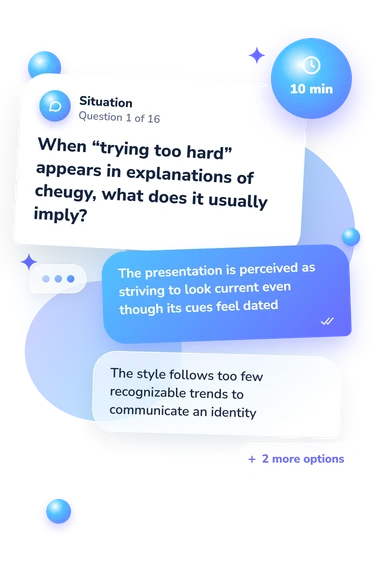
Each item presents a short scenario or definition with four answer choices. The respondent selects the option that best fits the term’s use, attending to context rather than a rigid checklist. This makes the assessment a cheugy culture quiz, not a personality measure: it tests cultural interpretation, not a person’s wardrobe or décor.
The result condenses performance into one displayed knowledge score. Higher displayed results indicate stronger understanding of the concept, history, and usage represented by the items; they do not establish whether the respondent is cheugy.
The questionnaire is conceptually consistent with a published study examining cheugy’s emergence, meanings, and usage, but it is not presented as an adaptation of that study. Public accounts of the term’s circulation connect it with style, performance, and generational interpretation.
This online knowledge questionnaire is not presented as a standardized psychometric instrument. Familiarity with internet culture, subjective wording, and changing trends can affect performance, so the score is best treated as a snapshot of understanding rather than a permanent identity label.
- Zimmer, Benjamin; Wright, Kelly E.; Hughes, Brianne; and Carson, Charles E. “Among the New Words.” American Speech, vol. 97, no. 3, 2022, pp. 412-428. 10.1215/00031283-10096035
- Lorenz, Taylor. “What Is ‘Cheugy’? You Know It When You See It.” The New York Times, April 29, 2021.
- Hobbs, Julia. “What Does ‘Cheugy’ Style Really Mean? Vogue Dissects the Gen-Z Term.” British Vogue, June 4, 2021.
Updated: