
Christmas Book Quiz
How the Scales are Structured
Who Usually Takes This Test?
See How You Compare
Below is a preview of how scores are typically distributed across each scale.
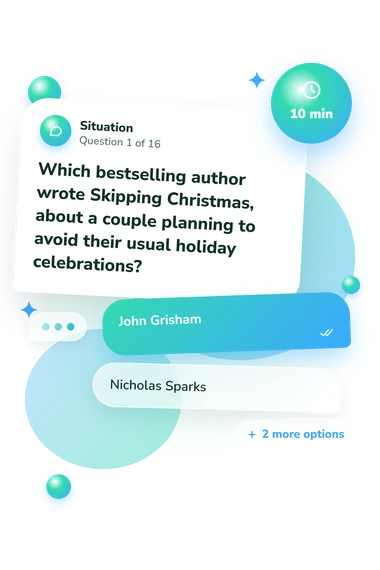
Example Questions From the Test
- John Grisham
- Nicholas Sparks
- David Baldacci
- James Patterson
- Anne of Green Gables
- What Katy Did
- Little Women
- The Railway Children
- The Adventure of the Speckled Band
- The Adventure of the Beryl Coronet
- The Adventure of the Copper Beeches
- The Adventure of the Blue Carbuncle
Christmas Book Quiz - Description and methodology of the test
Designed for readers who enjoy Christmas books, the Christmas Book Quiz offers a focused way to answer christmas book quiz questions about authors, titles, characters, and memorable holiday scenes. It also works as a Christmas in literature quiz for curious adults, students, families, and book-club members who want a light knowledge challenge and ideas for further seasonal reading.
What This Assessment Explores
The questionnaire measures recall of Christmas books and literature, not reading speed, personal taste, or emotional response. Items ask you to connect writers with books, identify titles from plots, and remember details from Christmas books for children and adults. Some also test familiarity with seasonal figures and classic narrative situations.
The result uses one scale, Christmas Book Knowledge (0-16), with these bands:
- Emerging Reader (0-6) shows partial recognition and leaves many author-story connections to explore.
- Developing Expert (7-12) reflects solid knowledge of familiar Christmas books while allowing room to strengthen less familiar details.
- Christmas Literature Expert (13-16) indicates broad accuracy across famous writers, classics, mysteries, and children’s favorites.
A higher score means stronger performance on these literary facts, not superior taste or appreciation. Christmas book trivia is treated as a structured recall task, so an unfamiliar title can affect the result even when its themes are understood.
Methodology and Evidence Base
Methodologically, this is a four-option, single-answer knowledge quiz. Each item presents a literary clue or question, and the respondent selects one title, author, or plot answer. The total reflects correct answers across the set, so it summarizes demonstrated recall rather than estimating personality or reading ability. As a Christmas literature test, it can be influenced by guessing, prior exposure, and familiarity with particular editions or adaptations.
The relevant literary context includes Giddens's 2019 work on Christmas literature, while McKnight adds context about fiction in Christmas culture and Dickens's 1843 novella represents the classic tradition tested here. Stephens and McCallum explain how stories persist through retellings and changing cultural frames. These sources provide literary context and conceptual alignment, not psychometric evidence for this quiz.
This quiz has no established standardized norms or psychometric estimates. Its bands describe performance on this question set and can vary with guessing, prior reading, and familiarity with films or retellings.
- Giddens, Eugene. Christmas Books for Children. Cambridge University Press, 2019. 10.1017/9781108590259
- McKnight, Natalie. "Fiction." In The Oxford Handbook of Christmas, edited by Timothy Larsen, Oxford University Press, 2020, pp. 397-410. 10.1093/oxfordhb/9780198831464.013.32
- Dickens, Charles. A Christmas Carol. Chapman and Hall, 1843.
- Stephens, John, and Robyn McCallum. Retelling Stories, Framing Culture: Traditional Story and Metanarratives in Children's Literature. Garland, 1998.
Updated: