
Design and Technology Quiz
How the Scales are Structured
Who Usually Takes This Test?
See How You Compare
Below is a preview of how scores are typically distributed across each scale.
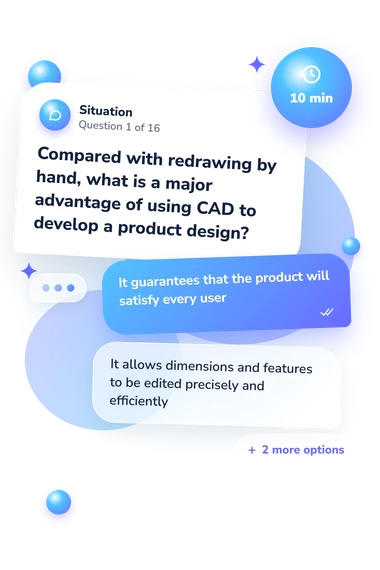
Example Questions From the Test
- Any diameter below 10.05 mm
- Only a diameter of exactly 10.00 mm
- Diameters from 9.90 mm to 10.10 mm
- Diameters from 9.95 mm to 10.05 mm
- Orthographic projection
- One-point perspective drawing
- Exploded isometric drawing
- Freehand rendering
- It moves the fulcrum inside the load
- It increases the turning effect produced by the applied force
- It removes the reaction force at the pivot
- It makes the load weigh less
Design and Technology Quiz - Description and methodology of the test
People who want a clear snapshot of their practical design knowledge can use this design and technology quiz to check how confidently they understand common materials, processes, systems, and design decisions. It suits learners, teachers preparing revision, and curious adults who want a structured starting point. As a design and technology assessment, it turns broad subject knowledge into an accessible result with useful review priorities.
What This Assessment Explores
Rather than measuring artistic style or preference, the questionnaire checks whether respondents can recognize and apply ideas used to design, make, and evaluate products. It suits learners, returning adults, and anyone wanting an overview.
The groups are:
- Materials and manufacturing show how timber, plastics, metals, forming, and production choices affect outcomes.
- Design practice covers CAD, technical drawing, specifications, iteration, ergonomics, repair, and life-cycle thinking.
- Systems and control examine feedback, inputs and outputs, circuits, and component arrangements.
- Structures and mechanics connect forces, levers, tolerances, and bracing with performance.
As a quiz about design technology, it tests whether knowledge transfers from definitions to applied situations. Its Design and Technology Knowledge scale runs from 0-16. Results are labelled Foundation to build (0-6), Developing knowledge (7-12), or Strong core knowledge (13-16), describing the level shown in this question set rather than a professional qualification.
Methodology and Scientific Basis
The format of this design and technology test uses 16 multiple-choice items, each presenting a question with four answer options and one best response. The items move between recognition of concepts and application to design, production, materials, structures, and control situations.
Scoring is one total rather than separate scores for each topic. The displayed categories describe performance within this question set, not every design skill.
Its content is aligned with the broad knowledge domains set out by Department for Education (2015), including materials, manufacturing, design processes, systems, structures, and sustainability. Wammes et al. (2022) describe a separate diagnostic instrument focused on technological-systems knowledge; it is conceptually relevant here, not evidence that this online assessment has been validated. This questionnaire is conceptually consistent with that research, not an adaptation of its published tool.
The displayed result is a descriptive educational summary, and its bands do not provide population norms or reliability estimates for broader comparison. Previous teaching, revision, familiarity with technical vocabulary, and guessing can affect the result, so use it to guide review and self-reflection rather than infer broad competence.
- Department for Education. (2015). Design and technology GCSE subject content. Department for Education. Reference DFE-00283-2015.
- Wammes, D., Slof, B., Schot, W., & Kester, L. (2022). Pupils’ prior knowledge about technological systems: design and validation of a diagnostic tool for primary school teachers. International Journal of Technology and Design Education, 32, 2577-2609. 10.1007/s10798-021-09697-z