
Empirical and Molecular Formulas Quiz
How the Scales are Structured
Who Usually Takes This Test?
See How You Compare
Below is a preview of how scores are typically distributed across each scale.
Example Questions From the Test
- NO2
- N2O2
- N2O4
- N4O2
- CH2
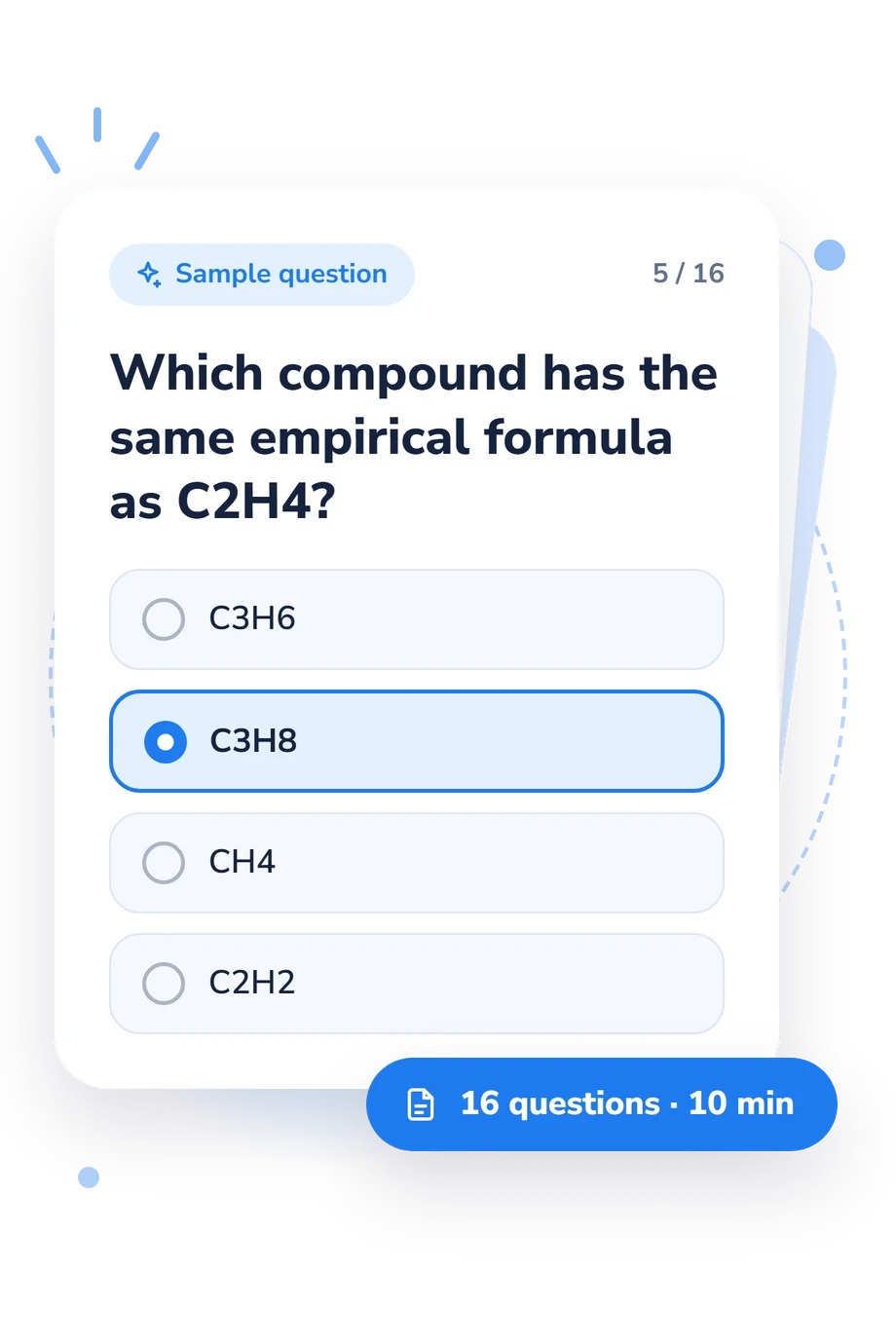
- C2H4
- CH5
- C2H5
- C3H6
- C3H8
- CH4
- C2H2
Empirical and Molecular Formulas Quiz - Description and methodology of the test
Students who are unsure when to reduce a formula, convert mole amounts, or use molar mass can use the empirical and molecular formulas quiz to focus their review. It suits chemistry learners who want a focused check of conceptual understanding and calculation choices. Its result helps show whether foundational relationships, multi-step reasoning, or accurate application deserve more attention during formula calculation practice.
What This Assessment Explores
The questions examine movement between elemental composition, simplest whole-number ratios, empirical formula mass, and molecular formula mass. They also test fractional ratios, mass-percentage data, and the difference between molecular formulas and ionic formula units. This makes the assessment useful for learners reviewing introductory chemistry and checking readiness for empirical- and molecular-formula calculations.
The result is organized under one knowledge scale. It summarizes performance across conceptual and calculation-based tasks:
- Empirical and Molecular Formulas Knowledge (0-16) shows Foundations to review at 0-6, Developing knowledge at 7-12, and Strong knowledge at 13-16; these bands indicate whether you should revisit core definitions and ratio reduction, practise fractional ratios and formula-mass calculations, or apply the relationships consistently.
The result can guide practice with molecular-formula questions and turn the outcome into a study plan: a lower band directs attention to definitions and mole ratios, while a higher band invites precision checks across varied problem types.
Methodology and Scientific Basis
Each item offers four answer choices and requires one response. It covers molar masses, deriving molecular formulas, reducing elemental ratios, converting mass percentages to mole relationships, and distinguishing formula units from discrete molecules. Together, these tasks check definitions and calculation sequences.
The score is one aggregate knowledge result rather than separate trait scores. Reviewing a missed choice helps with empirical formula practice: check whether the difficulty involved choosing the smallest ratio, clearing fractional ratios, or finding the integer relationship between empirical and molecular formula masses. Labels describe current performance on these tasks, not a fixed level of chemical ability.
Taskin and Bernholt (2014) provide the closest research context by describing recurring difficulties in interpreting chemical formulae. DeMeo (2001) emphasizes conservation-of-matter assumptions in empirical-formula problems, while OpenStax Chemistry 2e presents the standard calculation pathway. This questionnaire is conceptually consistent with those sources, not adapted from any one.
Guessing, arithmetic slips, prior instruction, and careful reading can affect an online attempt. The displayed bands describe performance on this question set rather than a population comparison. They reflect formula reduction and molecular-formula calculations.
- Taskin, Vahide, and Sascha Bernholt. Students' Understanding of Chemical Formulae: A Review of Empirical Research. International Journal of Science Education 36, no. 1 (2014): 157-185. 10.1080/09500693.2012.744492
- DeMeo, Stephen. Making Assumptions Explicit: How the Law of Conservation of Matter Can Explain Empirical Formula Problems. Journal of Chemical Education 78, no. 8 (2001): 1050-1052. 10.1021/ed078p1050
- Flowers, Paul, Klaus Theopold, Richard Langley, and William R. Robinson. Chemistry 2e. Houston, TX: OpenStax, 2019. Chapter 3, section 3.2, Determining Empirical and Molecular Formulas.
Updated: