
Dare Quiz
How the Scales are Structured
Who Usually Takes This Test?
See How You Compare
Below is a preview of how scores are typically distributed across each scale.
Example Questions From the Test
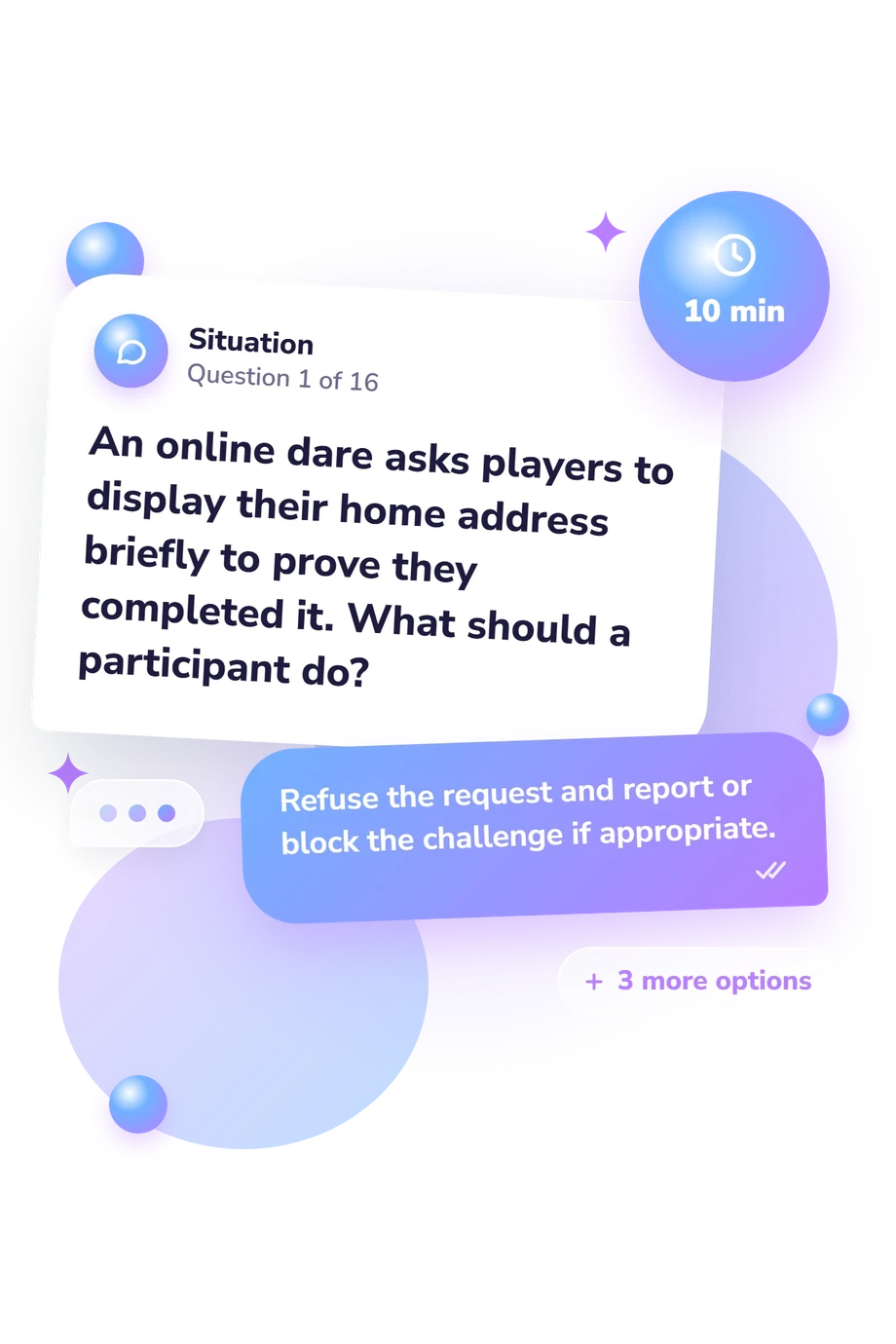
- Refuse the request and report or block the challenge if appropriate.
- Share it with a small private group rather than publicly.
- Cover the house number but show the street name.
- Show only part of the address and remove the post afterward.
- Use a small amount because a limited serving reduces exposure.
- Ask another player whether the snack has caused problems before.
- Choose a non-food alternative rather than guessing about the ingredients.
- Continue if the package does not display a prominent warning.
- Players must announce personal limits before the game starts.
- Every player receives the same number of difficult dares.
- The group decides disputes by majority vote.
- Anyone may skip or replace a dare without punishment or ridicule.
Dare Quiz - Description and methodology of the test
For people deciding whether a dare is genuinely voluntary, safe, and respectful, the Dare2020.site Quiz offers a structured way to examine judgment in social challenge situations. This online dare safety quiz examines serious questions about privacy, pressure, recording, or injury. The result places overall recognition of consent, social impact, and physical-safety principles into a result band before participation or hosting.
What This Assessment Explores
The scenarios examine how a participant responds when a challenge affects another person, personal information, or bodily safety. The Dare Quiz safety questions focus on practical judgment: recognizing pressure, preserving free choice, and replacing unsafe activities without shaming anyone.
The central result is Dare Knowledge (0-16). Its bands are Foundations to build (0-6), Developing judgment (7-12), and Strong knowledge (13-16). They describe recognition of responsible principles, not proof that a particular dare is safe.
These are the main decision areas:
- Consent and boundaries show whether refusal, hesitation, and withdrawal remain valid throughout the activity.
- Privacy and recording show whether joining a dare is separated from permission to film or share.
- Physical and substance hazards show whether avoidable exposure is replaced with safer alternatives.
- Social impact shows whether the respondent notices coercion, embarrassment, property damage, and escalation pressure.
Methodology and Evidence Base
The scenario-based multiple-choice knowledge format presents short situations with four answer choices. The preferred option generally protects consent, privacy, or physical safety, so the method measures applied recognition of risk rather than abstract agreement with safety slogans. Scenarios cover posting, strangers, alcohol, flames, allergens, blindfolds, escalation, and injury.
No item-by-item scoring rule is provided, so individual answer weights cannot be inferred. Because the score is labelled unvalidated, its bands are practical feedback rather than population norms.
The evidence base is conceptually consistent with the Viral Internet Challenges Scale (Ortega-Barón et al., 2023), but this questionnaire is not a direct adaptation or validation of that instrument. Middelberg and colleagues (2025) support attention to injury, online exposure, and social pressure. Harakeh and de Boer (2019) clarify how peer encouragement can influence risk-taking, while Avery et al. (2016) document the potential seriousness of flame-based challenges.
As an online knowledge questionnaire and self-reflection quiz, it reflects hypothetical judgment and can be affected by current circumstances, response bias, and the respondent’s ability to notice pressure or danger. It is most useful for identifying principles to discuss and situations to reconsider before a challenge begins.
- Ortega-Barón, J., Machimbarrena, J. M., Montiel, I., & González-Cabrera, J. (2023). Viral internet challenges scale in preadolescents: An exploratory study. Current Psychology, 42(15), 12530-12540. 10.1007/s12144-021-02692-6
- Middelberg, L. K., Mason, A. E., Miller, S., Helwig, S., & McKenzie, L. B. (2025). Risky social media challenges: a scoping review, 2000-2024. Injury Epidemiology, 13(1), Article 1. 10.1186/s40621-025-00647-0
- Harakeh, Z., & de Boer, A. (2019). The effect of active and passive peer encouragement on adolescent risk-taking. Journal of Adolescence, 71, 10-17. 10.1016/j.adolescence.2018.12.004
- Avery, A. H., Rae, L., Summitt, J. B., & Kahn, S. A. (2016). The Fire Challenge: A Case Report and Analysis of Self-Inflicted Flame Injury Posted on Social Media. Journal of Burn Care & Research, 37(2), e161-e165. 10.1097/BCR.0000000000000324
Updated: