
Charles Dickens Quiz
How the Scales are Structured
Who Usually Takes This Test?
See How You Compare
Below is a preview of how scores are typically distributed across each scale.
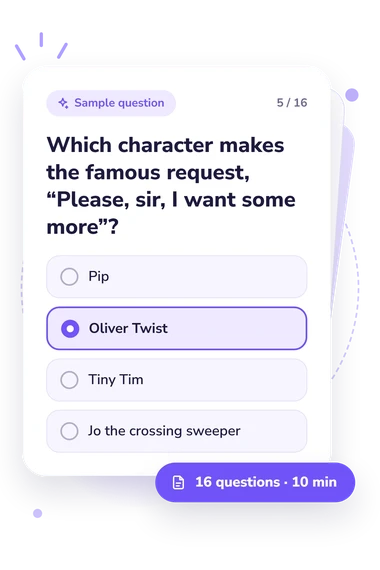
Example Questions From the Test
- Jacob Marley
- The Ghost of Christmas Past
- The Ghost of Christmas Yet to Come
- The Ghost of Christmas Present
- Mr. Micawber
- Uriah Heep
- James Steerforth
- Daniel Peggotty
- Dombey and Son
- Bleak House
- Great Expectations
- The Old Curiosity Shop
Charles Dickens Quiz - Description and methodology of the test
Readers deciding whether to test their familiarity with Dickens’s fiction and literary career can use this Dickens quiz as a knowledge exercise. It suits curious readers, students, and anyone returning to the novels; the Charles Dickens Quiz Questions and Answers assessment offers a compact way to decide how deeply to pursue Dickens. The result gives an overall level of Dickens knowledge to help you decide what to read next.
What This Assessment Measures
This assessment measures factual and contextual knowledge of Charles Dickens rather than writing style or personal preference. Its questions cover scenes, character identities, novel settings, social concerns, professional details, and quotations. They ask the reader to retrieve information and connect a detail with the right work.
The questions use four recurring themes:
- Plot and character recognition asks you to identify figures, relationships, and important events.
- Novel and setting knowledge tests whether you place stories in their social or historical contexts.
- Themes and criticism examines familiarity with Dickens’s treatment of education, bureaucracy, poverty, work, and institutions.
- Career and textual details checks recall of pen names, quotations, and unfinished projects.
These themes are covered within one overall level of Dickens knowledge rather than separate domain scores. This Charles Dickens trivia quiz suits self-directed reading and study review.
Methodology and Evidence Base
Each item uses a prompt with four answer choices. Questions mix direct recall with interpretive framing: they may ask for a character, title, quotation, pen name, or the work matching a social criticism. The format focuses on recognition and retrieval rather than claiming to measure literary interpretation.
The questionnaire reports an overall 0-16 result on the Charles Dickens Knowledge scale. Its bands are Foundations to revisit (0-6), Developing Dickens reader (7-12), and Dickens expert (13-16). Its exact scoring rule is not documented, so these labels describe performance within this questionnaire rather than literary expertise.
Schlicke’s book, Leighton and Surridge’s discussion of the illustrated novel, and Dickens’s 1843 Christmas text provide literary facts and context for the questions, not psychometric evidence. The online questionnaire has no stated standardization, norms, reliability estimates, or validity evidence.
Results can vary with prior reading, memory, guessing, and personal familiarity. Read the score as a snapshot of recall and a prompt for further reading. A Charles Dickens literature quiz can guide a reading plan, but no score captures everything a reader knows.
- Schlicke, Paul, ed. The Oxford Companion to Charles Dickens: Anniversary Edition. Oxford University Press, 2011. ISBN 9780199640188.
- Leighton, Mary Elizabeth, and Lisa Surridge. "The Illustrated Novel." In Charles Dickens in Context, edited by Sally Ledger and Holly Furneaux, Cambridge University Press, 2011, pp. 166-177. 10.1017/CBO9780511975493.023.
- Dickens, Charles. A Christmas Carol. Chapman and Hall, 1843.