
Do You Think in Words or Pictures Quiz
How the Scales are Structured
Who Usually Takes This Test?
See How You Compare
Below is a preview of how scores are typically distributed across each scale.
Example Questions From the Test
- The story I tell myself about what happened
- Named events accompanied by occasional visual fragments
- A sequence of recognizable places and faces
- Vivid scenes with spatial, color, or lighting details
- I sense the overall tone or emotional shape before words appear
- A few key words surface around a broader, nonverbal impression
- I mentally try several phrases and choose among them
- I conduct a detailed inner conversation before writing
- I follow the language and meaning without forming much of a scene
- I get occasional flashes of a character or location
- Many scenes appear, though some details remain indistinct
- The setting and action unfold as a sustained visual sequence
Do You Think in Words or Pictures Quiz - Description and methodology of the test
People curious about how their thoughts are organized can use the Do You Think in Words or Pictures Quiz to examine tendencies toward word-led, picture-led, or blended thinking. It suits anyone reflecting on planning, memory, reading, or communication rather than seeking a fixed label. Thinking in words or pictures can vary by task, and the result identifies word-led, picture-led, or blended tendencies, including ease of switching or combining formats.
What This Assessment Explores
Across planning, navigation, memory, reading, explanation, and learning, the questions examine word-led thought, picture-led imagery, and translation between language and imagery as a thought develops. Imagery is only one part of this profile; visual and verbal thinking, plus flexible switching, are measured alongside it.
The three result scales are:
- Flexible/Blended Thinking (0-15) measures switching or combining formats: Stable-format preference 0-5, Selective blending 6-10, Strong blended affinity 11-15.
- Picture-Led Thinking (0-15) measures scene-based and spatial imagery: Language/Concept-Led 0-5, Situationally Visual 6-10, Strong Picture Affinity 11-15.
- Word-Led Thinking (0-15) measures labels, inner dialogue, and verbal sequences: Image/Impression-Led 0-5, Situationally Verbal 6-10, Strong Word Affinity 11-15.
The highest score marks the strongest affinity; scores within one point indicate a blended result.
Methodology and Evidence Base
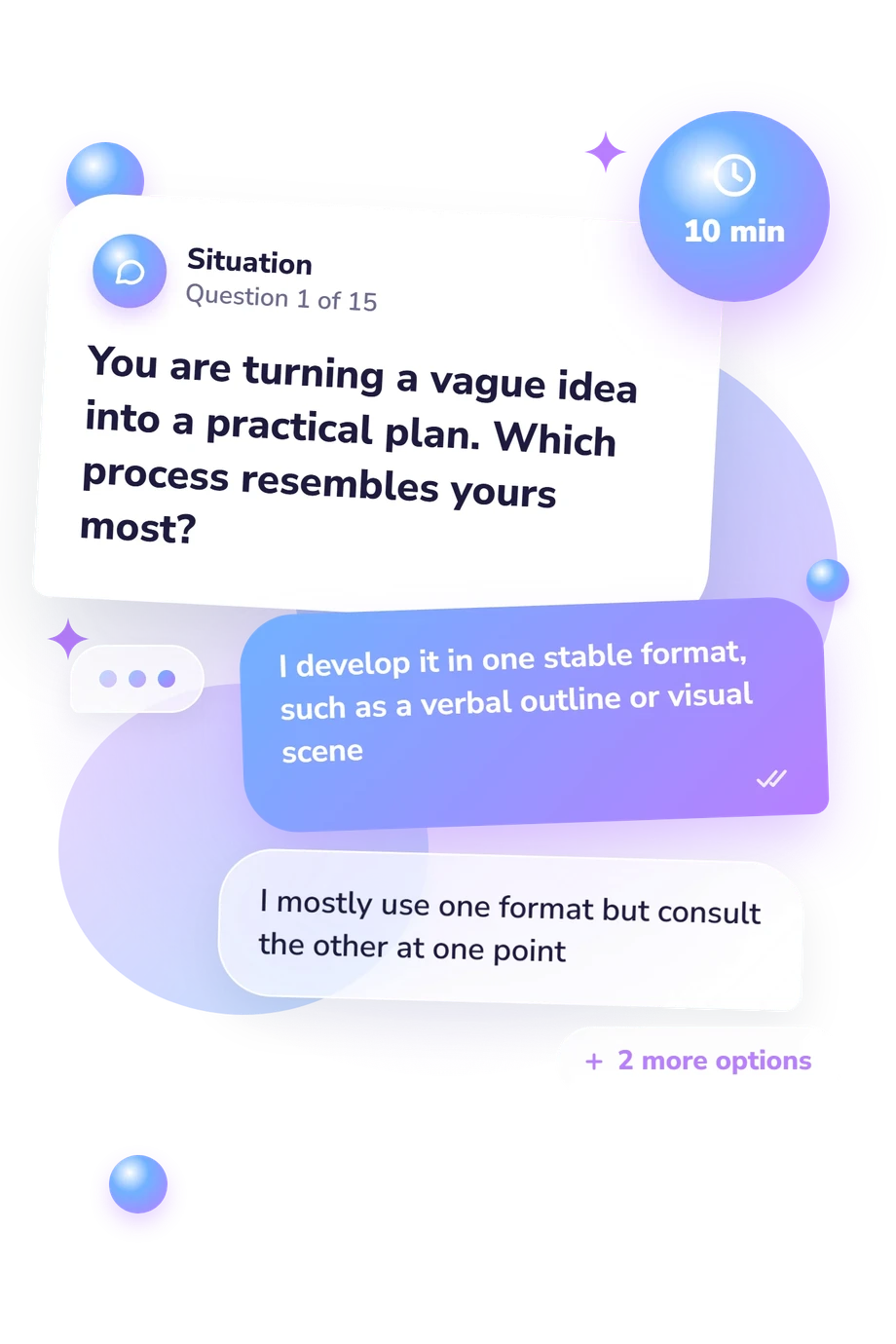
Each prompt presents a concrete situation and four contrasting response patterns spanning stable, picture-led, word-led, and blended forms of thinking. This makes the questionnaire a self-report measure of preferred mental representation, not a performance task.
The 2023 study by Chkhaidze, Coulson, and Kiyonaga offers the closest conceptual comparison for preferred thought format and narrative recall. The questionnaire is also conceptually consistent with the Internal Representations Questionnaire (Roebuck and Lupyan, 2020) and the object-spatial-verbal cognitive style model described by Blazhenkova and Kozhevnikov (2009); it is not presented as an adaptation of any of them.
Responses are aggregated into three displayed scores with result bands, but the questionnaire has no established standardized weighting, normative reference values, or clinical cutoffs; its interpretation is limited to the displayed result bands. Interpret the result as a pattern across situations, not as evidence that one answer reflects greater intelligence or creativity.
Because responses depend on introspection, memory, context, and willingness to choose accurately, scores can vary across tasks or periods; the questionnaire captures a self-described tendency, not an invariant cognitive style.
- Chkhaidze, Ana, Seana Coulson, and Anastasia Kiyonaga. (2023). Individual Differences in Preferred Thought Formats Predict Features of Narrative Recall. Proceedings of the Annual Meeting of the Cognitive Science Society, 45, 1624-1629.
- Roebuck, Hettie, and Gary Lupyan. (2020). The Internal Representations Questionnaire: Measuring modes of thinking. Behavior Research Methods, 52(5), 2053-2070. 10.3758/s13428-020-01354-y
- Blazhenkova, Olesya, and Maria Kozhevnikov. (2009). The new object-spatial-verbal cognitive style model: Theory and measurement. Applied Cognitive Psychology, 23(5), 638-663. 10.1002/acp.1473
Updated: