
Diseases Quiz
How the Scales are Structured
Who Usually Takes This Test?
See How You Compare
Below is a preview of how scores are typically distributed across each scale.
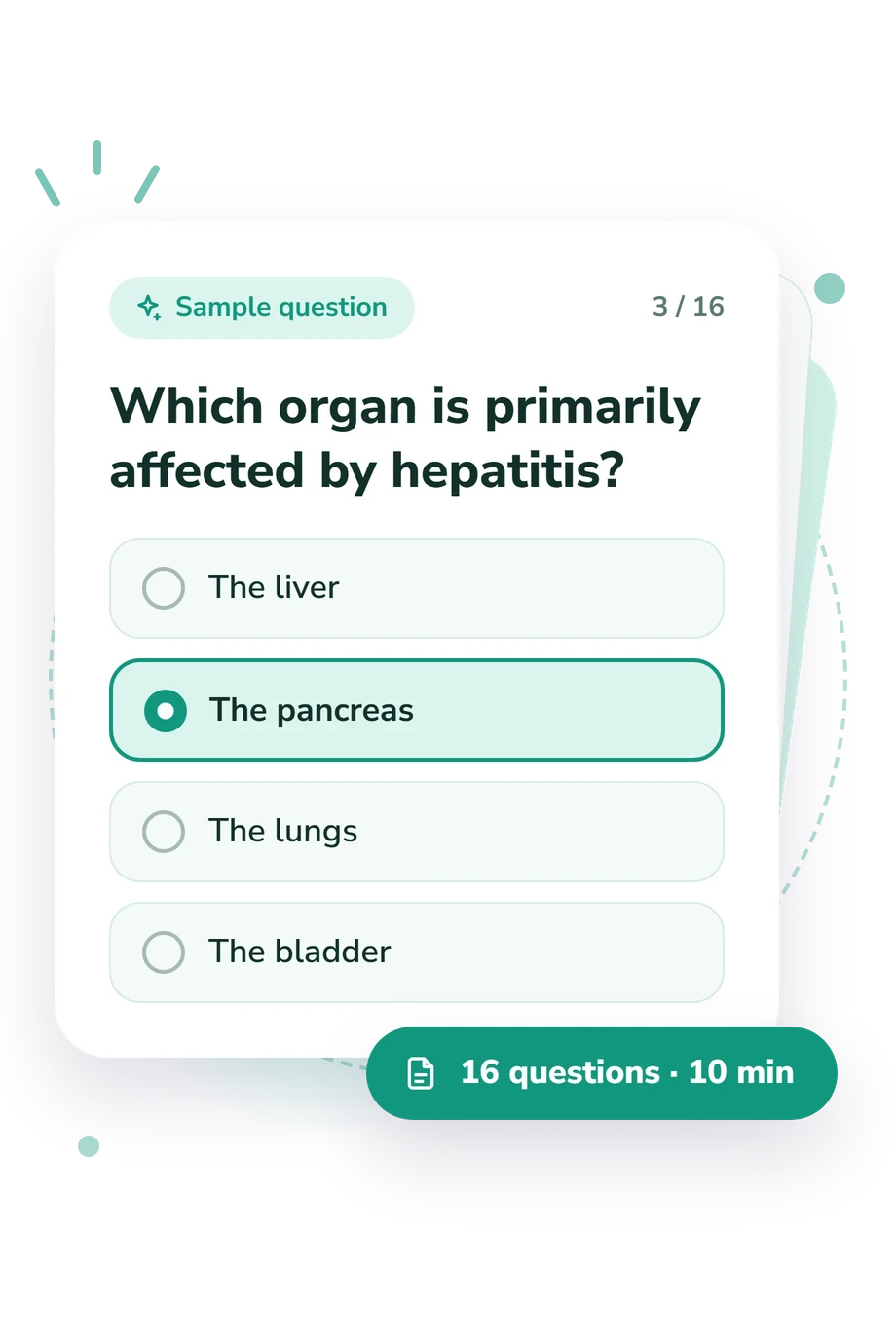
Example Questions From the Test
- Through the bite of an infected mosquito
- Through droplets released by coughing
- Through contaminated drinking water
- Through the bite of an infected tick
- The liver
- The pancreas
- The lungs
- The bladder
- A parasite
- A bacterium
- A virus
- A fungus
Diseases Quiz - Description and methodology of the test
People who want to refresh core medical knowledge can use the Diseases Quiz to examine how well they distinguish conditions, causes, symptoms, prevention, and basic treatment principles. It suits students, general learners, and anyone revising basic health information who wants a quiz about diseases. The assessment offers a structured knowledge check for learners revising broad medical concepts or preparing for health-related study.
What This Assessment Explores
The questionnaire measures disease knowledge rather than personal health status. Prompts connect conditions with pathogens, organs, processes, symptoms, prevention, and treatment. This makes the assessment useful as a disease knowledge test for learners reviewing common medical topics.
The questions cover four thematic areas, contributing to one overall result:
- Infectious disease recognition tests links among pathogens, transmission, vaccination, antibiotic use, and affected conditions.
- Noncommunicable disease knowledge checks distinctions among chronic conditions, mechanisms, and body systems.
- Symptoms and body systems assess connections between a condition, its process, organ, or warning sign.
- Prevention and treatment principles examine protective measures, treatment boundaries, routine checks, and urgent symptoms.
Your score appears as Diseases Knowledge: 0-16. Foundation 0-6 means core ideas may need review; Developing 7-12 reflects functional understanding; Strong 13-16 shows consistent knowledge across sampled topics. It is an educational result, not a personal diagnosis.
Methodology and Scientific Basis
Each item presents a factual or situational prompt with four answer choices. Most ask for the best explanation, distinction, or response. The format tests relationships rather than personal symptoms or medical history. Together, the items form a broad medical knowledge test covering infectious and noncommunicable conditions, transmission, disease mechanisms, prevention, and treatment boundaries.
The final display gives one aggregate knowledge score and assigns a displayed level band. Content is conceptually consistent with the Infectious Disease Knowledge Questionnaire (IDKQ), a published questionnaire assessing infectious-disease knowledge. It also overlaps with Chamroonsawasdi and colleagues' published questionnaire on noncommunicable-disease knowledge and health behavior, only in relevant disease-knowledge content, not their full constructs.
These sources support the subject areas, but this online questionnaire is separate from both instruments; its displayed bands are not published norms from them. Results can reflect prior education, guessing, attention, and familiarity with medical vocabulary. A correct answer shows recognition of tested information, not ability to apply it clinically, so use the score to identify learning priorities rather than interpret personal symptoms.
- Secginli S, Ilhan N, Torun G, Altiner Yas M, Dogru Bolat S. Development and Psychometric Testing of an Infectious Disease Knowledge Questionnaire in a Convenience Sample. International Journal of Environmental Research and Public Health. 2026;23(3):356. 10.3390/ijerph23030356
- Chamroonsawasdi K, Chottanapund S, Tunyasitthisundhorn P, Phokaewsuksa N, Ruksujarit T, Phasuksathaporn P. Development and Validation of a Questionnaire to Assess Knowledge, Threat and Coping Appraisal, and Intention to Practice Healthy Behaviors Related to Non-Communicable Diseases in the Thai Population. Behavioral Sciences. 2017;7(2):20. 10.3390/bs7020020
Updated: