
Does She Like Someone Else Quiz
How the Scales are Structured
Who Usually Takes This Test?
See How You Compare
Below is a preview of how scores are typically distributed across each scale.
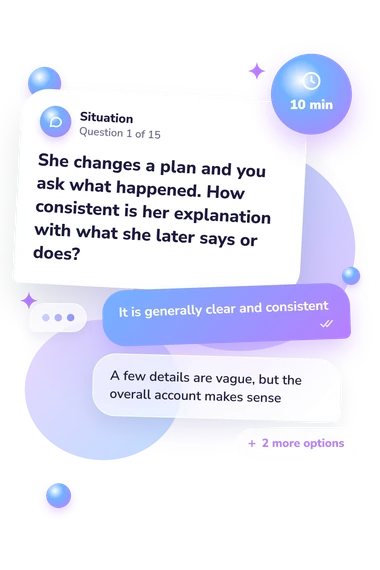
Example Questions From the Test
- It is generally clear and consistent
- A few details are vague, but the overall account makes sense
- Important details change enough to leave me uncertain
- Her accounts repeatedly conflict in substantial ways
- She responds comfortably in a way that fits what I already understand
- She seems mildly awkward but gives a straightforward explanation
- She becomes notably evasive or changes the subject each time
- Her response is strongly defensive and conflicts with what she has previously said
- Rarely, or about as often as other people in her life
- Occasionally enough for me to notice, but not as a pattern
- Often across several unrelated conversations
- Very often, with many topics being redirected toward that person
Does She Like Someone Else Quiz - Description and methodology of the test
People who feel a partner becoming harder to read can use the Does She Like Someone Else Quiz to organize observations before deciding what to ask. This relationship uncertainty test addresses uncertainty about expectations and communication alongside changes in warmth, availability, attention, or shared plans. It helps turn unease into specific topics for conversation without treating suspicion as proof.
What This Assessment Explores
Rather than trying to prove a private feeling, the questionnaire organizes reported changes in attention, warmth, availability, planning, communication, and focus on one person. It suits someone noticing signs she likes someone else and wanting to organize reported concerns for direct discussion.
The result presents three dimensions:
- Changes in Your Connection (0-15) reflects shifts in attention, warmth, availability, and shared plans: Steady or limited shift (0-5), Noticeable shift (6-10), or Broad shift (11-15).
- Focus on a Particular Person (0-15) summarizes attention directed toward one person: Little specific pattern (0-5), Recurring focus (6-10), or Concentrated focus (11-15).
- Relationship Clarity (0-15) measures unresolved ambiguity or difficulty discussing the relationship: Shared clarity (0-5), Partial clarity (6-10), or Clarity blocked (11-15).
Together, these results distinguish reported changes in the connection, attention directed toward one person, and relationship clarity; they describe reported patterns rather than causes or private feelings.
Methodology and Scientific Basis
Each of the 15 items describes a situation and offers four ordered choices. Options progress from clearer, more consistent, or less concentrated patterns toward conflicting, repeated, or unresolved ones. Responses feed the dimensions, but point assignments and weighting are not stated, so the ranges do not justify inventing scoring.
Research on suspicion, jealousy, and relational uncertainty provides the closest frame for this does your crush like someone else quiz. A study by Weigel and Shrout links suspected infidelity with psychological, physical, and behavioral consequences. Pfeiffer and Wong's Multidimensional Jealousy Scale treats jealousy as multidimensional; Knobloch and Solomon's work examines uncertainty about expectations and unresolved questions. The questionnaire's themes are conceptually consistent with these works, not an adaptation or validated reproduction of their instruments.
Interpret scores as prompts for direct discussion. A higher score may indicate more noticeable connection changes, more concentrated attention, or more unresolved ambiguity, depending on the dimension; it cannot establish motive, infidelity, or another person's feelings. Memory, distress, and selective attention can shape self-report. The questionnaire has no stated standardization, clinical norms, or diagnostic status.
- Weigel, Daniel J., and M. Rosie Shrout. “Suspicious minds: The psychological, physical and behavioral consequences of suspecting a partner’s infidelity.” Journal of Social and Personal Relationships 38, no. 3 (2021): 865-887. 10.1177/0265407520975851
- Pfeiffer, Susan M., and Paul T. P. Wong. “Multidimensional jealousy.” Journal of Social and Personal Relationships 6, no. 2 (1989): 181-196. 10.1177/026540758900600203
- Knobloch, Leanne K., and Denise Haunani Solomon. “Measuring the sources and content of relational uncertainty.” Communication Studies 50, no. 4 (1999): 261-278. 10.1080/10510979909388499