
DNA Technology Quiz
How the Scales are Structured
Who Usually Takes This Test?
See How You Compare
Below is a preview of how scores are typically distributed across each scale.
Example Questions From the Test
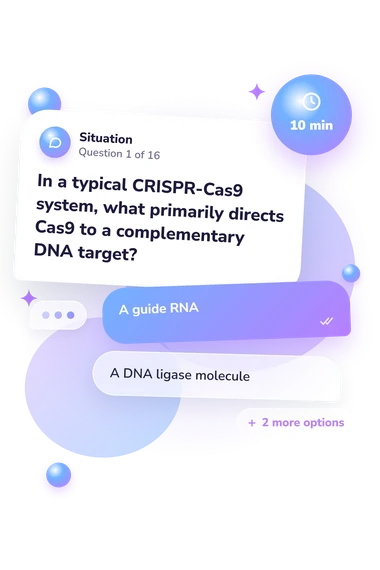
- A guide RNA
- A DNA ligase molecule
- A fluorescent reporter protein
- A selectable marker
- To separate DNA fragments according to size
- To make many copies of a selected DNA region
- To join DNA fragments into a continuous molecule
- To translate a gene directly into protein
- They bind permanently to the DNA template before synthesis begins
- They cut the newly synthesized strand at a specific base
- They prevent primers from pairing with the template
- They lack the 3′ hydroxyl group needed to add the next nucleotide
DNA Technology Quiz - Description and methodology of the test
For students, science learners, and anyone reviewing laboratory concepts, the DNA Technology Quiz checks whether you can connect familiar techniques with the problems they solve. It is useful before a course, during revision, or as a quick self-check, while the result highlights strengths and helps prioritize topics for review. This molecular biology quiz measures how well you connect each method with its purpose and evidence.
What This Assessment Explores
It asks when DNA methods are used and how their results should be read. Scenarios include CRISPR-Cas9 targeting, cDNA, PCR, cloning, gels, sequencing, transformation, selection, and STR variation. As a quiz about recombinant DNA technology, it tests mechanisms, design, and interpretation.
These themes fall into three practical areas:
- Molecular mechanisms explain guide RNAs, reverse transcription, and chain termination.
- DNA construction covers cloning, ligation, transformation, and selectable markers.
- Analytical interpretation links PCR, gels, controls, junction tests, and STRs to conclusions.
The result measures recognition of core tools, purposes, and experimental logic. Its interpretation distinguishes ideas to review, developing command of methods, and a well-developed grasp of major technologies and applications across contexts.
Methodology and Scientific Basis
Each item presents four answer choices and asks for the best interpretation of a mechanism, purpose, or outcome. The format moves from definitions to laboratory scenarios, including junction-PCR evidence, qPCR threshold cycles, and a no-template control. The displayed DNA Technology Knowledge scale runs 0-16 and uses three bands: Foundations to build (0-6), Developing knowledge (7-12), and Strong knowledge (13-16); the highest band is an educational score, not certification of laboratory competence.
The questionnaire is conceptually consistent with Green and Sambrook's 2012 Molecular Cloning manual, which covers cloning, amplification, transformation, electrophoresis, hybridization, and sequencing. PCR principles correspond to Mullis and Faloona's 1987 work; CRISPR-Cas9 targeting to Jinek and colleagues' 2012 study; and chain-termination sequencing to Sanger and colleagues' 1977 study. Together, these sources support the subject matter; the questionnaire is not presented as an adaptation of one published instrument.
This DNA technology assessment is an educational knowledge measure whose bands describe subject understanding. Prior study, guessing, wording familiarity, and current concentration can influence interpretation. Use missed topics to guide review and practical learning, keeping conclusions within the concepts tested.
- Green, Michael R., and Joseph Sambrook. Molecular Cloning: A Laboratory Manual. 4th ed. Cold Spring Harbor Laboratory Press, 2012. ISBN 978-1-936113-42-2.
- Mullis, Kary B., and Fred A. Faloona. Specific synthesis of DNA in vitro via a polymerase-catalyzed chain reaction. Methods in Enzymology 155 (1987): 335-350. 10.1016/0076-6879(87)55023-6.
- Jinek, Martin, Krzysztof Chylinski, Ines Fonfara, Michael Hauer, Jennifer A. Doudna, and Emmanuelle Charpentier. A programmable dual-RNA-guided DNA endonuclease in adaptive bacterial immunity. Science 337, no. 6096 (2012): 816-821. 10.1126/science.1225829.
- Sanger, Frederick, Steven Nicklen, and Alan R. Coulson. DNA sequencing with chain-terminating inhibitors. Proceedings of the National Academy of Sciences 74, no. 12 (1977): 5463-5467. 10.1073/pnas.74.12.5463.