
Complement Quiz
How the Scales are Structured
Who Usually Takes This Test?
See How You Compare
Below is a preview of how scores are typically distributed across each scale.
Example Questions From the Test
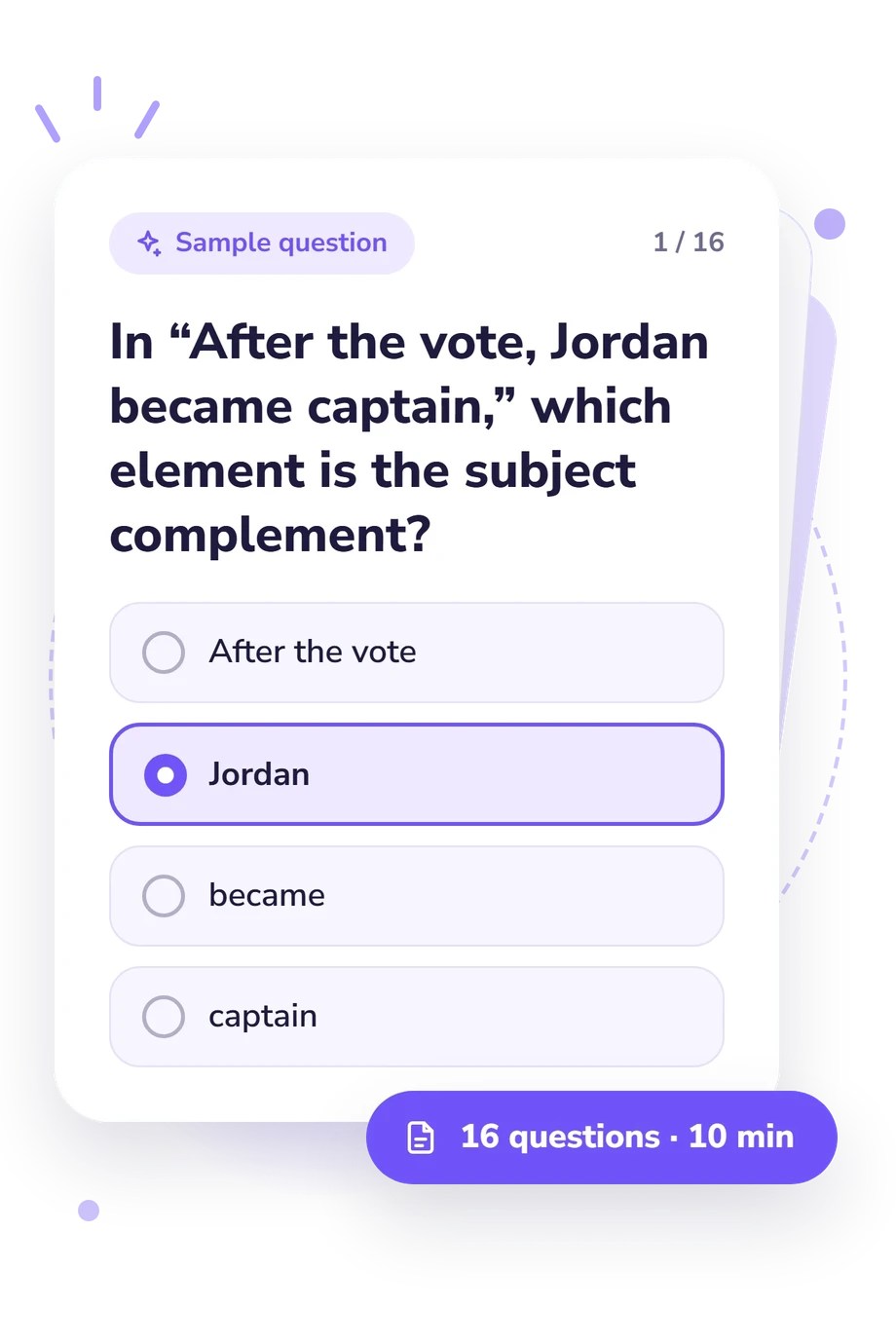
- After the vote
- Jordan
- became
- captain
- Rina
- is proud
- of her progress
- her progress
- slippery
- The storm
- the roads
- made
Complement Quiz - Description and methodology of the test
Readers who want a clearer grasp of sentence structure can use the complement quiz to examine how English expressions complete one another. As an English grammar assessment, it suits learners, teachers, and anyone checking whether a grammar explanation matches actual usage. The result gives an overall indication of command, with broad guidance for further study rather than a detailed profile of individual grammar distinctions.
What This Assessment Explores
The assessment focuses on complement relationships: words, phrases, or clauses whose presence completes meaning licensed by another expression. Items ask readers to separate required complements from optional modifiers and identify a selected element’s function in a sentence.
The main themes are:
- Subject and object complements show how a phrase identifies or describes a subject or object.
- Direct and indirect objects show how participants connect to verbs such as prepare, mail, or show.
- Complements of adjectives, nouns, and verbs show how dependent phrases or clauses complete expressions such as proud, fact, hope, or believe.
Because these are complement grammar questions, sentence context matters: the task tests grammatical function rather than word recognition. The reported scale is Complement Knowledge (0-16): Foundations to strengthen (0-6), Developing command (7-12), and Strong command (13-16).
Methodology and Evidence Base
In this complement grammar test, each item presents a sentence or definition and asks the reader to identify a grammatical role. Four answer choices separate the target from alternatives such as a modifier, direct object, or subject complement. One question uses a passive transformation to support the analysis.
The questionnaire reports one displayed overall result, interpreted through the three catalogue-defined bands.
Its framework is conceptually consistent with Huddleston and Pullum (2002), whose account distinguishes complements from optional modifiers and relates them to verbs, adjectives, nouns, and clauses. The later student grammar text by Huddleston, Pullum, and Reynolds offers a complementary explanatory reference. These sources support the terminology and reasoning, but the online questionnaire is not presented as an adaptation or validation of either work.
As an English grammar complement test, it gives learners a focused snapshot of performance on these items. Because the result reflects performance on these items, it should be read as a focused grammar snapshot rather than a complete measure of English proficiency.
- Huddleston, Rodney, and Geoffrey K. Pullum. The Cambridge Grammar of the English Language. Cambridge University Press, 2002. 10.1017/9781316423530.
- Huddleston, Rodney, Geoffrey K. Pullum, and Brett Reynolds. A Student's Introduction to English Grammar. 2nd ed. Cambridge University Press, 2022. 10.1017/9781009085748.
Updated: