
EHS Quiz
How the Scales are Structured
Who Usually Takes This Test?
See How You Compare
Below is a preview of how scores are typically distributed across each scale.
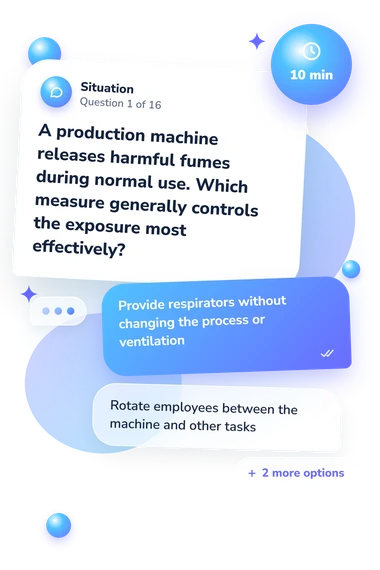
Example Questions From the Test
- Provide respirators without changing the process or ventilation
- Rotate employees between the machine and other tasks
- Capture the fumes at their source with properly designed local exhaust ventilation
- Post warning signs beside the machine
- The percentage of planned safety inspections completed on time
- The number of recordable injuries last quarter
- The number of workdays lost after incidents
- The volume of material released in past spills
- A frequent event that has no credible harmful consequence
- A reasonably likely event with potentially severe consequences
- A highly visible condition that does not expose anyone
- A minor inconvenience reported by the largest department
EHS Quiz - Description and methodology of the test
Workers, supervisors, and learners who want to examine practical hazard awareness can use this EHS Quiz to review how they would respond to common workplace situations. It suits anyone seeking an environmental health and safety quiz that focuses on decisions rather than memorized terminology. The result places overall EHS knowledge in one displayed band and identifies topics that may deserve further training.
What This Assessment Explores
Practical workplace knowledge, rather than personality or symptoms, is the focus. The scenarios test whether respondents can recognize effective controls, safe work practices, reporting duties, and urgent response priorities. They cover fumes, damaged equipment, hazardous energy, chemical waste, ergonomic strain, confined spaces, spills, fire, and eye exposure.
The questions cover these themes; they are not separate scores:
- Questions about hazard control ask respondents to choose stronger controls before relying on procedures or personal protective equipment.
- Questions about chemical and environmental care test recognition of safe handling, containment, labeling, waste compatibility, and drain protection.
- Questions about incidents and emergencies ask respondents to identify appropriate responses to near misses, alarms, evacuation, first aid, and qualified assistance.
- Questions about work planning and human factors cover ergonomics, permit controls, and decisions that reduce exposure before work begins.
That makes the result useful for workers, supervisors, learners, and anyone reviewing a workplace safety quiz before training.
Methodology and Evidence Base
The assessment uses multiple-choice items with four answer choices. They ask respondents to distinguish effective controls from substitutes and to select actions for reporting, isolation, containment, evacuation, or assistance. The displayed result is a single EHS Knowledge scale ranging from 0-16: Building the basics (0-6) signals a need to review foundational concepts; Developing knowledge (7-12) indicates understanding of many core principles with room for targeted practice; and Strong foundation (13-16) indicates broad practical knowledge, not certification or proof of site-specific competence.
Conceptually, the questionnaire is consistent with safety cross-training knowledge expectations and with a heat-stress-specific knowledge-assessment approach. It is not an adaptation or standardized administration of those published works. OSHA’s recommended-practices framework supports the focus on controls, reporting, emergency planning, and improvement, while the questions also address environmental aspects, impacts, and operational controls.
Viewed as an EHS knowledge test, this questionnaire offers a focused snapshot rather than a norm-referenced judgment. Results can reflect prior training, attention, and interpretation of a scenario. No item-weighting formula or population norms are stated, so use the score to target review alongside local procedures.
- Emery, Robert J., Scott J. Patlovich, Kristin G. King, and Janelle Rios. "A Means of Codifying Safety Cross-Training Knowledge Expectations for Biosafety Professionals." Applied Biosafety 28, no. 1 (2023): 11-21. 10.1089/apb.2022.0032
- Tetzlaff, Emily J., Bruce E. Oddson, Kristina-Marie T. Janetos, Robert D. Meade, and Glen P. Kenny. "Developing and Refining a Knowledge Assessment Instrument for Individuals Involved in Managing Occupational Heat Stress: Paper A." American Journal of Industrial Medicine 68, no. 12 (2025): 1062-1076. 10.1002/ajim.70024
- Occupational Safety and Health Administration. Recommended Practices for Safety and Health Programs. OSHA 3885. U.S. Department of Labor, October 2016.
- Stapleton, Philip J., Margaret A. Glover, and S. Petie Davis. Environmental Management Systems: An Implementation Guide for Small and Medium-Sized Organizations. 2nd ed. NSF International, 2001. EPA 832-B-01-001.
Updated: