
Creepypasta Proxy Quiz
How the Scales are Structured
Who Usually Takes This Test?
See How You Compare
Below is a preview of how scores are typically distributed across each scale.
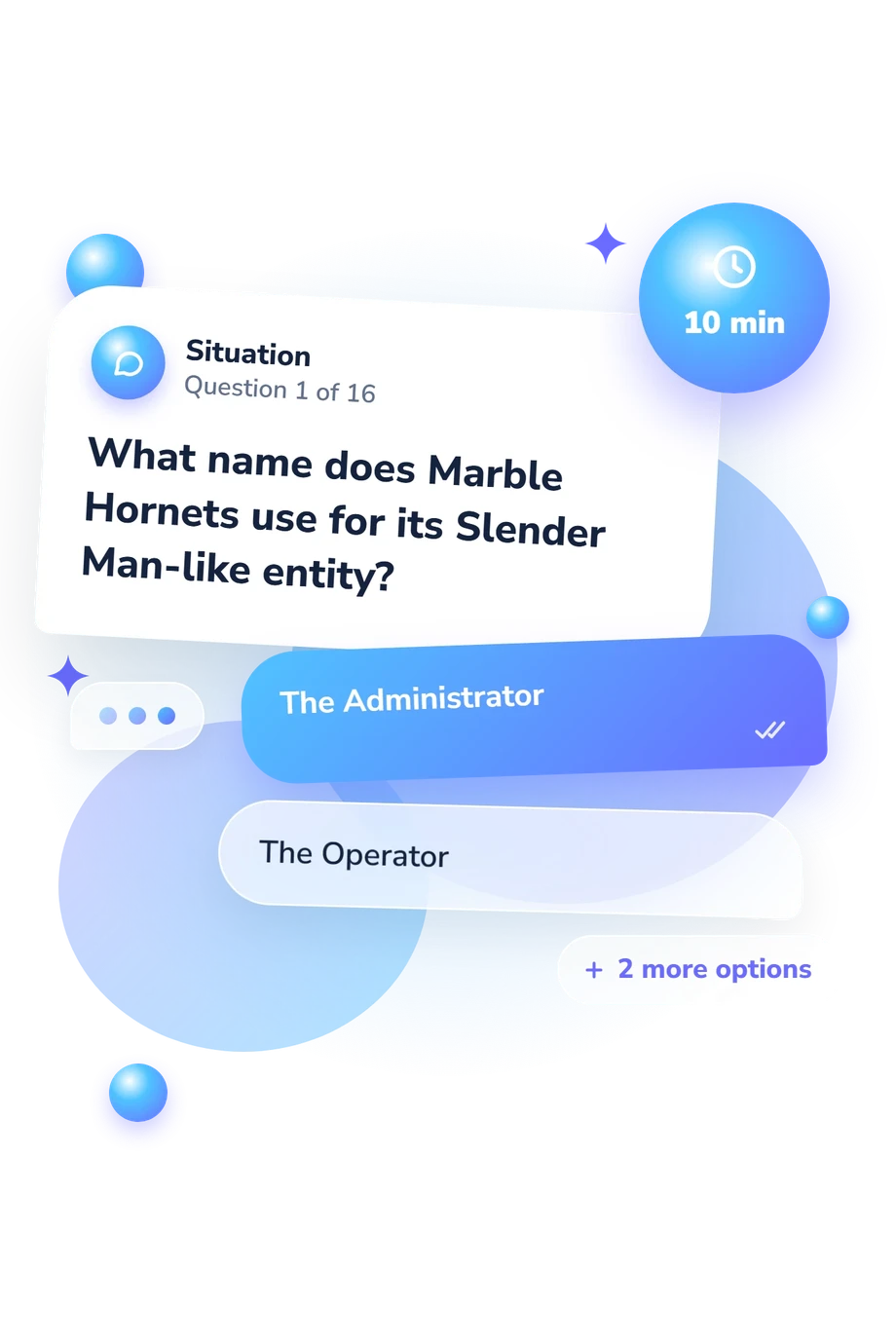
Example Questions From the Test
- The Administrator
- The Operator
- HABIT
- The Observer
- Eyeless Jack
- Homicidal Liu
- Jeff the Killer
- Jane the Killer
- Marble Hornets
- TribeTwelve
- Slender: The Eight Pages
- EverymanHYBRID
Creepypasta Proxy Quiz - Description and methodology of the test
Fans who want to separate original stories from crossover assumptions can use the Creepypasta Proxy Quiz to test how accurately they distinguish characters, sources, and continuity. Readers taking this proxy quiz often want a clearer profile of their source-aware knowledge, especially when canon, adaptation, and fanon overlap within familiar internet horror stories.
What This Assessment Explores
The questionnaire examines practical knowledge of creepypasta lore rather than personal taste or identification with a character. Its items connect figures with original works, test canon-versus-fanon judgment, and check whether adaptations or crossovers have changed the surrounding context. Readers can use the result to locate gaps in source-aware continuity knowledge.
The questions cluster around four areas:
- Source recognition shows whether you can connect characters and events with their originating story or series.
- Canon and fanon judgment reflects whether you separate creator-established details from wiki summaries, crossover images, and repeated fandom claims.
- Adaptation awareness captures how well you notice when a game, web series, or retelling changes context.
- Creepypasta Proxy Knowledge reports the overall result: Foundation Building covers 0-6, Developing Lore Knowledge covers 7-12, and Source-Savvy covers 13-16, measuring familiarity with documented lore and distinctions among canon, adaptation, and fan interpretation.
Methodology and Scientific Basis
Each question uses four answer choices and asks for recognition or source-aware judgment. The alternatives distinguish original material from adaptation, fan wiki claim, crossover image, or unsupported interpretation; the items ask for source-aware judgments, and the result summarizes selected lore knowledge.
The questionnaire presents the result through the three displayed knowledge bands, which describe knowledge levels rather than population norms or diagnostic thresholds. Because continuity and terminology vary among works and fan communities, the result is an online summary of selected creepypasta knowledge rather than a final ruling on every fan version.
Its emphasis on provenance and adaptation is conceptually consistent with Chess and Newsom (2015) on participatory internet mythology and with Chess’s analysis of Marble Hornets’ genre negotiations, but the questionnaire is not presented as an adaptation of either published work. Source landmarks include Eric Knudsen’s 2009 Something Awful posts and Marble Hornets, created by Troy Wagner, Joseph DeLage, and Tim Sutton. These works provide context for the questions’ attention to provenance, adaptation, and collaborative canon. Memory, uneven fandom exposure, and ambiguous continuity can affect performance, so the band guides further source-checking rather than settling every disputed detail.
- Chess, Shira, and Eric Newsom. Folklore, Horror Stories, and the Slender Man: The Development of an Internet Mythology. New York: Palgrave Macmillan, 2015. 10.1057/9781137491138.
- Chess, Shira. "Open-Sourcing Horror: The Slender Man, Marble Hornets, and Genre Negotiations." Information, Communication & Society 15, no. 3 (2012): 374-393. 10.1080/1369118X.2011.642889.
- Knudsen, Eric [Victor Surge]. "Create Paranormal Images." Something Awful Forums, June 10, 2009.
- Wagner, Troy, Joseph DeLage, and Tim Sutton, creators. Marble Hornets. THAC, 2009-2014, YouTube web series.
Updated: