
Commerce Quiz Questions
How the Scales are Structured
Who Usually Takes This Test?
See How You Compare
Below is a preview of how scores are typically distributed across each scale.
Example Questions From the Test
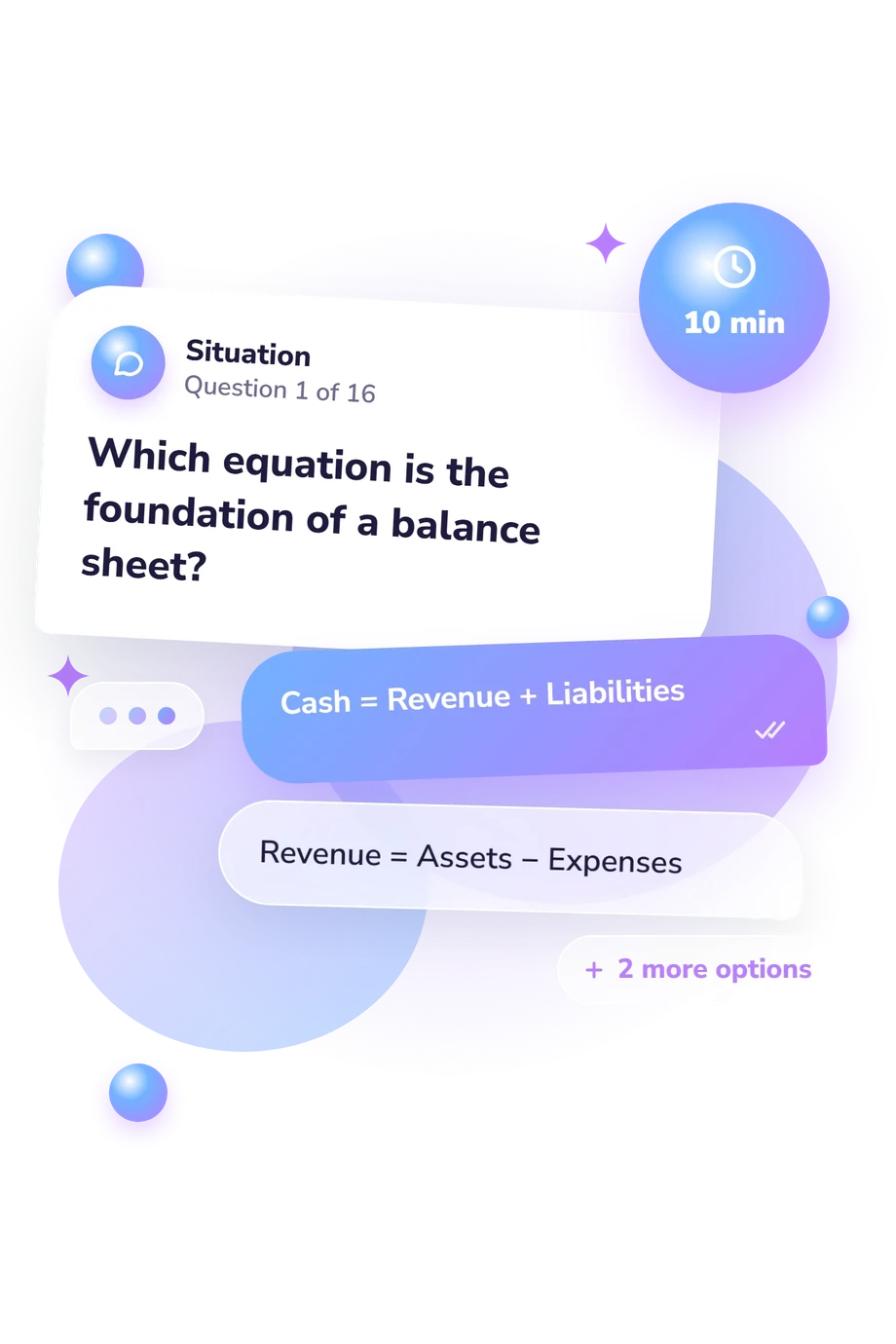
- Cash = Revenue + Liabilities
- Revenue = Assets − Expenses
- Assets = Liabilities + Owner's Equity
- Profit = Assets − Owner's Equity
- The demand curve would shift to the right
- The demand curve would shift to the left
- Supply would automatically decrease
- There would be movement down the same demand curve
- Employees should manage without formal leadership
- Effective management practices depend on the situation
- One leadership style is effective in every organization
- Managers should base decisions only on past financial results
Commerce Quiz Questions - Description and methodology of the test
For students, professionals, and curious learners, Commerce Quiz Questions offers a focused way to check how well business principles transfer from definitions to decisions. The result indicates overall command across the sampled topics and can help direct further review. A quiz on commerce can therefore support study planning, workplace refreshers, or structured self-reflection without reducing business understanding to one specialty.
What This Assessment Measures
The content spans several areas, so a result depends on recognizing relationships as well as recalling terms. Items cover financial statements, cash flow, break-even points, demand, inventory, productivity, opportunity cost, segmentation, delegation, procurement, and conflicts of interest. This makes the business knowledge quiz a broad check.
The main dimensions:
- Accounting and finance show whether you can connect balance-sheet structure, profit, cash flow, and break-even reasoning.
- Economics and operations show how you handle trade-offs involving demand, inventory, productivity, opportunity cost, and scale.
- Marketing, management, and ethics show whether you can apply segmentation, delegation, channel decisions, situational thinking, and conflict-of-interest principles.
All three areas feed one scale, Commerce Knowledge (0-16). Foundations to build (0-6) signals concepts to review; Developing command (7-12) shows core ideas with some distinctions or calculations needing practice; Strong command (13-16) indicates broad, consistent knowledge across sampled topics.
Methodology and Evidence Base
Each item presents a definition, calculation, or realistic business scenario with answer choices. Selecting the best option tests recognition and application across the sampled topics rather than written reasoning or case analysis.
The questionnaire displays one overall result rather than separate subject subscores. As a commerce knowledge assessment, it offers a compact snapshot of performance across the sampled topics and can guide further review. The displayed bands are interpretation labels for performance on the sampled items.
Methodologically, this is a brief, self-administered educational knowledge assessment. Its coverage is conceptually consistent with the Major Field Test in Business, a business-domain reference, and with Bernal-Guerrero, Cárdenas-Gutiérrez, and Montoro-Fernández, whose study addresses basic business knowledge. It is not presented as an adaptation or validation of either instrument.
Performance can vary with prior study, guessing, attention, familiarity with business language, and context, particularly when items require calculations or distinctions between related principles. The result is a focused indicator of knowledge on the sampled items: it reflects performance on this selection of business questions, not a definitive measure of overall business competence.
- Educational Testing Service. Major Field Tests: Business. Princeton, NJ: Educational Testing Service; 2021.
- Bernal-Guerrero A, Cárdenas-Gutiérrez AR, Montoro-Fernández E. Basic business knowledge scale for secondary education students. Development and validation with Spanish teenagers. PLOS ONE. 2020;15(7):e0235681. 10.1371/journal.pone.0235681
Updated: