
Cube Personality Quiz
How the Scales are Structured
Who Usually Takes This Test?
See How You Compare
Below is a preview of how scores are typically distributed across each scale.
Example Questions From the Test
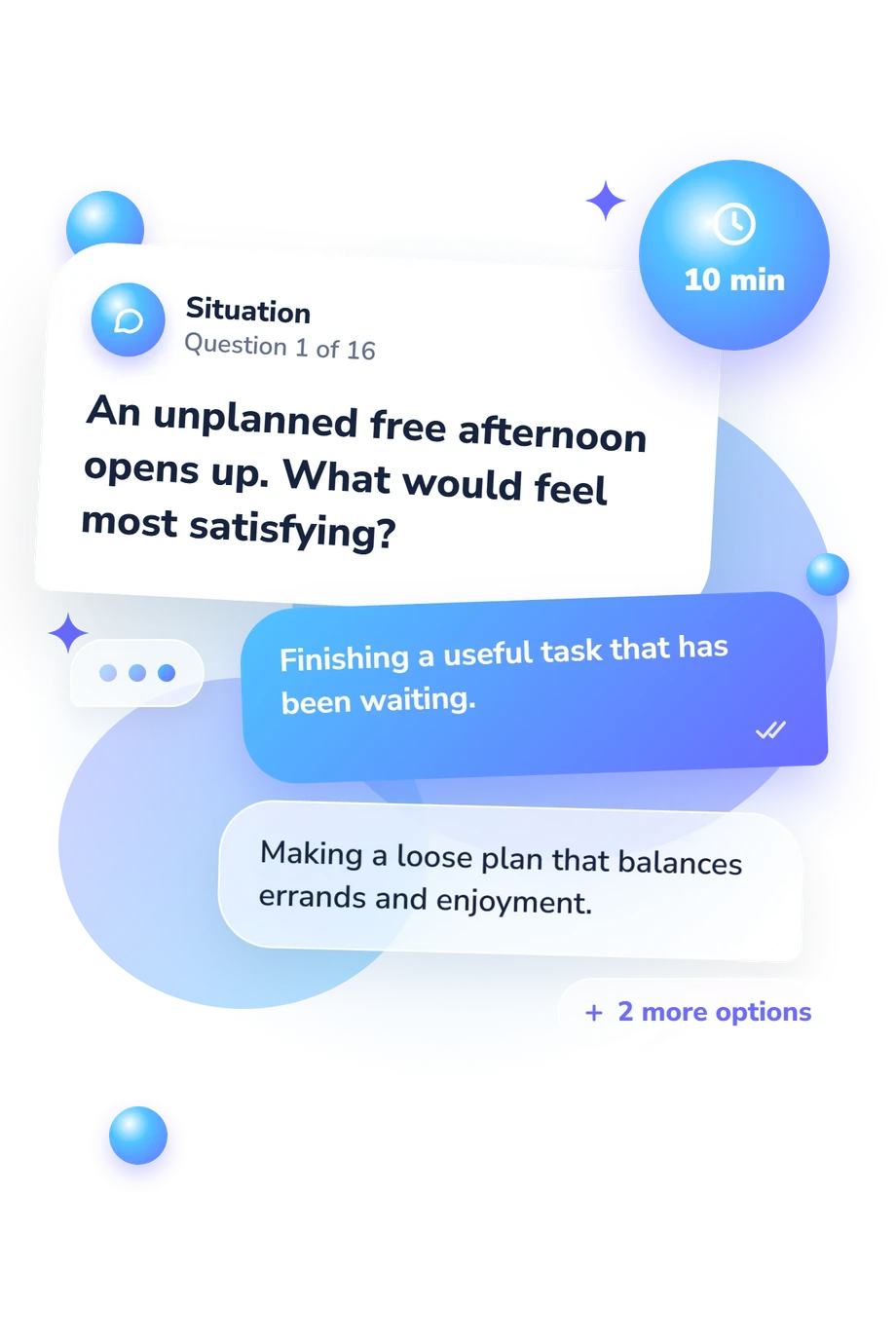
- Finishing a useful task that has been waiting.
- Making a loose plan that balances errands and enjoyment.
- Following a creative idea wherever it leads.
- Going somewhere unfamiliar without deciding the details first.
- Turn the idea into concrete steps, roles, and a timeline.
- Ask about resources and constraints before the group commits.
- Listen for a while and point out details others have missed.
- Expand the idea with unusual possibilities and bold variations.
- Reflect privately before deciding what I want to say.
- Ask for time and organize my thoughts in writing.
- Hear the other perspective and discuss it fairly soon.
- Talk through my immediate reaction while the issue is fresh.
Cube Personality Quiz - Description and methodology of the test
People who want a playful way to examine how they respond to structure, novelty, imagination, and reflection may find this cube personality quiz useful. It is designed for self-reflection, translating choices in symbolic and everyday situations into a profile of preferred approaches. The cube quiz can help you name patterns in decision-making, changing plans, creative problem-solving, and social observation.
What This Assessment Explores
Imagined scenes and everyday choices work together here. The questions examine how you build structure, transform ideas, approach novelty, and pause to understand before acting. A cube personality test result describes relative affinities rather than a fixed identity, helping you notice preferred approaches in decisions, projects, changing plans, and unfamiliar social settings.
The four displayed dimensions are:
- Grounded Builder (0-12) reflects preference for stability, practical structure, and turning ideas into workable action.
- Imaginative Shapeshifter (0-12) shows symbolic thinking, creative transformation, and flexible interpretation.
- Open Explorer (0-12) shows attraction to novelty, firsthand experience, and discovering possibilities through action.
- Quiet Observer (0-12) shows reflective distance, patient attention, and deliberate participation.
The displayed bands for every dimension are Light affinity (0-4), Mixed affinity (5-8), and Strong affinity (9-12). The highest score is the strongest affinity, while scores within one point form a blended result.
Methodology and Evidence Base
Each of the 16 items presents a situation-such as a changed plan, unfamiliar place, stalled project, or difficult feeling-with four response options. Choices span practical action, imaginative reframing, exploration, and observation; some scenes use the cube as a symbolic prompt. Choosing what feels most natural keeps the format accessible but makes the result dependent on honest self-report.
Scores are combined into four dimensions and interpreted comparatively: the highest result indicates the strongest current affinity, while close results can form a blended profile. This cube personality assessment is not norm-referenced, because population norms, reliability coefficients, and diagnostic cutoffs are not established for it.
Its closest conceptual source is the Kokology Cube exercise (Nagao and Saito, 2000), but this questionnaire is not its reproduction or validation. Lilienfeld, Wood, and Garb’s analysis of projective techniques cautions against treating symbolic responses as objective measures. The 2014 AERA, APA, and NCME standards likewise require evidence suited to the intended use. Mood, memory, self-awareness, and impression management can shape self-report.
- Nagao, Tadahiko, and Isamu Saito. Kokology: The Game of Self-Discovery. Touchstone, 2000. ISBN 9780684871486.
- Lilienfeld, Scott O., James M. Wood, and Howard N. Garb. "The Scientific Status of Projective Techniques." Psychological Science in the Public Interest, vol. 1, no. 2, 2000, pp. 27-66. 10.1111/1529-1006.002.
- American Educational Research Association, American Psychological Association, and National Council on Measurement in Education. Standards for Educational and Psychological Testing. American Educational Research Association, 2014.
Updated: