
Central Tendency Quiz
How the Scales are Structured
Who Usually Takes This Test?
See How You Compare
Below is a preview of how scores are typically distributed across each scale.
Example Questions From the Test
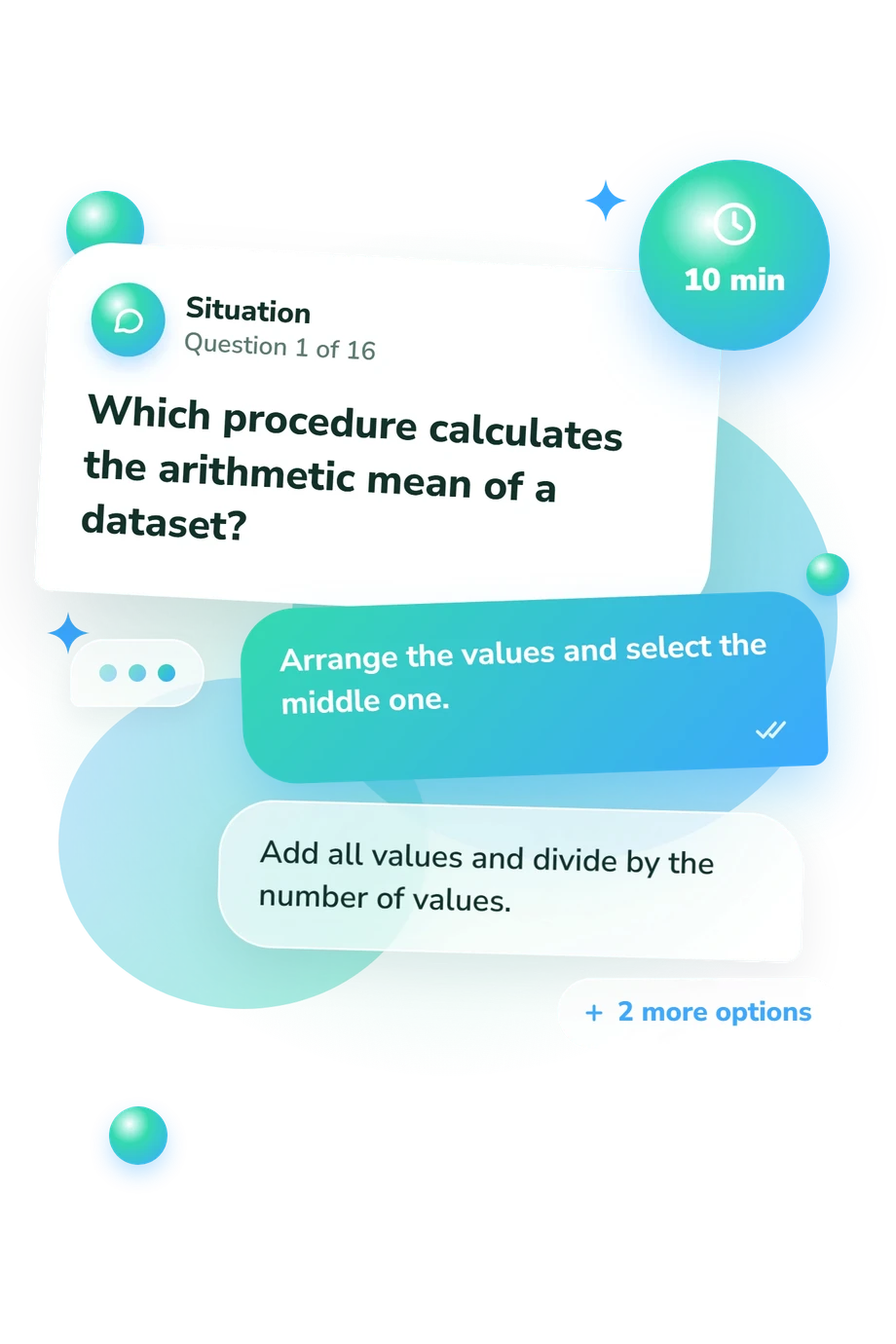
- Arrange the values and select the middle one.
- Add all values and divide by the number of values.
- Identify the value that occurs most often.
- Subtract the smallest value from the largest value.
- The mean, median, and mode are all 2.
- The mean and median are 2, while the mode is 3.
- The mean is 2, the median is 11/6, and the mode is 1.
- The mean is 11/6, and both the median and mode are 2.
- The mean, median, and mode are all 6.
- The median is 10, while the mean and mode are 6.
- The mean is 10, while both the median and mode are 6.
- The mode is 26 because it is the most extreme measurement.
Central Tendency Quiz - Description and methodology of the test
Learners checking classroom understanding of data summaries can use the Chapter 10 Mid Chapter Quiz Geometry as a focused review of central tendency. It suits students revising lessons, teachers directing practice, and independent learners identifying concepts that need another look. Reviewing answers for the Chapter 10 mid-chapter geometry quiz can connect each response with the calculation or definition behind it. Results highlight study priorities rather than overall mathematical ability.
What the Test Measures
The questions examine how learners calculate and select central-tendency measures in geometry contexts. They cover definitions, frequency tables, weighted means, outliers, categorical data, symmetry, shifts, and combined results. This makes it a useful mean median mode quiz for checking procedure and interpretation.
The main skill groups are:
- Calculation skills show whether you can find means, weighted means, medians, and modes accurately.
- Measure selection shows whether you can match a summary to categorical data, typical values, or outlier-affected data.
- Reasoning across datasets shows whether you can predict effects of shifts, symmetry, and unequal group sizes.
Results are summarized by Central Tendency Knowledge (0-16): Foundations to build (0-6) calls for review of definitions; Developing knowledge (7-12) shows core understanding with more practice for outliers, weighting, or measure selection; Strong knowledge (13-16) indicates accurate application. It describes quiz performance, not overall mathematical ability.
Methodology and Evidence Base
Each item presents a problem with four answer choices and asks the learner to calculate, identify, or interpret a result. Success depends on arithmetic and choosing the measure that fits the data. As a central tendency practice quiz, it can reveal a misconception that one formula may miss.
Scoring summarizes performance across the selected-response items and assigns the displayed result band; item weighting and partial credit are not part of the stated scoring description. Read the score as feedback on the sampled content, especially whether a learner can explain why a mean, median, or mode fits a situation.
Its evidence base is conceptually consistent with Ismail and Chan (2015) on errors in central-tendency reasoning, Landtblom and Sumpter (2025) on students’ choices of useful measures, and Chan, Ismail, and Sumintono (2016) on statistical reasoning. The quiz should not be treated as a standardized reproduction of those studies.
Interpretation should guide study planning: performance may vary with instruction, wording, and familiarity with the examples. The quiz cannot establish broad mathematical ability or replace a fuller assessment of statistical reasoning.
- Zaleha Ismail and Shiau Wei Chan. Malaysian Students’ Misconceptions about Measures of Central Tendency: An Error Analysis. AIP Conference Proceedings, 1643, 93-100 (2015). 10.1063/1.4907430
- Karin Landtblom and Lovisa Sumpter. Which Measure of Central Tendency Is Most Useful? Grade 6 Students’ Expressed Statistical Literacy. Statistics Education Research Journal, 24(2), 1-18 (2025). 10.52041/serj.v24i2.811
- Shiau Wei Chan, Zaleha Ismail, and Bambang Sumintono. A Framework for Assessing High School Students’ Statistical Reasoning. PLOS ONE, 11(11), e0163846 (2016). 10.1371/journal.pone.0163846
Updated: