
Dr. Oz Alzheimer's Memory Quiz
How the Scales are Structured
Who Usually Takes This Test?
See How You Compare
Below is a preview of how scores are typically distributed across each scale.
Example Questions From the Test
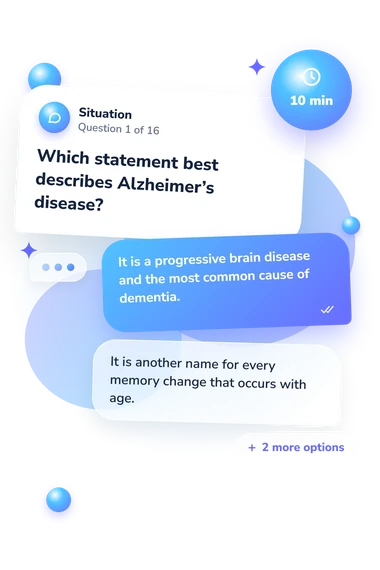
- It is a progressive brain disease and the most common cause of dementia.
- It is another name for every memory change that occurs with age.
- It is a temporary state of confusion that always resolves within hours.
- It is a normal stage of aging that affects everyone who lives long enough.
- Getting lost while walking through one’s own neighborhood
- Losing the ability to manage bills that were previously routine
- Frequently forgetting recent conversations without later recall
- Temporarily struggling to recall a name and remembering it later
- A family history of late-life dementia
- A recently started medicine with anticholinergic effects
- The person’s current age
- The number of years the person attended school
Dr. Oz Alzheimer's Memory Quiz - Description and methodology of the test
People who want a clearer grounding in Alzheimer’s disease, memory changes, and practical responses can use the Dr Oz Alzheimer's Memory Quiz Test as an educational self-check. People who use this Dr Oz brain quiz can distinguish ordinary lapses from concerning patterns and prepare for informed conversations with a healthcare professional. The result reflects topic knowledge, not personal memory ability.
What This Assessment Explores
This questionnaire examines practical knowledge about Alzheimer’s disease rather than testing whether the respondent has a memory disorder. It covers dementia’s relationship to Alzheimer’s, ordinary lapses versus concerning changes, delirium, safety, assessment, communication, medicines, and treatment claims. It suits readers and caregivers who want to respond thoughtfully to possible cognitive changes.
The questionnaire links factual knowledge with proportionate action, making it an Alzheimer's memory test that keeps safety and independence in view. The result uses one educational scale:
- Alzheimer’s Memory Knowledge (0-16) measures recognition of core facts about Alzheimer’s, memory changes, assessment, safety, and practical support.
- Foundation to build (0-6) indicates that the differences among ordinary lapses, persistent cognitive changes, and sudden confusion need review.
- Developing knowledge (7-12) indicates understanding of many central ideas, with some gaps in assessment, support, or safety.
- Strong knowledge (13-16) indicates a well-rounded understanding of Alzheimer’s, memory changes, and practical support.
Methodology and Scientific Basis
Each item uses multiple-choice answers with one best-supported response. The choices contrast evidence-based action with minimization, overreaction, unsafe delay, or unjustified diagnosis. As a self-administered educational assessment, the questionnaire therefore assesses knowledge and judgment about Alzheimer’s-related situations, not memory performance itself.
The result displays the questionnaire score and corresponding educational band; the individual answer weighting is not specified. Because the bands are unvalidated educational summaries rather than clinical cutoffs, the result cannot diagnose or rule out Alzheimer’s disease or another condition.
The methodology is conceptually consistent with Alzheimer's Disease Knowledge Test (Dieckmann et al., 1988), the Alzheimer's Disease Knowledge Scale, and the Dementia Knowledge Assessment Scale. However, this questionnaire is not presented as an adaptation of those instruments, so their psychometric findings do not validate this online version. As an Alzheimer's quiz, performance can reflect prior learning, attention, wording, confidence, and current stress; it also shows how well the respondent recognizes distinctions such as dementia versus Alzheimer’s and appropriate responses to safety concerns. Gradual concerning changes need professional assessment; sudden confusion or immediate danger calls for urgent help.
- Dieckmann, Lisa, Steven H. Zarit, Judy M. Zarit, and Margaret Gatz. The Alzheimer's Disease Knowledge Test. The Gerontologist. 1988;28(3):402-408. 10.1093/geront/28.3.402
- Carpenter, Brian D., Steve Balsis, Poorni G. Otilingam, Priya K. Hanson, and Margaret Gatz. The Alzheimer's Disease Knowledge Scale: Development and Psychometric Properties. The Gerontologist. 2009;49(2):236-247. 10.1093/geront/gnp023
- Annear, Michael J., Christine M. Toye, Claire E. Eccleston, Frances J. McInerney, Kate-Ellen J. Elliott, Bruce K. Tranter, Thomas Hartley, and Andrew L. Robinson. Dementia Knowledge Assessment Scale: Development and Preliminary Psychometric Properties. Journal of the American Geriatrics Society. 2015;63(11):2375-2381. 10.1111/jgs.13707