
Cub Scout Quiz
How the Scales are Structured
Who Usually Takes This Test?
See How You Compare
Below is a preview of how scores are typically distributed across each scale.
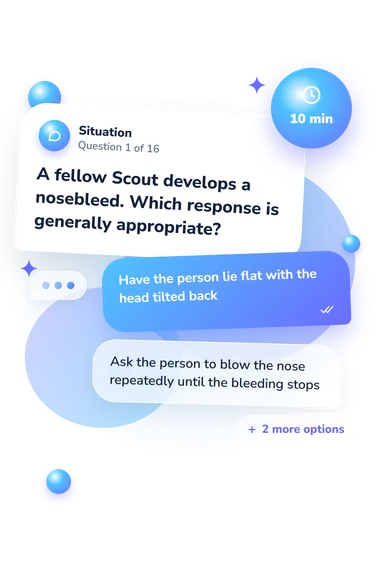
Example Questions From the Test
- Heat, fuel, and carbon dioxide
- Heat, fuel, and oxygen
- Fuel, smoke, and oxygen
- Sparks, ash, and oxygen
- Stop, drop to the ground, and roll
- Pull the burning clothing over your head
- Run toward the nearest source of water
- Remain standing while calling for emergency help
- Directly beneath the tallest tree nearby
- A substantial enclosed building or hard-topped vehicle
- A low spot where you lie flat on the ground
- An open-sided picnic shelter
Cub Scout Quiz - Description and methodology of the test
For Scouts, families, and adult leaders, this assessment offers a practical way to see how scenario choices reveal applied knowledge in outdoor and group situations. The cub scout quiz questions ask the respondent to select an action rather than simply recall a definition. As a cub scout knowledge test, it shows how familiar the respondent is with the reasoning behind safe, responsible choices.
What This Assessment Explores
This check examines decisions a Scout may face outdoors and in groups. In this Cub Scout quiz, questions and answers require applied knowledge through safer choices, protecting others, caring for nature, and recognizing when help is needed.
The groups represented in the questions are:
- First aid covers responses to bleeding, burns, cold exposure, allergies, and emergencies.
- Personal safety covers fire, hot objects, clothing ignition, and supervised pocketknife use.
- Outdoor conduct covers campsites, wildlife, lightning shelter, and Leave No Trace.
- Navigation and teamwork cover compass direction, buddy awareness, and staying findable after separation.
The Cub Scout Knowledge scale runs 0-16. Trail Starter (0-6) means some essentials are recognized, while first-aid, outdoor-conduct, and safety basics need review; Growing Scout (7-12) means many common skills are understood, with a few areas to practice; Skills Ready (13-16) shows strong knowledge across the situations covered.
Methodology and Evidence Base
Each item presents a short situation followed by four answer choices. The respondent selects the option that best matches safe, responsible practice. The quiz reports one overall score with the displayed bands, but the point value assigned to each response is not specified.
The method is an online, scenario-based multiple-choice knowledge assessment. Its content is conceptually consistent with Guide to Safe Scouting (Boy Scouts of America, 2024), which provides safety guidance for activities, emergencies, tools, weather, and the outdoors.
First-aid content also connects with the educational focus examined by Bilal and Hussein (2026) in their study of Scout leaders. That study offers contextual support for the relevance of first-aid knowledge, not evidence that this questionnaire is validated.
Viewed as a cub scout knowledge quiz, the result is best used to identify topics for review, supervised practice, and discussion. Because the questionnaire has no stated population norms or certification status, its labels are educational rather than formal qualifications. Performance can vary with guessing, attention, prior instruction, and the situation imagined by the respondent.
- Boy Scouts of America. Cub Scout Leader Book. Irving, TX: Boy Scouts of America, 2024.
- Scouting America. Guide to Safe Scouting. Online edition, updated 2025.
- Bilal, Rajha Abdul Hussein, and Bashir Shaker Hussein. The impact of an educational program in developing first aid knowledge for Scout leaders holding the wooden badge. Sport Culture, 17(Special Issue), 589-608, 2026. 10.25130/sc.2026.17.30