
Colleen Hoover Book Boyfriend Quiz
How the Scales are Structured
Who Usually Takes This Test?
See How You Compare
Below is a preview of how scores are typically distributed across each scale.
Example Questions From the Test
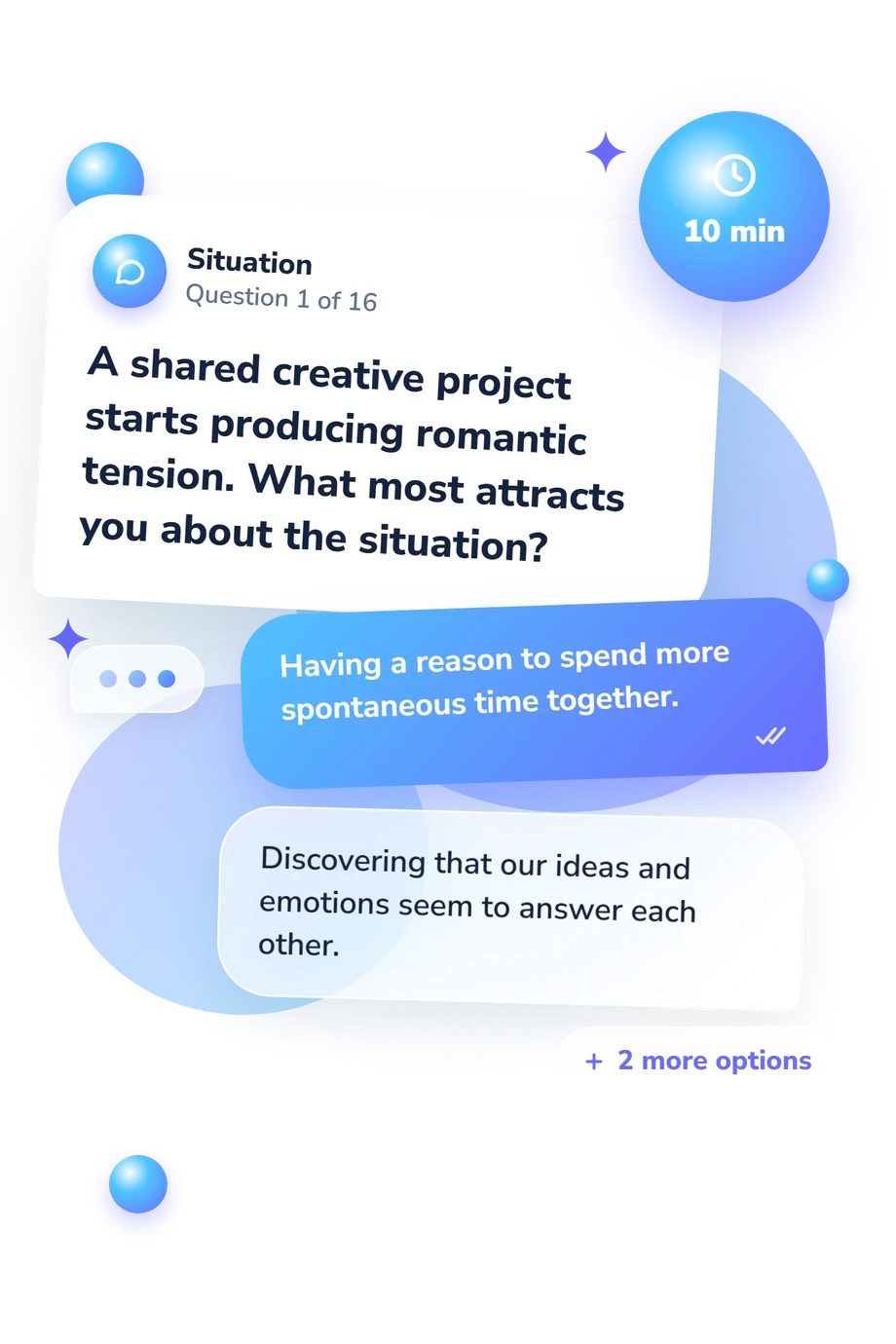
- Having a reason to spend more spontaneous time together.
- Discovering that our ideas and emotions seem to answer each other.
- The thrill of keeping the creative and romantic sides unpredictable.
- Finishing the project well; I would rather keep romance separate.
- Two friends steadily discovering that they already understand each other.
- A guarded person confronting the past and gradually making room for love.
- Two ambitious people learning to fit their long-term plans together.
- An immediate attraction that becomes an unpredictable adventure.
- Working side by side on music, writing, or another creative idea.
- Cooking a familiar meal and talking through the week.
- Heading out without a plan and seeing where the night goes.
- Sharing favorite songs and explaining the memories behind them.
Colleen Hoover Book Boyfriend Quiz - Description and methodology of the test
Readers who enjoy Colleen Hoover’s fictional relationships can use the Colleen Hoover Book Boyfriend Quiz to examine which romantic dynamics feel most compelling to them. As a quiz about who your Colleen Hoover boyfriend is, it connects personal preferences with recurring fictional relationship patterns without evaluating a real partner. The result helps readers name the story qualities and relationship dynamics they find compelling.
What This Assessment Explores
Fictional affinity covers pace, communication, loyalty, vulnerability, creativity, and future orientation. Scenarios cover conflict, support, chemistry, and shared plans. The result identifies a fictional Colleen Hoover love interest, not a real relationship.
Four displayed dimensions are:
- Atlas Corrigan Affinity (0-12) measures patient, grounded, loyal, future-minded attraction: Different Rhythm (0-4), Steady Connection (5-8), Strong Atlas Affinity (9-12).
- Dean Holder Affinity (0-12) measures direct, intense, candid, devoted attraction and difficult-truth seeking: Different Energy (0-4), Loyal Spark (5-8), Strong Holder Affinity (9-12).
- Miles Archer Affinity (0-12) measures attraction to guarded intensity, chemistry, action-based affection, and gradual vulnerability: Different Tempo (0-4), Conditional Chemistry (5-8), Strong Miles Affinity (9-12); this reflects fiction, not approval of unavailable behaviour.
- Ridge Lawson Affinity (0-12) measures creative partnership, expressive communication, sensitivity, and art-grown bonds: Different Frequency (0-4), Shared Notes (5-8), Strong Ridge Affinity (9-12).
Methodology and Scientific Basis
The questionnaire uses a scenario-based self-report: 16 short scenarios offer four possible reactions or priorities. Choices address closeness, conflict, support, timing, communication, and ambition, so the profile reflects recurring preferences rather than one isolated answer. There is no single correct response. The result compares four fictional character-affinity scores: the highest is strongest, while totals within one point form a blended result.
Research on parasocial interaction and narrative-character identification offers conceptual context for bonds with fictional figures and identification with narrative characters. Those themes are conceptually consistent with this questionnaire’s fictional-affinity construct, but it is not a validated adaptation of those measures.
The displayed categories are the intended interpretive frame for the fictional character-affinity profile; they describe fictional romantic preferences rather than personality. Self-report can shift with mood, current experience, cultural expectations, and self-awareness, so the profile is best used to reflect on fictional dynamics and whether dramatic appeal differs from real-life preferences.
- Nicole Liebers and Holger Schramm. “Friends in books: The influence of character attributes and the reading experience on parasocial relationships and romances.” Poetics, vol. 65, 2017, pp. 12-23. 10.1016/j.poetic.2017.10.001
- Kate Y. Huang and Helene H. Fung. “Measuring identification with narrative characters: the development and validation of a new scale.” Current Psychology, vol. 43, 2024, pp. 24835-24849. 10.1007/s12144-024-06191-2
- Donald Horton and R. Richard Wohl. “Mass Communication and Para-Social Interaction: Observations on Intimacy at a Distance.” Psychiatry, vol. 19, no. 3, 1956, pp. 215-229. 10.1080/00332747.1956.11023049
Updated: