
Dr. Goglia Metabolic Quiz
How the Scales are Structured
Who Usually Takes This Test?
See How You Compare
Below is a preview of how scores are typically distributed across each scale.
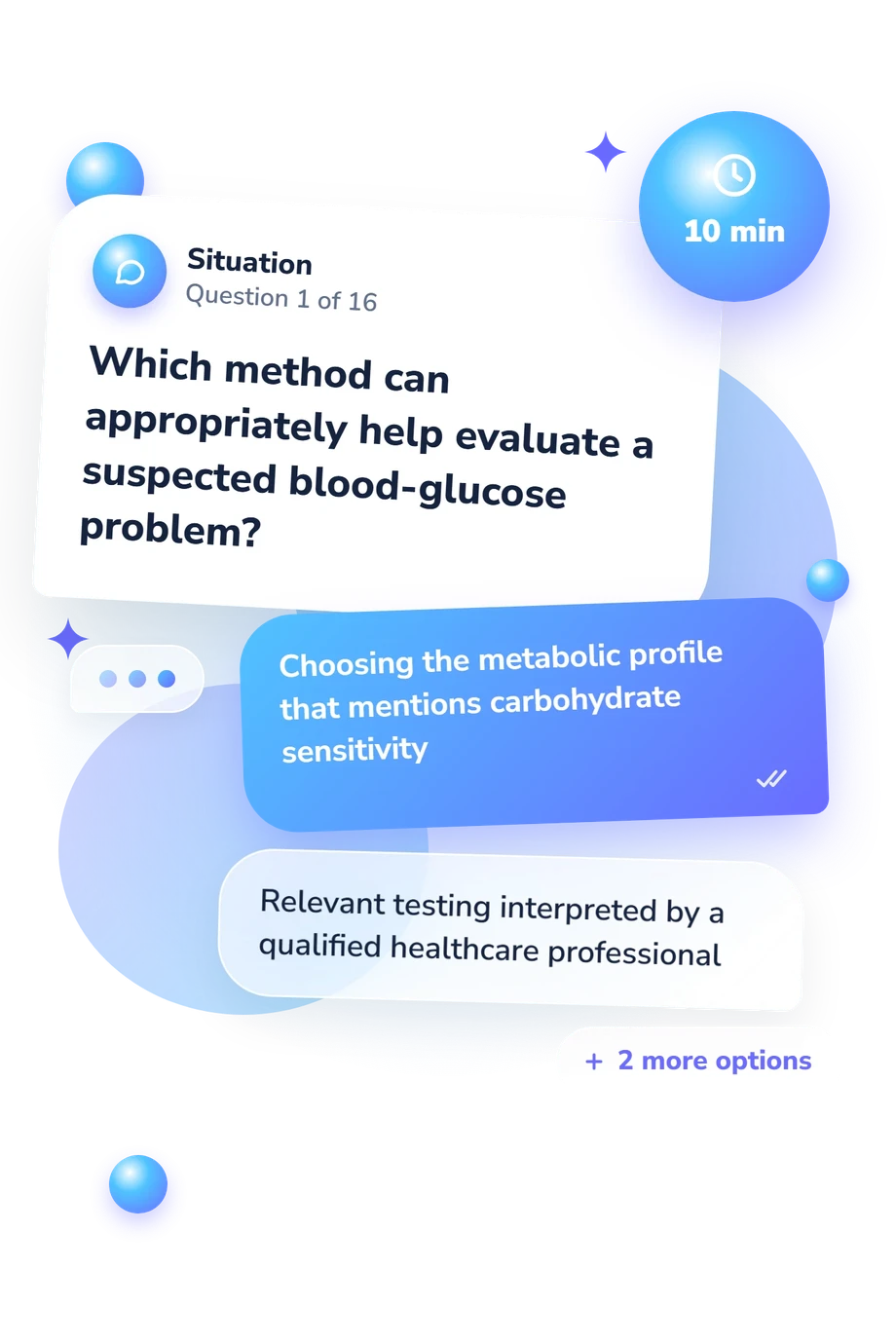
Example Questions From the Test
- Serving as the body's only possible energy source
- Helping the body absorb vitamins A, D, E, and K
- Preventing all changes in blood glucose
- Replacing the need for dietary protein
- They are converted directly into essential amino acids
- They are required for absorbing every vitamin
- They can be broken down into glucose and used as fuel
- They permanently determine resting metabolic rate
- Preferred breakfast flavor
- Usual meal timing
- Self-selected metabolic profile
- Age
Dr. Goglia Metabolic Quiz - Description and methodology of the test
Readers considering a major diet change can use the Dr Goglia Metabolic Quiz to test whether they understand the limits of drawing dietary conclusions from personal food experiences. Readers taking the Dr Goglia quiz can use its result to evaluate whether their conclusions about those experiences respect the limits of metabolic typing. The result supports a more careful decision about what this framework can explain without prescribing a fixed diet.
What This Assessment Explores
This tool checks understanding of metabolic concepts and the limits of metabolic typing. It helps readers understand what a metabolic typing questionnaire can and cannot show when dietary conclusions are drawn from personal food experiences.
Four themes shape the result:
- Metabolism fundamentals explain how energy is obtained, used, and maintained in the body.
- Macronutrient roles clarify what carbohydrate, protein, and fat contribute to physiology.
- Food-response interpretation separates useful observations from conclusions drawn from one experience.
- Framework limits identify what personal food experiences cannot prove about disease or diet.
The result is reported as Dr. Goglia Metabolic Framework Knowledge (0-16). Its bands are Foundations to build (0-6), Developing understanding (7-12), and Strong framework literacy (13-16). This describes framework literacy, not a personal metabolic type or required macronutrient ratio.
Methodology and Scientific Basis
Each of the 16 items presents a question or scenario with four answer choices. Topics include glucose assessment, training demands, macronutrient roles, satiety, basal-metabolic-rate estimates, and warning symptoms. The preferred answer separates established knowledge from unsupported conclusions.
The single knowledge score is divided into three bands, but no per-item weighting rule is stated. Lower results indicate foundational concepts to revisit, middle results suggest developing understanding, and higher results indicate stronger framework literacy. As a metabolism knowledge test, it highlights topics for review rather than determining a personal metabolic category or required diet.
The ideas are conceptually consistent with Philip Goglia (2002), but this questionnaire is not a reproduced or validated version of that work. Camps et al. (2020) is a measured metabotype study; Hillesheim and Brennan (2020) is a review of metabotyping. Neither source validates this online questionnaire.
Because the items use educational and hypothetical situations, answers reflect knowledge and interpretation, not symptoms, food responses, or metabolic rate. The result is an unvalidated educational score, best read as a prompt for targeted review of concepts that remain unclear.
- Goglia, Philip L. Turn Up the Heat: Unlock the Fat-Burning Power of Your Metabolism. New York: Viking, 2002.
- Camps, Stefan Gerardus, Huann Rong Koh, Nan Xin Wang, and Christiani Jeyakumar Henry. A fructose-based meal challenge to assess metabotypes and their metabolic risk profile: A randomized, crossover, controlled trial. Nutrition 78 (2020): 110799. 10.1016/j.nut.2020.110799
- Hillesheim, Elaine, and Lorraine Brennan. Metabotyping and its role in nutrition research. Nutrition Research Reviews 33, no. 1 (2020): 33-42. 10.1017/S0954422419000179
Updated: