
Do You Dress Like Your Zodiac Sign Quiz
How the Scales are Structured
Who Usually Takes This Test?
See How You Compare
Below is a preview of how scores are typically distributed across each scale.
Example Questions From the Test
- I would weave in multiple sign-inspired elements
- I would dress for the celebration rather than the zodiac theme
- I might include one subtle reference
- I would let the sign influence the outfit’s overall mood
- I would wear it mainly when it happened to suit an outfit
- I would regularly style outfits around it as a personal signature
- I would enjoy the gift without necessarily wearing the symbol
- I would use it for selected occasions or layered looks
- I would probably prefer a very different board
- The sign board would contain a few appealing details
- The sign board would be among my stronger matches
- The sign board would feel remarkably close to my wardrobe
Do You Dress Like Your Zodiac Sign Quiz - Description and methodology of the test
People curious about astrology in their wardrobes can use the Do You Dress Like Your Zodiac Sign Quiz to compare personal choices with familiar sun-sign style descriptions. This zodiac sign clothing quiz suits anyone interested in personal style, symbolic details, or the difference between accidental resemblance and deliberate theme. Its questions compare clothing choices with zodiac-sign ideas, leaving room for practical needs, mood, and personal taste.
What the Questionnaire Measures
The questions focus on three wardrobe dimensions. They ask how strongly sun-sign descriptions resemble clothes you enjoy, whether zodiac references guide purchases or styling, and how comfortably your taste moves beyond expected aesthetics. For this zodiac style test, the result is most useful when these dimensions are read together rather than treated as one verdict.
These dimensions are:
- Style Independence (0-15) measures freedom beyond sign expectations: Sign-Centered 0-5, Flexible 6-10, or Independent Orbit 11-15.
- Sun-Sign Style Recognition (0-15) measures resemblance to sign-associated themes: Different Orbit 0-5, Partial Echo 6-10, or Strong Resemblance 11-15.
- Zodiac Styling Intentionality (0-15) measures deliberate use of zodiac ideas: Light-Touch Inspiration 0-5, Selective Inspiration 6-10, or Signature Inspiration 11-15.
Independence is not the reverse of recognition: a wardrobe can resemble a sign while staying flexible.
Methodology and Evidence Base
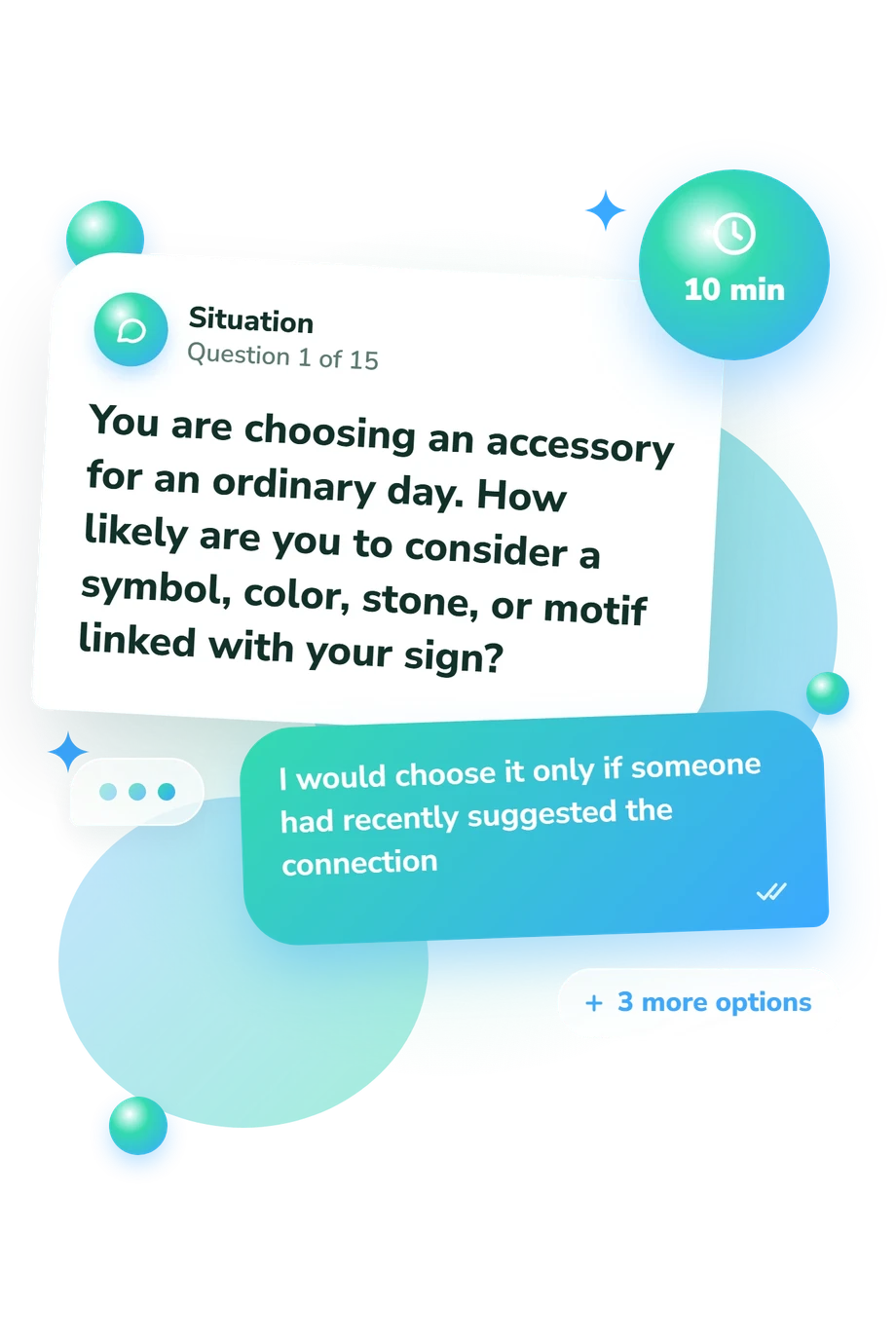
Each item presents an everyday styling situation, from choosing an accessory to packing for mixed plans or interpreting a compliment. Four answer choices describe varying sign influence, wardrobe resemblance, practical adjustment, or experimentation. Responses are organized into the three dimensions. The astrology clothing test provides no documented item-level point rule; its online scoring is not standardized or normed, so displayed ranges are result bands, not rules inferred from choices.
The questionnaire is conceptually consistent with Chung’s (2011) study of astrology, dressing motivation, and dressing style, but it is not an adaptation of that study. Feinberg, Mataro, and Burroughs (1992) link clothing to social identity; van Rooij (1994) and Hartmann, Reuter, and Nyborg (2006) caution against treating astrological categories as established explanations of personality differences.
Because the questions connect astrology with clothing choices, the result is a present self-report profile. It has no population norms or standardization, and answers may shift with context, taste, self-awareness, and response style. Read it as a prompt to reflect on familiar or intentional style, not as evidence that a birth sign determines clothing behavior.
- Chung, Mei-chen. (2011). The Difference Dressing Motivation and Dressing Style among Astrology. Master's thesis, Chung Yuan Christian University, 75 pp.
- van Rooij, Jan J. F. (1994). Introversion-extraversion: astrology versus psychology. Personality and Individual Differences, 16(6), 985-988. 10.1016/0191-8869(94)90243-7
- Feinberg, Richard A., Lisa Mataro, and W. Jeffrey Burroughs. (1992). Clothing and Social Identity. Clothing and Textiles Research Journal, 11(1), 18-23. 10.1177/0887302X9201100103
- Hartmann, Peter, Martin Reuter, and Helmuth Nyborg. (2006). The relationship between date of birth and individual differences in personality and general intelligence: A large-scale study. Personality and Individual Differences, 40(7), 1349-1362. 10.1016/j.paid.2005.11.017
Updated: