
CPR and BLS Pediatric Quiz
How the Scales are Structured
Who Usually Takes This Test?
See How You Compare
Below is a preview of how scores are typically distributed across each scale.
Example Questions From the Test
- 30 compressions to 1 breath
- 30 compressions to 2 breaths
- 5 compressions to 1 breath
- 15 compressions to 2 breaths
- About 2 cm, regardless of the infant’s size
- About one quarter of the chest’s front-to-back depth
- About 5 cm, the same target commonly used for a child
- About one third of the chest’s front-to-back depth, roughly 4 cm
- Over the upper end of the breastbone, close to the throat
- Directly over the left side of the chest above the heart
- Over the lowest tip of the breastbone
- In the center of the chest on the lower half of the breastbone
CPR and BLS Pediatric Quiz - Description and methodology of the test
For learners preparing for a pediatric resuscitation course, skills session, or refresher, the cpr and basic life support pediatric bls quiz checks whether key decisions for infants and children are understood. It focuses on recognition and first-response choices rather than personal characteristics. A pediatric BLS quiz result can point to concepts that merit another review before supervised practice.
What This Assessment Explores
This assessment asks learners to apply pediatric emergency-care principles to breathing problems, choking, unresponsiveness, pulse checks, compressions, ventilation, emergency activation, and AED use. The scenarios separate similar situations, such as effective coughing from severe obstruction and gasping from normal breathing. As a pediatric CPR test, it emphasizes recognition, sequence, and infant-child differences.
The questions cover four areas:
- Breathing and pulse recognition shows how the child’s condition changes the next response.
- Compression and ventilation technique covers rate, depth, recoil, breaths, and ratios.
- Choking care distinguishes effective cough, severe obstruction, and infant responses.
- Emergency response and AED decisions address help activation and pad use.
Pediatric CPR and BLS Knowledge runs from 0-16: Foundations to strengthen (0-6), Developing knowledge (7-12), and Strong knowledge (13-16). The bands indicate review needs, not certification or practical competence.
Methodology and Evidence Base
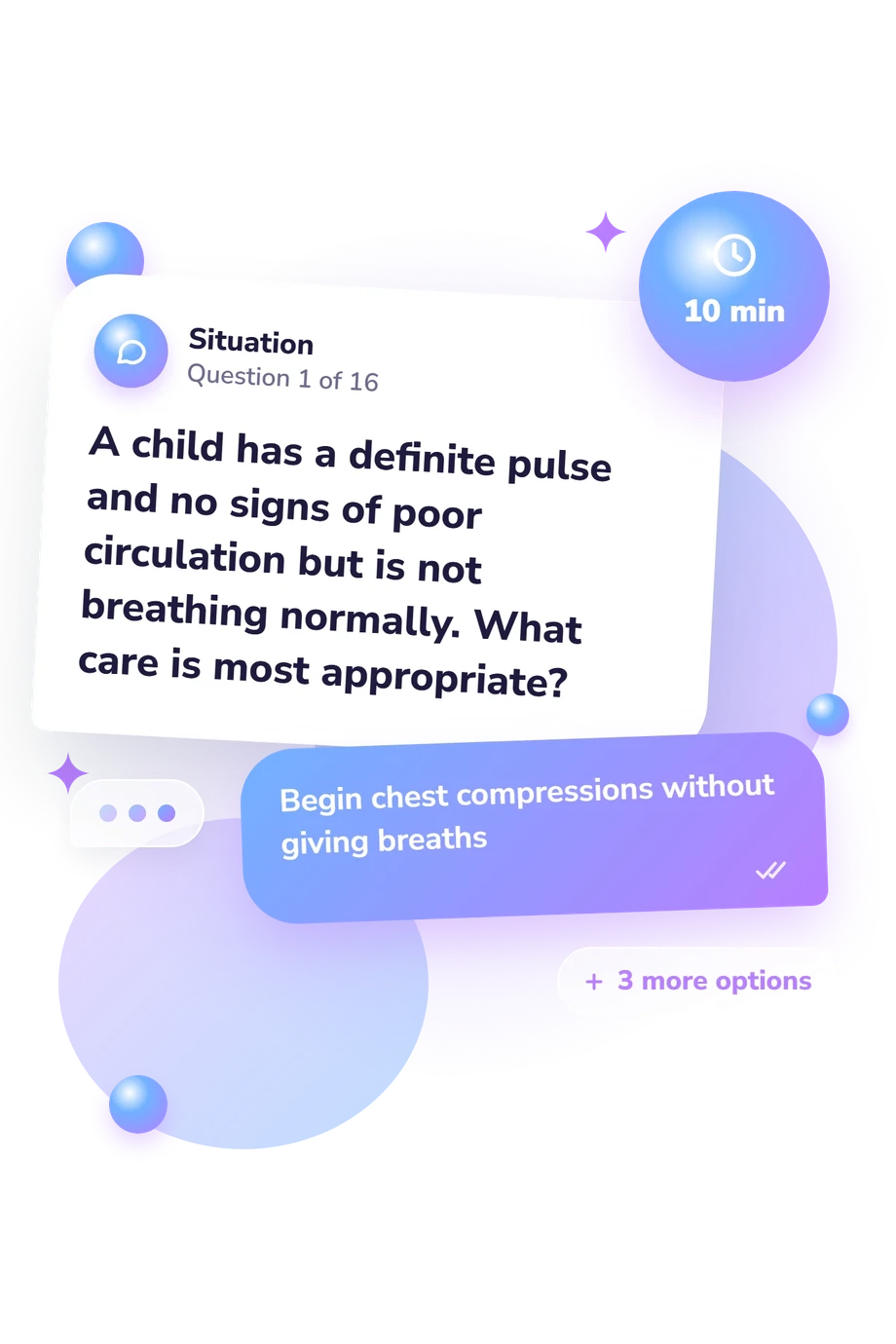
Each item presents a short emergency scenario or technique question with four answer choices. The respondent selects the option that best matches pediatric resuscitation guidance. The result is a bounded total on the displayed scale. Its displayed total summarizes performance across the knowledge topics represented by the items in this pediatric basic life support quiz. Answer-level weighting is not specified by the questionnaire.
Content is conceptually consistent with the 2025 AHA/AAP Pediatric BLS Guidelines. The 2020 AHA pediatric life-support guidance and 2025 ILCOR pediatric life-support consensus provide related context. These are guidance documents, not the questionnaire itself, and this test is not presented as an adaptation of any one published instrument. Its method is educational: single-best-answer items check recommended sequences and technique distinctions.
Interpretation is strongest when the result directs review of infant-versus-child distinctions, choking management, compressions, breaths, and AED use. The score is an unvalidated educational measure without a clinical cutoff; answers may reflect memory, wording, current context, or gaps in self-awareness. Current accredited training and local protocols remain the reference when action is required.
- Benny L. Joyner, Jr.; Maya Dewan; Aarti Bavare; Allan de Caen; Kimberly DiMaria; Joelle Donofrio-Odmann; Gwen Fosse; Sarah Haskell; Melissa Mahgoub; Garth Meckler; Jennifer Requist; Stephen M. Schexnayder; Michelle Olech Smith; David Werho; Tia T. Raymond. Part 6: Pediatric Basic Life Support: 2025 American Heart Association and American Academy of Pediatrics Guidelines for Cardiopulmonary Resuscitation and Emergency Cardiovascular Care. Circulation. 2025;152(16_suppl_2):S424-S447. 10.1161/CIR.0000000000001370
- Alexis A. Topjian; Tia T. Raymond; Dianne Atkins; Melissa Chan; Jonathan P. Duff; Benny L. Joyner, Jr.; Javier J. Lasa; Eric J. Lavonas; Arielle Levy; Melissa Mahgoub; Garth D. Meckler; Kathryn E. Roberts; Robert M. Sutton; Stephen M. Schexnayder; Pediatric Basic and Advanced Life Support Collaborators. Part 4: Pediatric Basic and Advanced Life Support: 2020 American Heart Association Guidelines for Cardiopulmonary Resuscitation and Emergency Cardiovascular Care. Circulation. 2020;142(16_suppl_2):S469-S523. 10.1161/CIR.0000000000000901
- Barnaby R. Scholefield; Jason Acworth; Kee-Chong Ng; Lokesh Kumar Tiwari; Tia T. Raymond; Andrea Christoff; Stephan Katzenschlager; Raffo Escalante-Kanashiro; Arun Bansal; Alexis Topjian; Monica Kleinman; Hiroshi Kurosawa; Michelle C. Myburgh; Jimena Del Castillo; Joseph Rossano; Jana Djakow; Anne-Marie Guerguerian; Vinay M. Nadkarni; Thomaz Bittencourt Couto; Stephen M. Schexnayder; Gabrielle Nuthall; Janice A. Tijssen; Gene Yong-Kwang Ong; James M. Gray; Jesus Lopez-Herce; Ester Shambekela Ambunda; Jerry P. Nolan; Katherine M. Berg; Laurie J. Morrison; Dianne L. Atkins; Allan R. de Caen; Pediatric Life Support Task Force Collaborators. Pediatric Life Support: 2025 International Liaison Committee on Resuscitation Consensus on Science With Treatment Recommendations. Circulation. 2025;152(16_suppl_1):S116-S164. 10.1161/CIR.0000000000001362
Updated: