
Do I Have a Personality Quiz
How the Scales are Structured
Who Usually Takes This Test?
See How You Compare
Below is a preview of how scores are typically distributed across each scale.
Example Questions From the Test
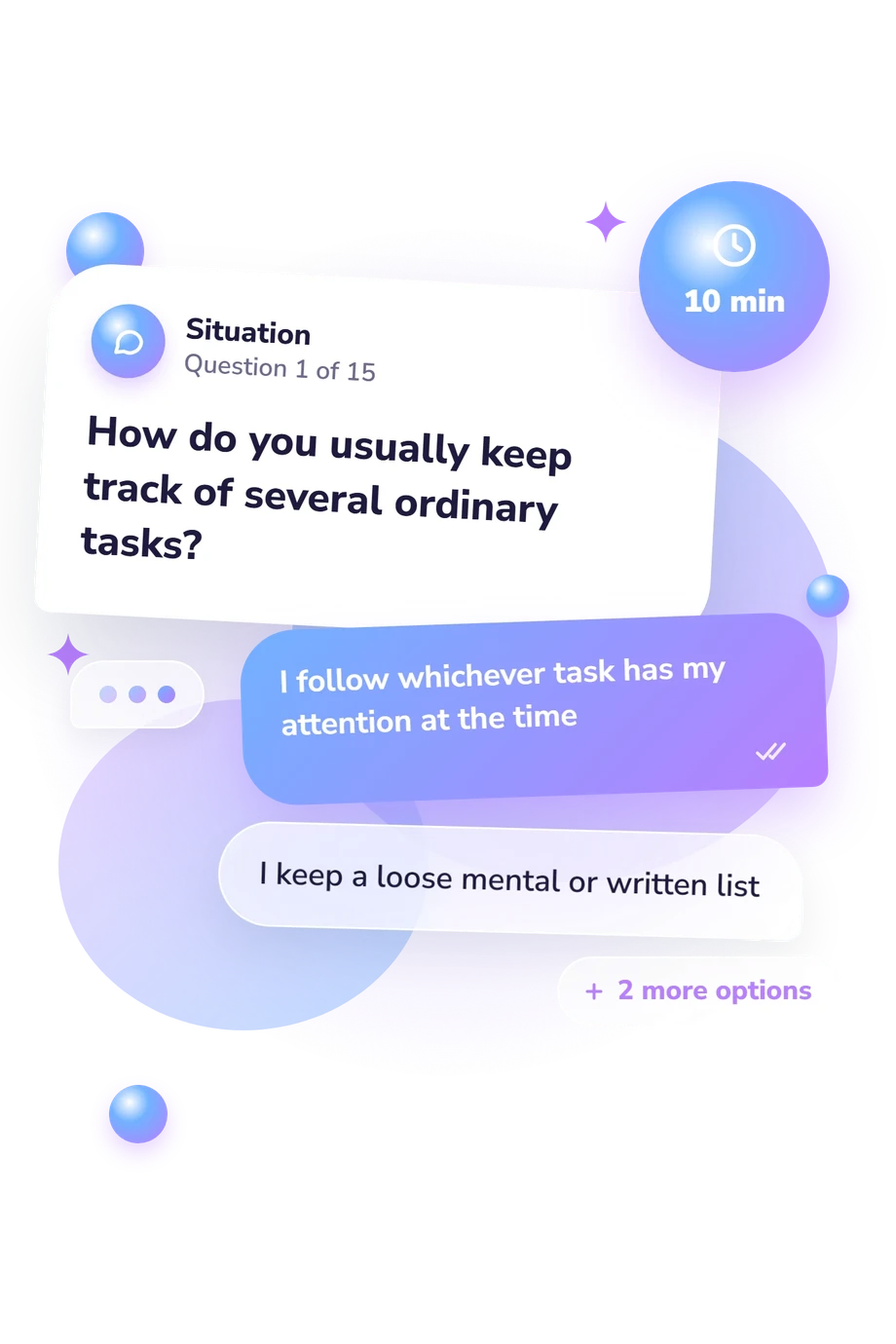
- I follow whichever task has my attention at the time
- I keep a loose mental or written list
- I use a prioritized list and revise it as needed
- I assign tasks to specific times and track each step
- Enjoy it privately before deciding whether to share
- Tell one person I trust
- Share it with a small circle
- Reach out broadly and celebrate with others
- I would rather keep it private while I process it
- I give a general answer without going far into my feelings
- I explain the main feeling and what prompted it
- I talk through the experience and my emotions in detail
Do I Have a Personality Quiz - Description and methodology of the test
For people seeking a structured way to reflect on how they relate to others, handle feelings, and organize everyday choices, Do I Have a Personality Quiz offers a concise self-report snapshot. It suits people considering a personality assessment for self-reflection, especially when they want language for recurring preferences and a clearer way to compare patterns across situations.
What This Assessment Explores
Three areas are sampled: emotional sharing, social engagement, and preference for predictability. The result describes tendencies rather than assigning one overall label. It may help a reader compare patterns across relationships, work, leisure, and unexpected changes. This psych personality quiz organizes everyday preferences into a reflective profile rather than assigning one defining type.
The displayed dimensions are:
- Emotional Openness (0-15) reflects how readily feelings are shared: Private processor (0-5), Selectively open (6-10), and Expressively open (11-15).
- Social Engagement (0-15) reflects social involvement, not ability or worth: Solitude-oriented (0-5), Selectively social (6-10), and Outwardly engaged (11-15).
- Structure Preference (0-15) reflects the preferred level of predictability: Improvisational (0-5), Lightly structured (6-10), and Plan-oriented (11-15).
These bands are descriptive rather than ranked. A result is most useful as a starting point for observing recurring choices, not as a fixed identity.
Methodology and Scientific Basis
Each item presents four response options covering privacy, spontaneity, social contact, and planning. Situations include task management, group discussion, personal disclosure, emotional reactions, trips, and last-minute changes. The respondent chooses the answer closest to their usual pattern, not an ideal self-image.
The result is reported through three displayed scales; the point contribution of each response is not specified, so the bands should be read as descriptive profiles rather than reconstructed scoring rules. Scores are best read as profiles of preference, with context shaping how any tendency appears.
The Big Five Questionnaire by Caprara and colleagues is a published personality questionnaire developed to assess the five-factor model and is relevant to this format. Work by Gross and John on emotional expressivity is also relevant, while work by Gosling and colleagues shows how brief self-report items can sample broad personality domains. This questionnaire is conceptually consistent with those works, not an adaptation, restandardized version, or normed edition of any one of them.
Comparing the result with repeated experiences can make a personality profile more useful. Current mood, self-awareness, and response bias may influence a brief self-report, and the reflective bands are not clinical cutoffs.
- Caprara, Gian Vittorio, Claudio Barbaranelli, Laura Borgogni, and Marco Perugini. 'The Big Five Questionnaire': A New Questionnaire to Assess the Five Factor Model. Personality and Individual Differences 15, no. 3 (1993): 281-288. 10.1016/0191-8869(93)90218-R
- Gross, James J., and Oliver P. John. 'Facets of Emotional Expressivity: Three Self-Report Factors and Their Correlates.' Personality and Individual Differences 19, no. 4 (1995): 555-568. 10.1016/0191-8869(95)00055-B
- Gosling, Samuel D., Peter J. Rentfrow, and William B. Swann Jr. 'A Very Brief Measure of the Big-Five Personality Domains.' Journal of Research in Personality 37, no. 6 (2003): 504-528. 10.1016/S0092-6566(03)00046-1
Updated: