
Do I Have B12 Deficiency Quiz
How the Scales are Structured
Who Usually Takes This Test?
See How You Compare
Below is a preview of how scores are typically distributed across each scale.
Example Questions From the Test
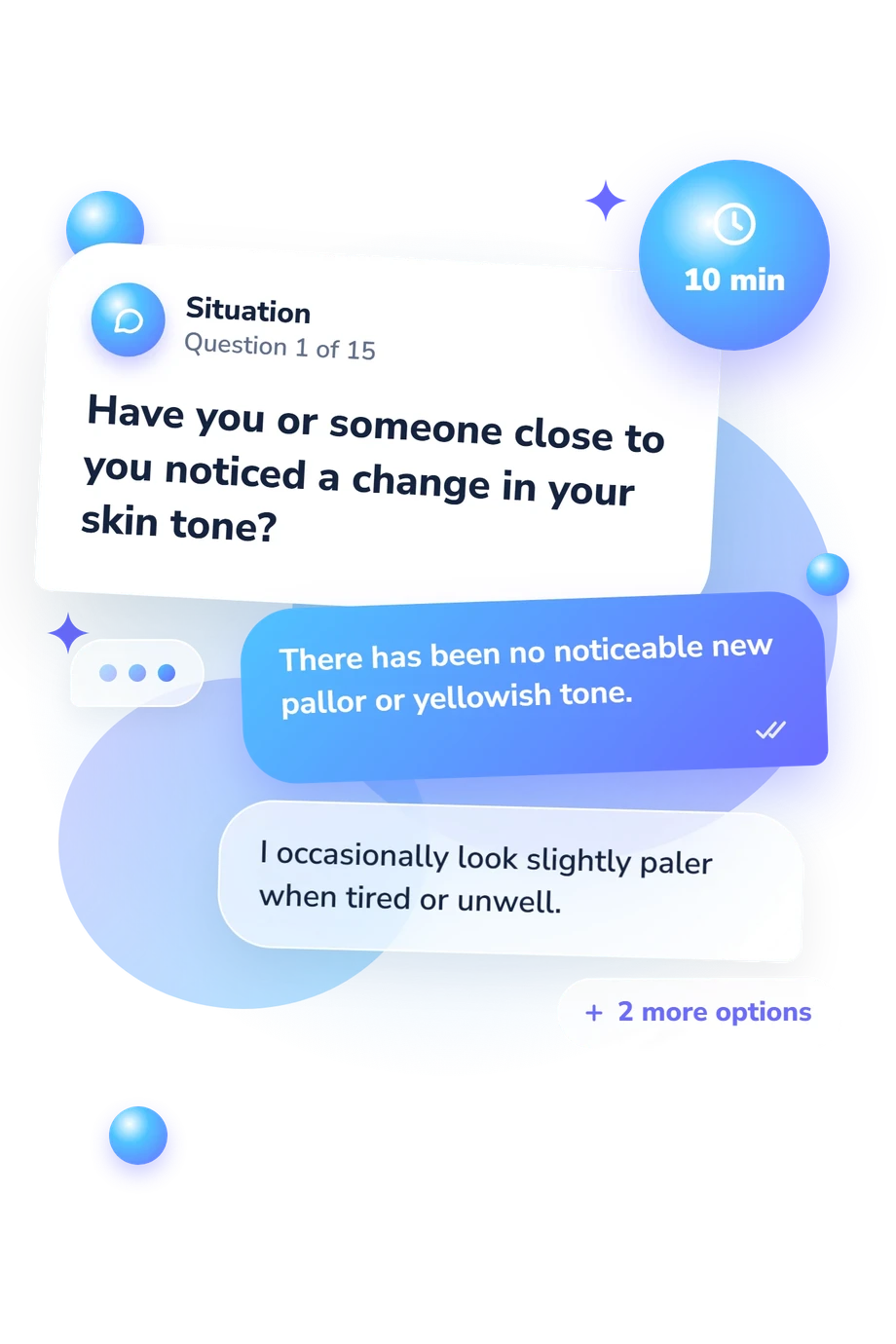
- There has been no noticeable new pallor or yellowish tone.
- I occasionally look slightly paler when tired or unwell.
- A pale or yellowish appearance has become noticeable or persistent.
- The change is pronounced, rapidly developing, or accompanied by marked weakness or breathlessness.
- A close relative has had pernicious anemia, but I have not been diagnosed with it.
- I have no known personal or close family history relevant to pernicious anemia.
- I have an autoimmune condition, such as autoimmune thyroid disease or type 1 diabetes, but no known pernicious anemia diagnosis.
- A clinician has identified pernicious anemia, intrinsic-factor problems, or autoimmune B12 malabsorption in me.
- A recent result was within the laboratory reference interval, with no newer concern raised.
- I have not had B12 tested, and no clinician has previously raised a B12 concern.
- I have previously had a borderline result or a low result that was treated and followed up.
- I have a recent low B12 result or related abnormal blood finding that has not yet been assessed or followed up.
Do I Have B12 Deficiency Quiz - Description and methodology of the test
People considering whether diet, medication, digestive history, or current symptoms could relate to vitamin B12 status may use the do i have b12 deficiency quiz to organize what deserves attention. This vitamin B12 deficiency quiz organizes symptoms, exposures, and relevant history into patterns a reader can discuss with a clinician and use when deciding whether testing or follow-up may be sensible.
What This Assessment Explores
It covers intake and absorption context, energy and blood-related signs, and neurological or sensory changes. Questions touch on diet, medicines, digestive history, pallor, mouth symptoms, concentration, balance, tingling, dizziness, weakness, and breathlessness. Intake and absorption items address B12 deficiency risk factors; symptoms can have other causes, so the result is not diagnostic.
The three result summaries are:
- B12 Intake and Absorption Context (0-15) records diet, medication, autoimmune, digestive, surgical, and prior-test contexts; bands are No items endorsed (0), Worth discussing (1-2), and Prompt follow-up (3-15).
- Energy and Blood-Related Signs (0-15) summarizes tiredness, pallor, breathlessness, dizziness, and related experiences; bands are No items endorsed (0), Worth noting (1-2), and Prompt follow-up (3-15).
- Neurological and Sensory Changes (0-15) summarizes altered sensation, concentration, balance, weakness, and walking changes; bands are No items endorsed (0), Worth noting (1-2), and Prompt follow-up (3-15).
Methodology and Scientific Basis
Each item offers four response options tailored to its topic: some address symptom frequency or intensity, while others distinguish history, exposure, diet, or previous test findings.
Responses populate the relevant summaries and ranges above; no validated point-by-point severity rule is used. The bands prompt attention rather than define clinical cutoffs, and each concerning endorsed experience matters independently: a single score-3 red-flag response overrides the total. This supports discussion when B12 deficiency symptoms persist or disrupt activity.
Symptom themes align conceptually with B12 PROM (Suijker et al., 2024); the NICE evidence review supports the covered risk-factor and symptom content. Medication items address evidence on metformin and acid suppression from de Jager et al. (2010) and Miller (2018). The questionnaire is not an adaptation of B12 PROM or these cited sources. Its standardization, sensitivity, specificity, and reference norms are not established. Memory and circumstances can shape answers; sudden confusion, falls, severe breathlessness, chest pain, fainting, or rapidly worsening weakness require urgent help.
- Suijker KIM, Plattel CHM, Seage CH, Ward N, James DH, Vis JY. Development of a Vitamin B12 Deficiency Patient-Reported Outcome Measure for Clinical Practice and Research. Food and Nutrition Bulletin. 2024;45(1_suppl):S73-S79. 10.1177/03795721241236284
- National Institute for Health and Care Excellence. Evidence reviews for risk factors and symptoms and signs for vitamin B12 deficiency: Vitamin B12 deficiency in over 16s: diagnosis and management. NICE Evidence Reviews Collection; 2024. ISBN 978-1-4731-5730-9.
- de Jager J, Kooy A, Lehert P, Wulffelé MG, van der Kolk J, Bets D, Verburg J, Donker AJM, Stehouwer CDA. Long term treatment with metformin in patients with type 2 diabetes and risk of vitamin B-12 deficiency: randomised placebo controlled trial. BMJ. 2010;340:c2181. 10.1136/bmj.c2181
- Miller JW. Proton Pump Inhibitors, H2-Receptor Antagonists, Metformin, and Vitamin B-12 Deficiency: Clinical Implications. Advances in Nutrition. 2018;9(4):511S-518S. 10.1093/advances/nmy023
Updated: