
Do I Need Diapers at Night Quiz
How the Scales are Structured
Who Usually Takes This Test?
See How You Compare
Below is a preview of how scores are typically distributed across each scale.
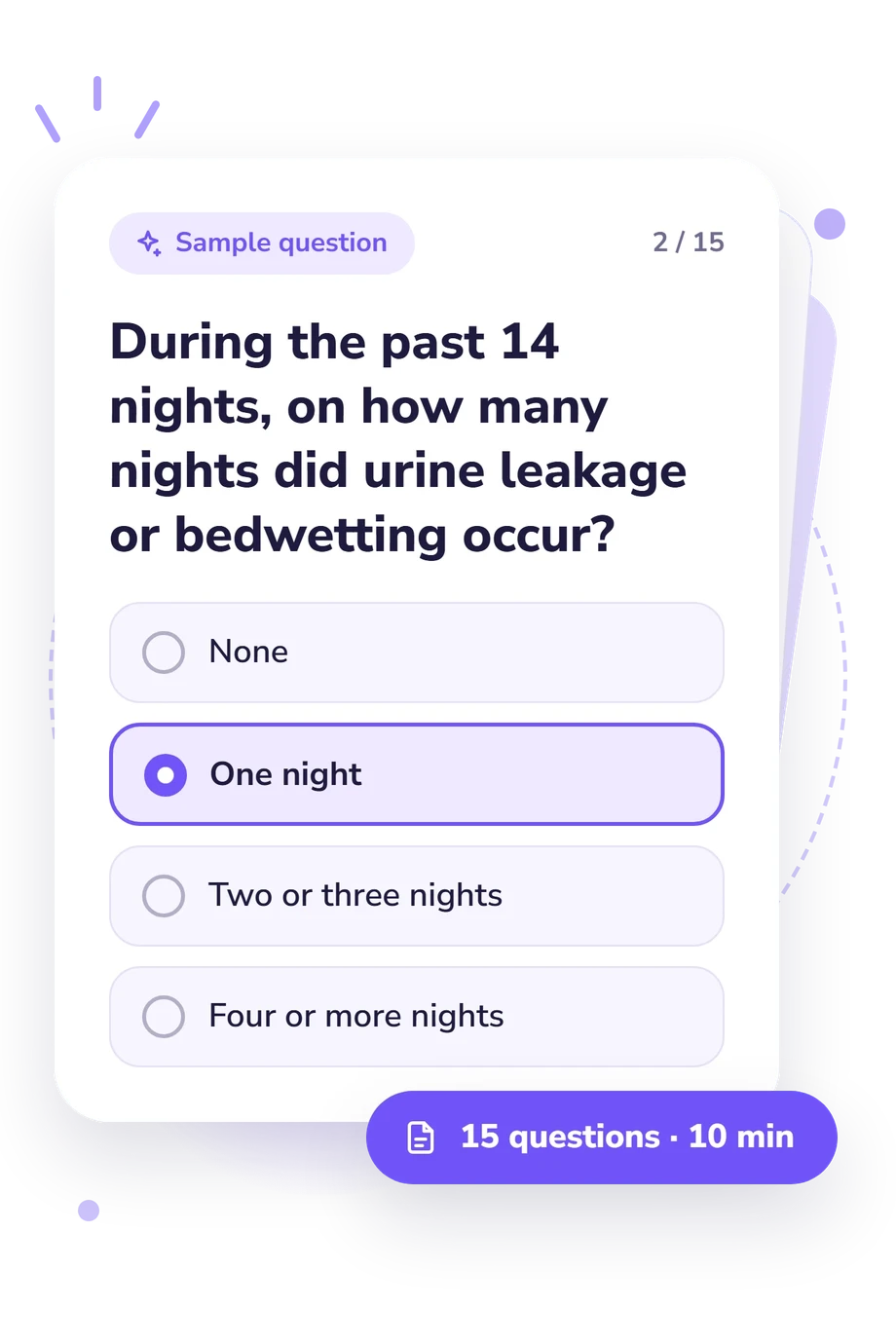
Example Questions From the Test
- None
- One night
- Two or three nights
- Four or more nights
- No leakage-related cleanup
- A quick change of underwear or a small washable item
- A change of sleepwear and sometimes the sheets
- A full bedding change or substantial cleanup on a regular basis
- There is no moisture to manage
- It stays within my regular underwear
- It reaches my sleepwear but usually not the bedding
- It reaches the bedding even when I use my usual precautions
Do I Need Diapers at Night Quiz - Description and methodology of the test
People considering nighttime protection can use this assessment to organize what is happening, how disruptive it feels, and whether symptoms deserve medical attention. The Do I Need Diapers at Night Quiz is intended for people reflecting on leakage, bedwetting, warning signs, or uncertainty about practical support. It considers the concern behind a should i wear a diaper to bed quiz, alongside changes in leakage, health symptoms, and daily impact.
What the Questionnaire Measures
Questions examine the pattern itself rather than treating nighttime wetness as an isolated event. This nighttime leakage assessment considers frequency, amount, moisture spread, predictability, ability to wake and reach the bathroom, cleanup, urinary symptoms, neurological warning signs, sleep, concentration, travel, shared sleeping, and emotional comfort. The result helps separate practical protection needs from signs that warrant evaluation.
The displayed result has three scales:
- Health Review Priority (0-15) shows Review the context (0-5), Arrange an evaluation (6-10), or Seek prompt assessment (11-15), and any single red-flag response overrides the total.
- Nighttime Leakage Pattern (0-15) describes a Limited pattern (0-5), Recurring pattern (6-10), or Frequent/substantial pattern (11-15), indicating how much protection may be practical.
- Sleep and Daily Impact (0-15) identifies Manageable impact (0-5), Noticeable impact (6-10), or Substantial impact (11-15) across rest, activities, and comfort.
Methodology and Evidence Base
This is a self-report questionnaire. Each item offers four responses, moving from no concern through occasional or recurring difficulty to a substantial or urgent situation. The result presents three scores; its unvalidated bands are reflective summaries, and the point-allocation method is not specified. They are not medical severity thresholds or diagnostic cutoffs, and the questionnaire provides no validated norms.
Lee et al. (2018) is the closest source because it links adult-onset nocturnal enuresis with possible causes, contributing factors, and quality-of-life effects; this questionnaire is not its adaptation. Akhavizadegan et al. (2019) provides context for adult enuresis, while NICE CG148 supports attention to urinary, neurological, bowel, and functional features when symptoms change. The questionnaire is conceptually consistent with these descriptions, but the cited sources do not establish its scoring bands.
Any bedwetting protection decision should be read alongside circumstances, not from a number alone. Memory, context, self-awareness, and candour can affect the result. Blood, fever with urinary symptoms, severe pain, confusion, or sudden loss of bladder or bowel control with new leg weakness or numbness warrants urgent care despite the total.
- Lee, D., Dillon, B., & Lemack, G. (2018). Adult Onset Nocturnal Enuresis: Identifying Causes, Cofactors and Impact on Quality of Life. LUTS: Lower Urinary Tract Symptoms, 10(3), 292-296. 10.1111/luts.12183
- Akhavizadegan, H., Locke, J. A., Stothers, L., & Kavanagh, A. (2019). A comprehensive review of adult enuresis. Canadian Urological Association Journal, 13(8), 282-287. 10.5489/cuaj.5485
- National Institute for Health and Care Excellence. (2012, updated 2023). Urinary incontinence in neurological disease: assessment and management. NICE guideline CG148. London: NICE.
Updated: