
Cuddle Positions Quiz
How the Scales are Structured
Who Usually Takes This Test?
See How You Compare
Below is a preview of how scores are typically distributed across each scale.
Example Questions From the Test
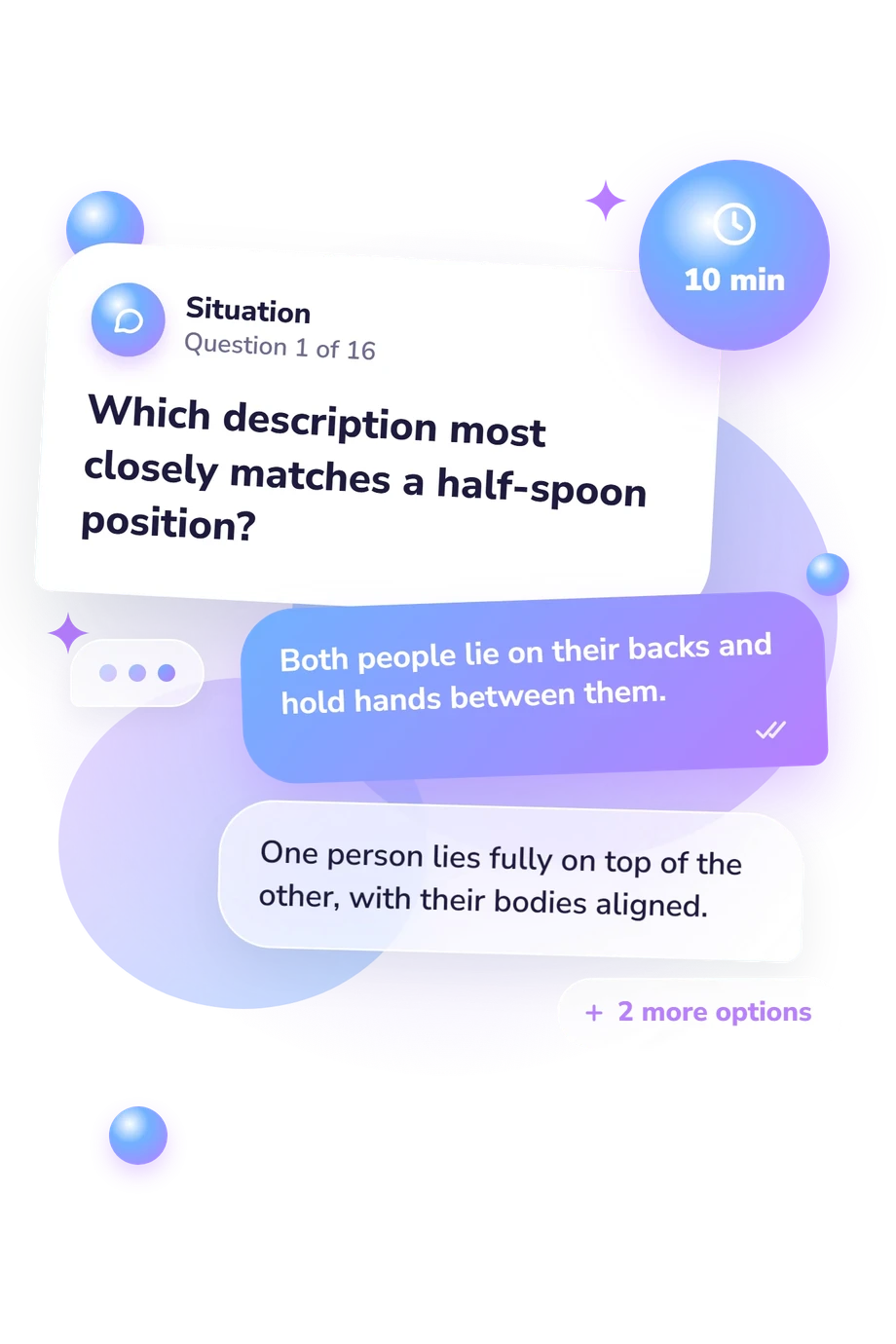
- Both people lie on their backs and hold hands between them.
- One person lies fully on top of the other, with their bodies aligned.
- One person lies mostly on their back while the other nestles partly against their side or chest.
- Both people face away from each other and touch only at the shoulders.
- Treat it as a cue to pause and check whether they want space or a change.
- It means the current position should continue without interruption.
- It proves that the person dislikes cuddling in general.
- Assume they are comfortable unless they physically move away.
- A close face-to-face embrace
- A leg hug, with legs or feet loosely touching or intertwined
- A full spoon with linked arms
- A lap pillow with both people sitting upright
Cuddle Positions Quiz - Description and methodology of the test
Readers considering whether to test their familiarity with affectionate contact may use the cuddle positions quiz for self-reflection before discussing or trying different arrangements. As a cuddle quiz about position names and comfort adaptations, it suits readers who want to identify topics they may wish to review, decide whether their understanding is broad enough for everyday situations, and approach the result as a prompt for further reflection.
What This Assessment Explores
The questions measure recognition of common cuddle arrangements and practical knowledge about adjusting them. They distinguish spooning, half-spooning, face-to-face, head-on-chest, lap-pillow, leg-hug, back-to-back, and light arm-drape arrangements. Other items focus on heat, neck strain, tingling limbs, height differences, movement, and a partner who becomes stiff or quiet.
Together, the result describes familiarity with position names, body alignment, pressure reduction, and respectful check-ins. It is not a rating of affection, relationship quality, or compatibility; it shows what the respondent knows about cuddling positions and comfort choices.
Results use Cuddle Positions Knowledge (0-16). The bands shown are:
- Starting Point (0-6) indicates some recognition but room to review arrangements and comfort cues.
- Developing Knowledge (7-12) shows familiarity with many positions and adaptations, with some gaps.
- Strong Knowledge (13-16) reflects a broad grasp of positions, comfort adjustments, and check-ins.
Methodology and Scientific Basis
Each question offers four choices, and the respondent selects the option that best fits the scenario. Items combine arrangement recognition with cuddle position knowledge about adjustments such as pillows, space, pressure from a tingling arm, or asking before moving closer. The displayed result runs from 0 to 16 correct answers; its bands describe levels of quiz knowledge about positions, comfort adaptations, and respectful check-ins.
The evidence base is conceptually consistent with Junker et al. (2016), which examined couples’ positions at sleep onset, and Schredl et al. (2022), which linked sleep-position patterns with relationship variables. van Anders et al. (2013) adds context about nurturant and sexual aspects of intimate partner cuddling. These studies support attention to arrangements, contact, and interpersonal meaning, but the online questionnaire is not an adaptation or validated reproduction of them.
Interpret the result as a snapshot of knowledge about positions, comfort adaptations, and respectful check-ins. Position names and arrangements vary, and performance can be affected by context or limited self-awareness. It is a knowledge profile rather than a diagnosis.
- Junker, I., Bergel, J., Deresko, E., Freund, S., & Schredl, M. (2016). Sleep positions of couples at sleep onset: A questionnaire study. International Journal of Dream Research, 9(2), 137-141. 10.11588/ijodr.2016.2.32590
- Schredl, M., Pramschiefer, E., Simon, P., Runge, H. L., & Onneken, G. (2022). Sleep positions of couples at sleep onset: Association with relationship quality and relationship duration. International Journal of Dream Research, 15(2), 255-259. 10.11588/ijodr.2022.2.90333
- van Anders, S. M., Edelstein, R. S., Wade, R. M., & Samples-Steele, C. R. (2013). Descriptive experiences and sexual vs. nurturant aspects of cuddling between adult romantic partners. Archives of Sexual Behavior, 42(4), 553-560. 10.1007/s10508-012-0014-8
Updated: